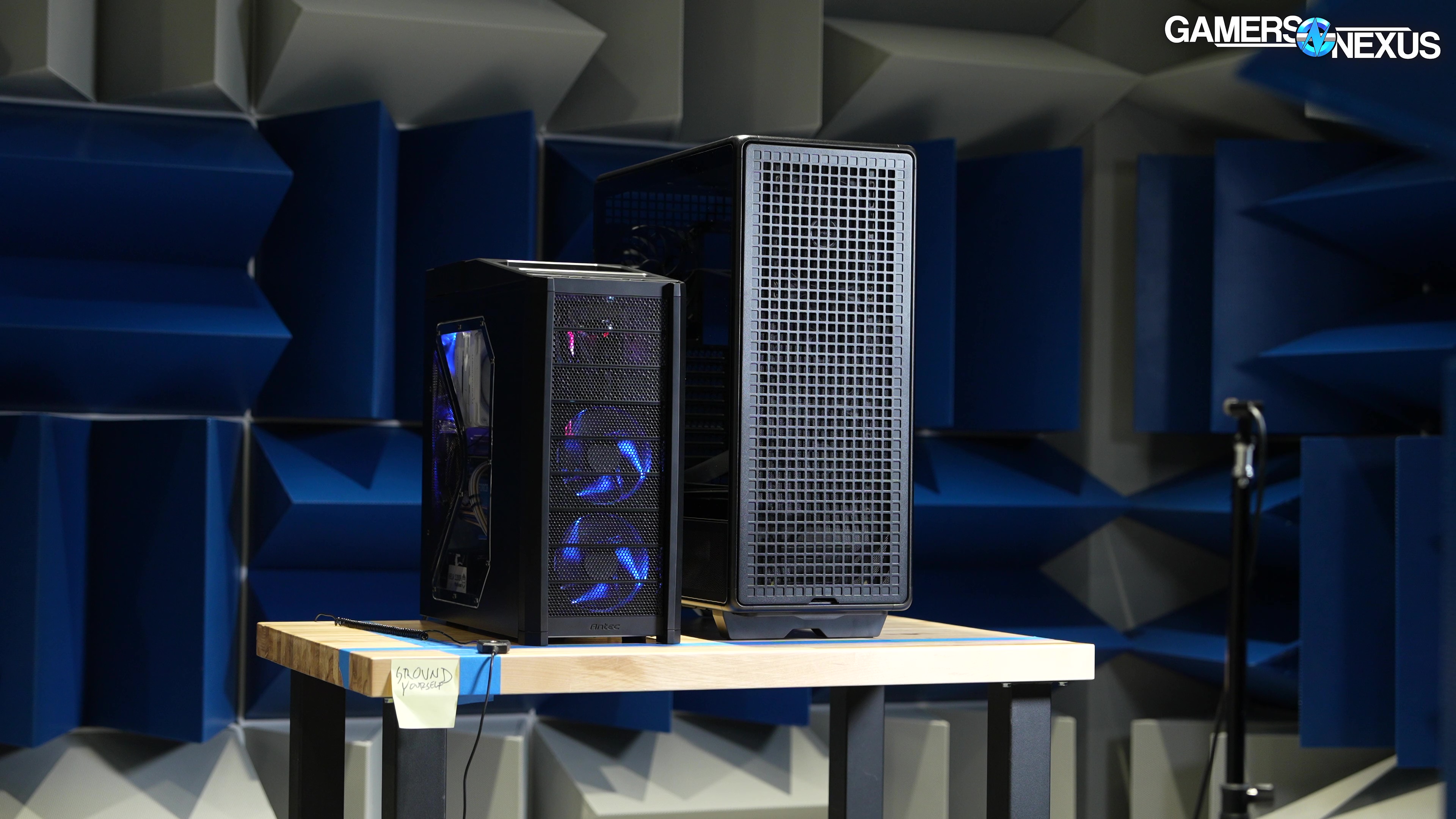
We're revisiting the GOAT of cases from an earlier era: The Antec 900 (or "Nine Hundred," originally), but also, we're reviewing Antec's brand new 2026 900 case
The Highlights
- The original Antec Nine Hundred was revolutionary and era-defining, and definitely a nostalgia punch for us in the office
- The new Antec 900 is too expensive for us to recommend
- The new case has absolutely nothing to do with the original GOATed 900 other than sharing a name
- Original MSRP: $300
- Release Date: March 5, 2026
Table of Contents
- AutoTOC

Intro
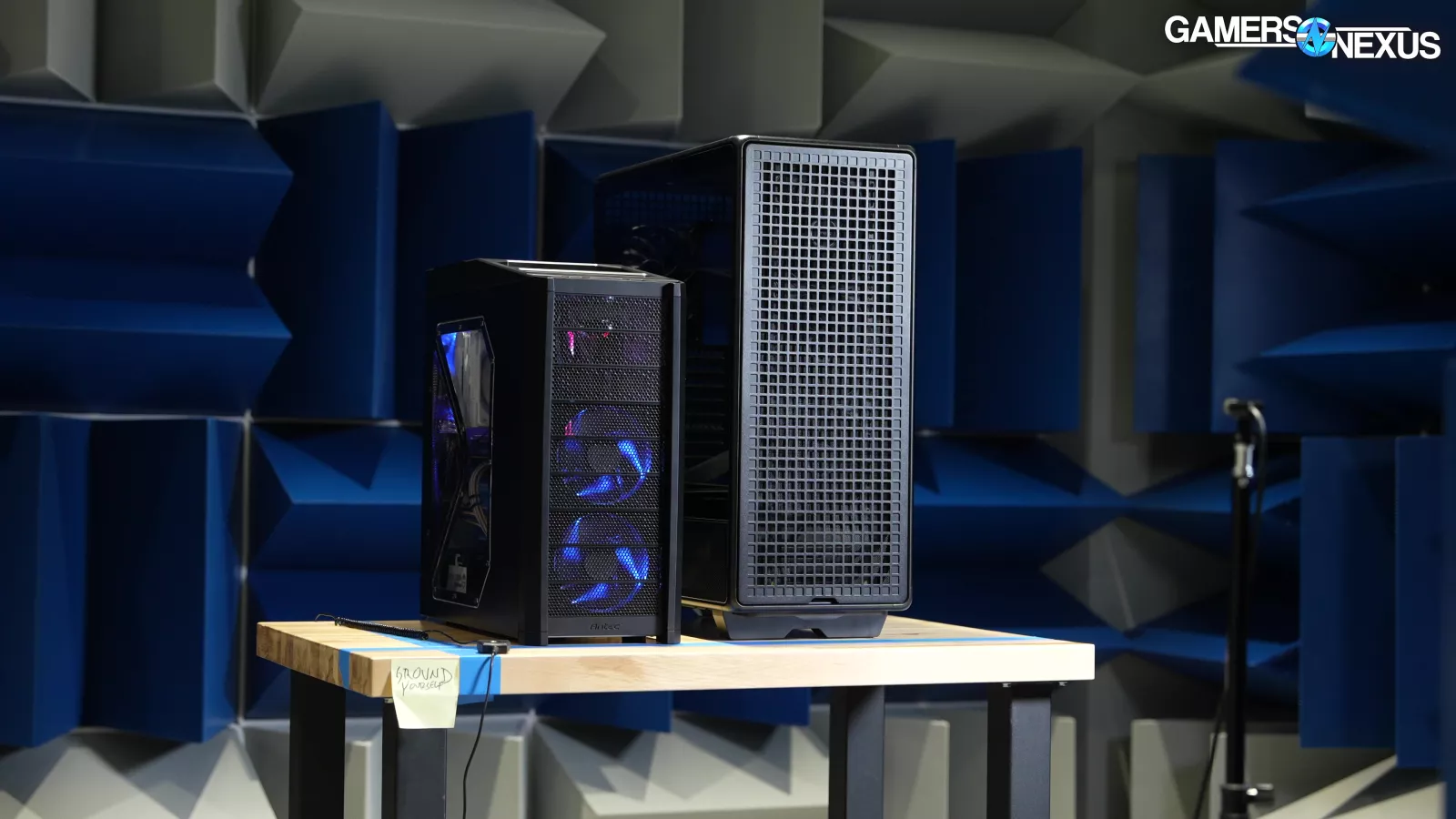
The legendary Antec Nine Hundred launched 20 years ago. One of the cases pictured below is Steve’s personal build, the second computer that he ever built, which he did 18 years ago.
Editor's note: This was originally published on March 5, 2026 as a video. This content has been adapted to written format for this article and is unchanged from the original publication.
Credits
Test Lead, Host, Writing
Steve Burke
Testing, Writing
Patrick Lathan
Video Editing
Mike Gaglione
Camera, Video Editing
Vitalii Makhnovets
Camera
Tim Phetdara
Andrew Coleman
Writing, Web Editing
Jimmy Thang
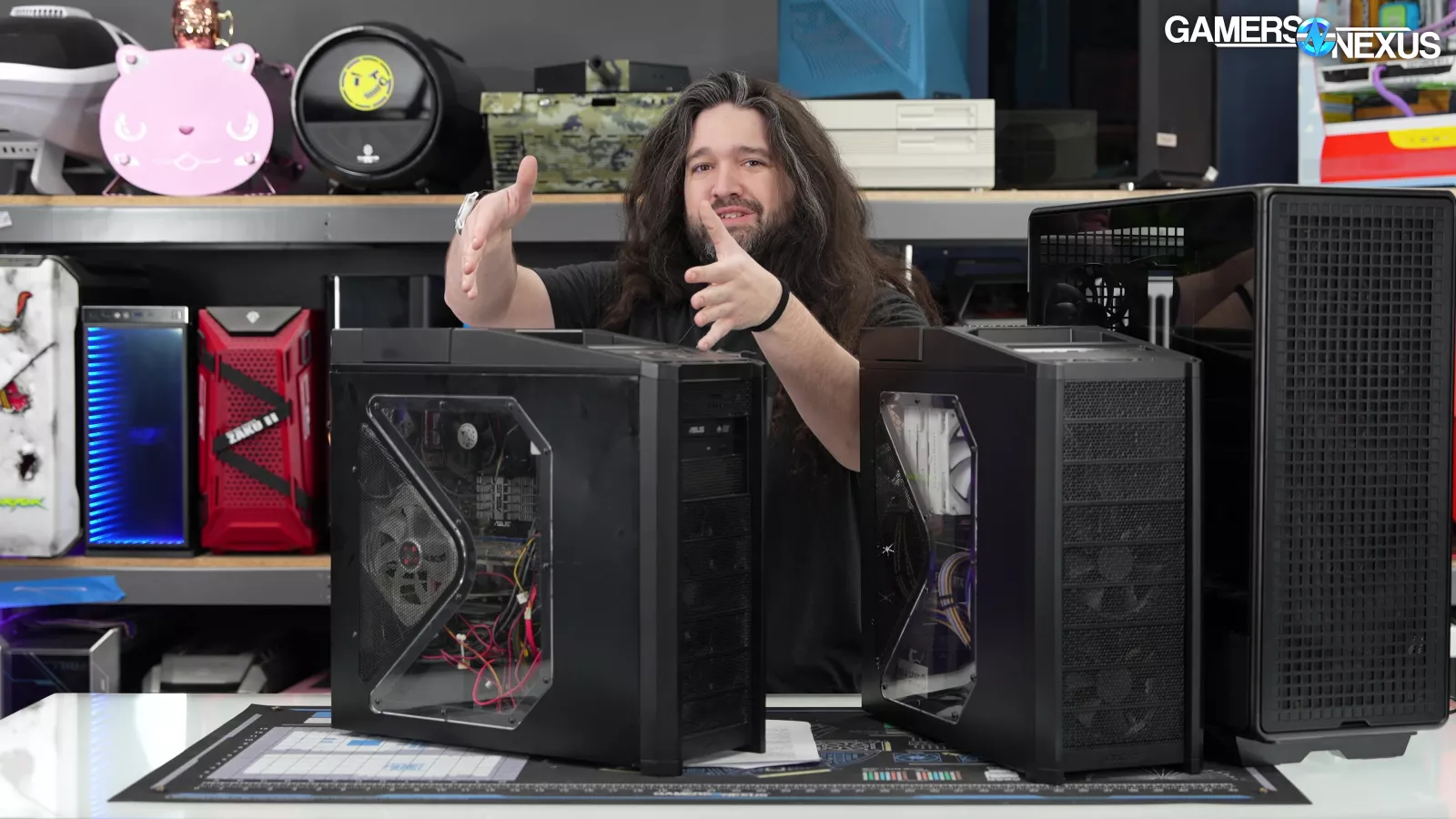
For its time, this case was revolutionary.
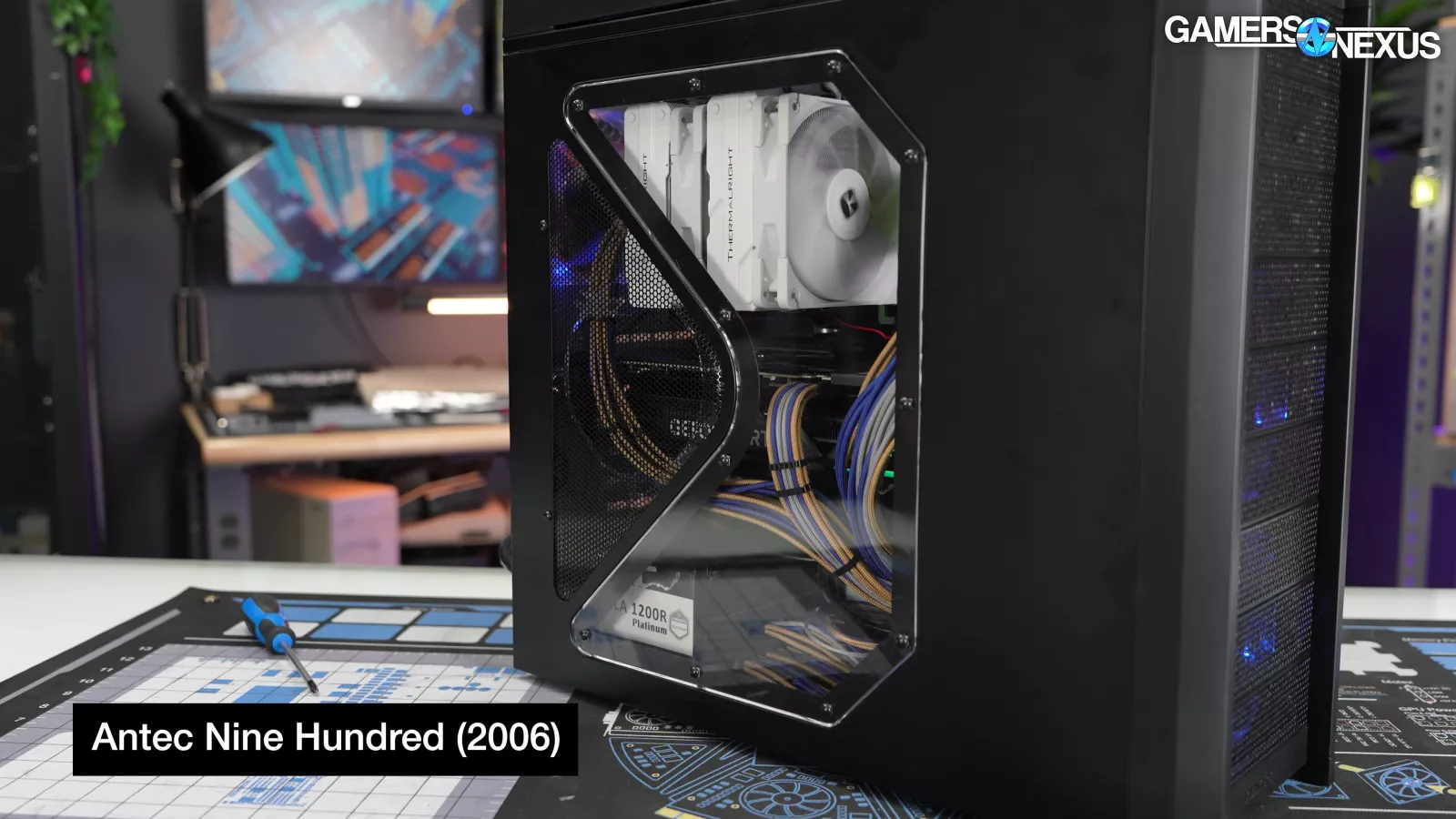
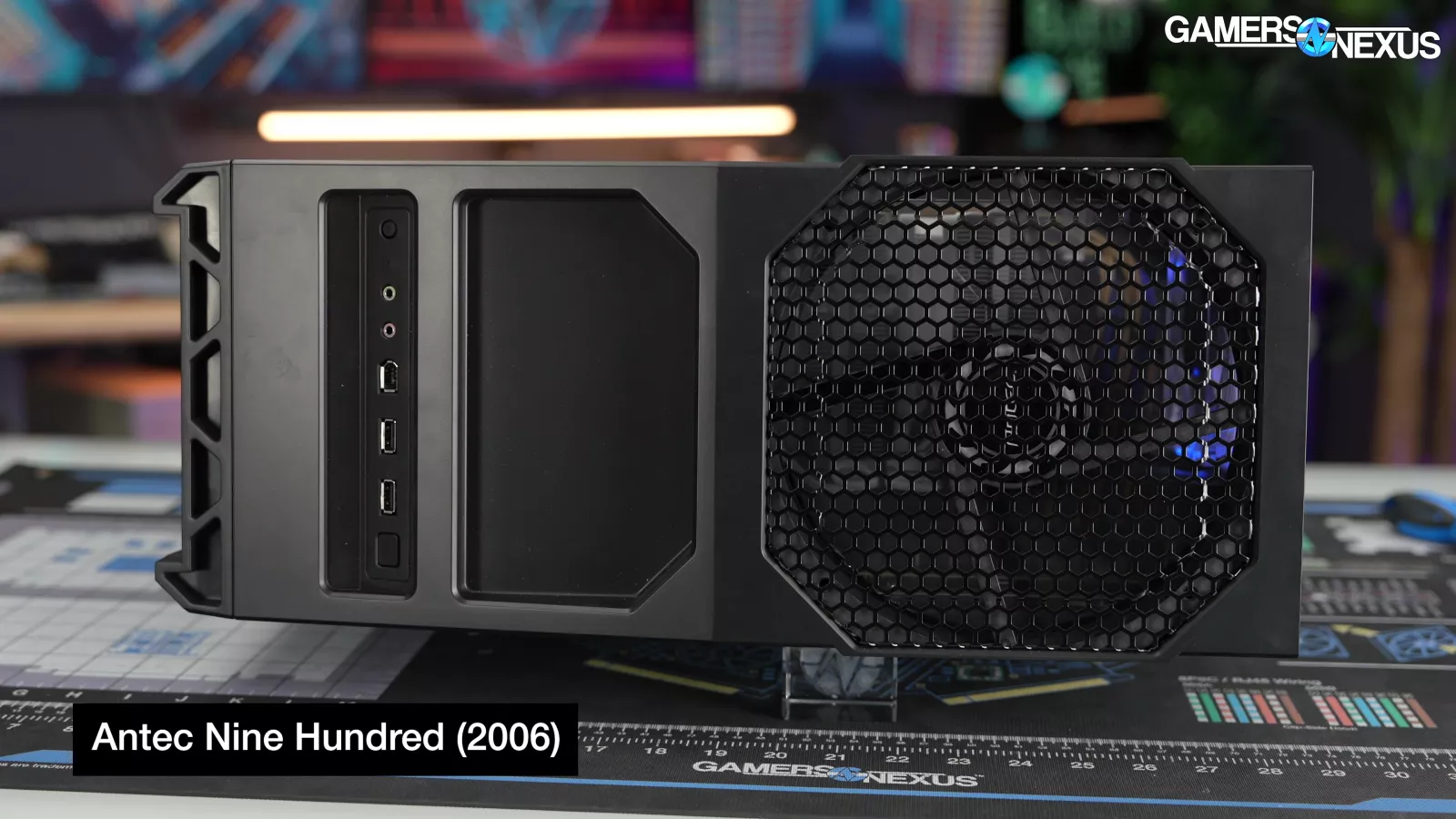
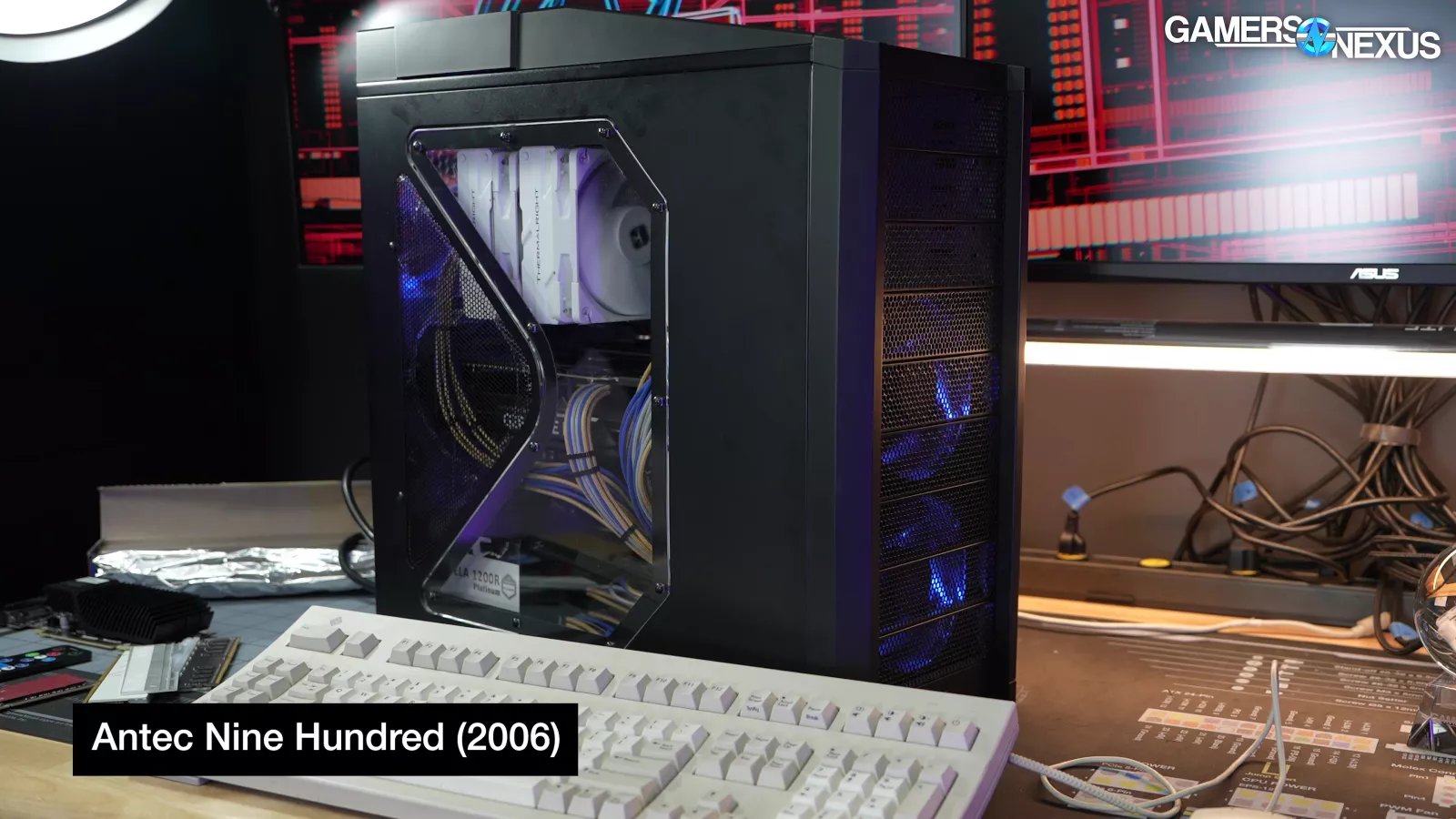
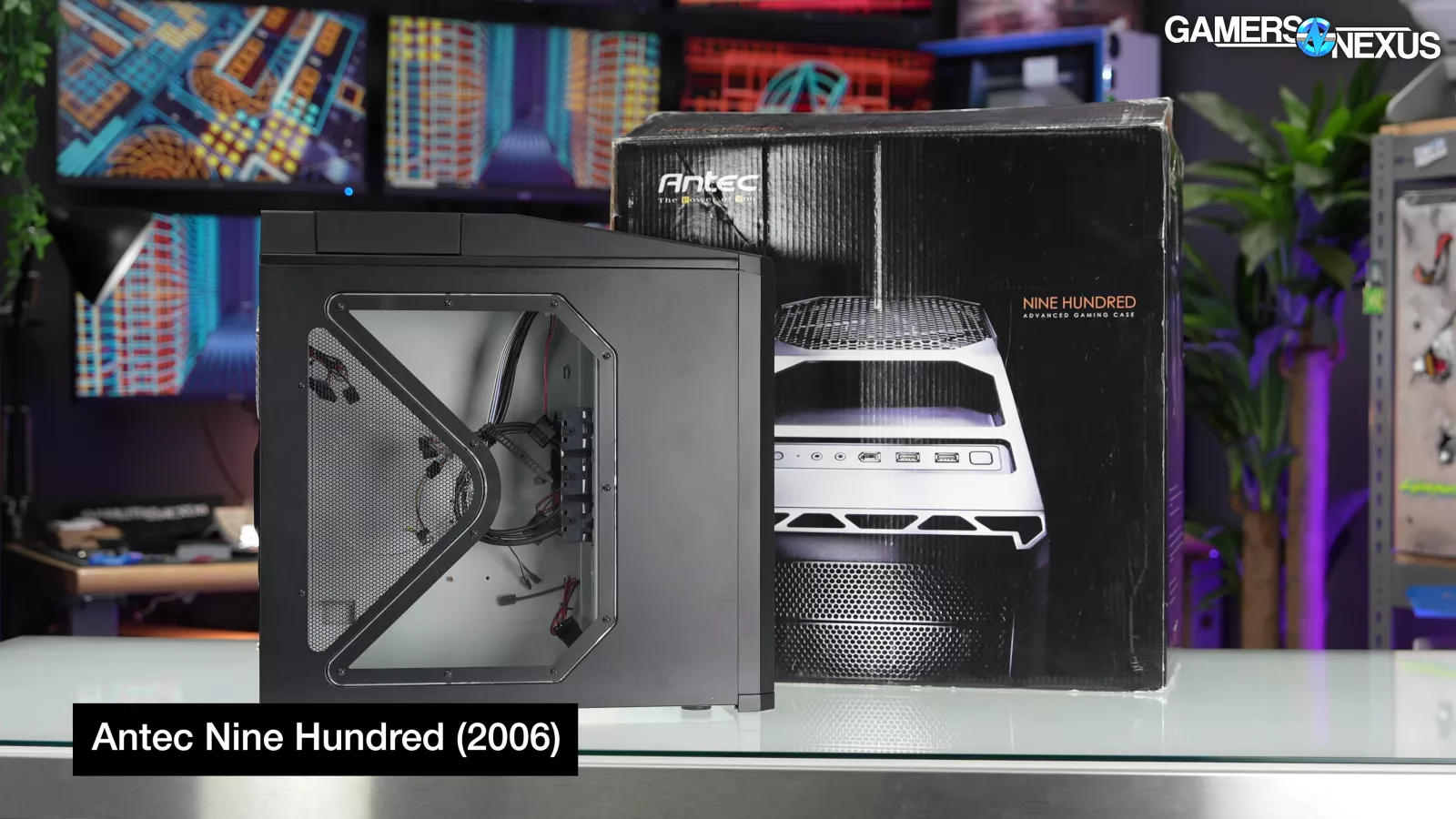
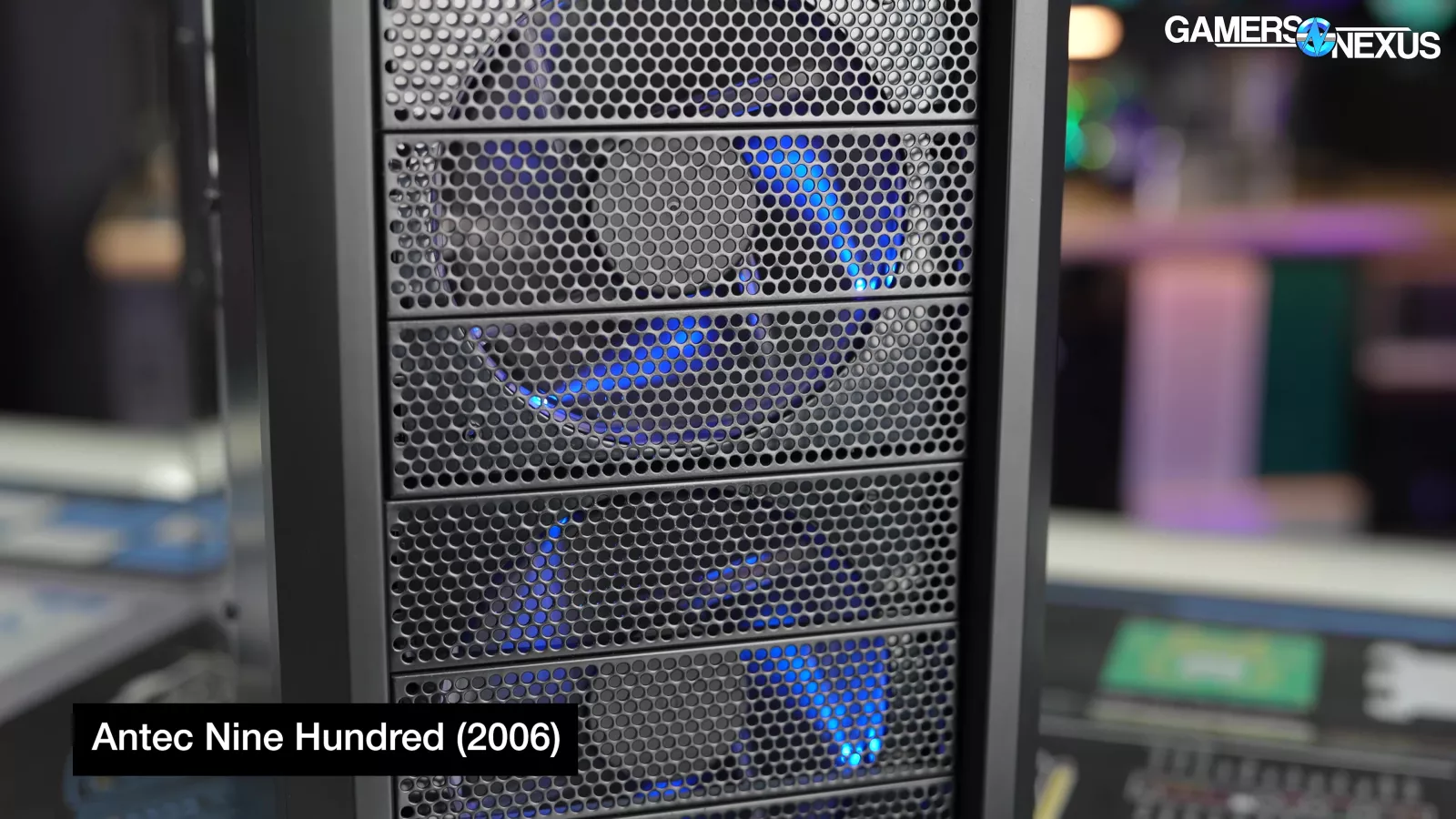
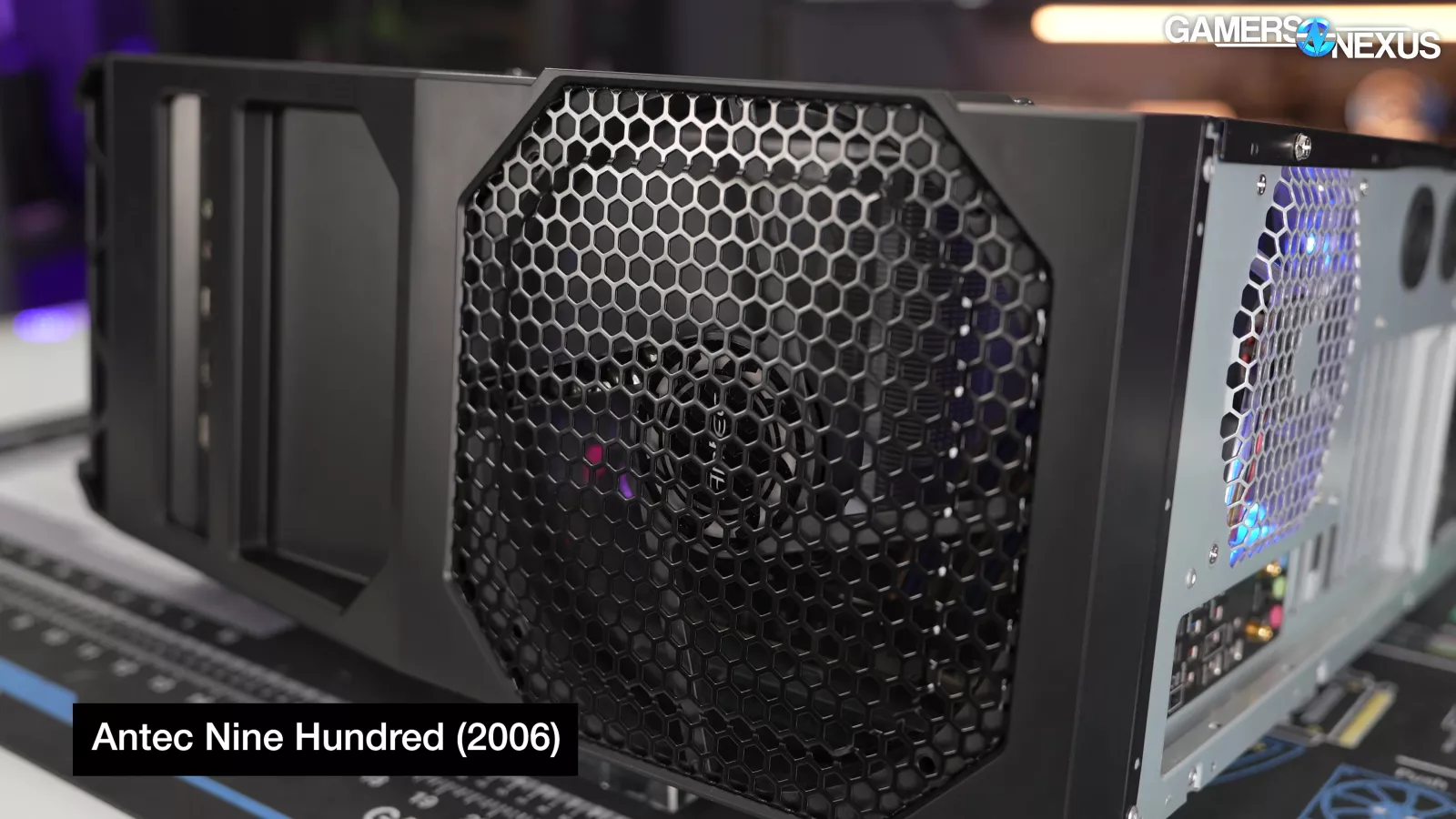
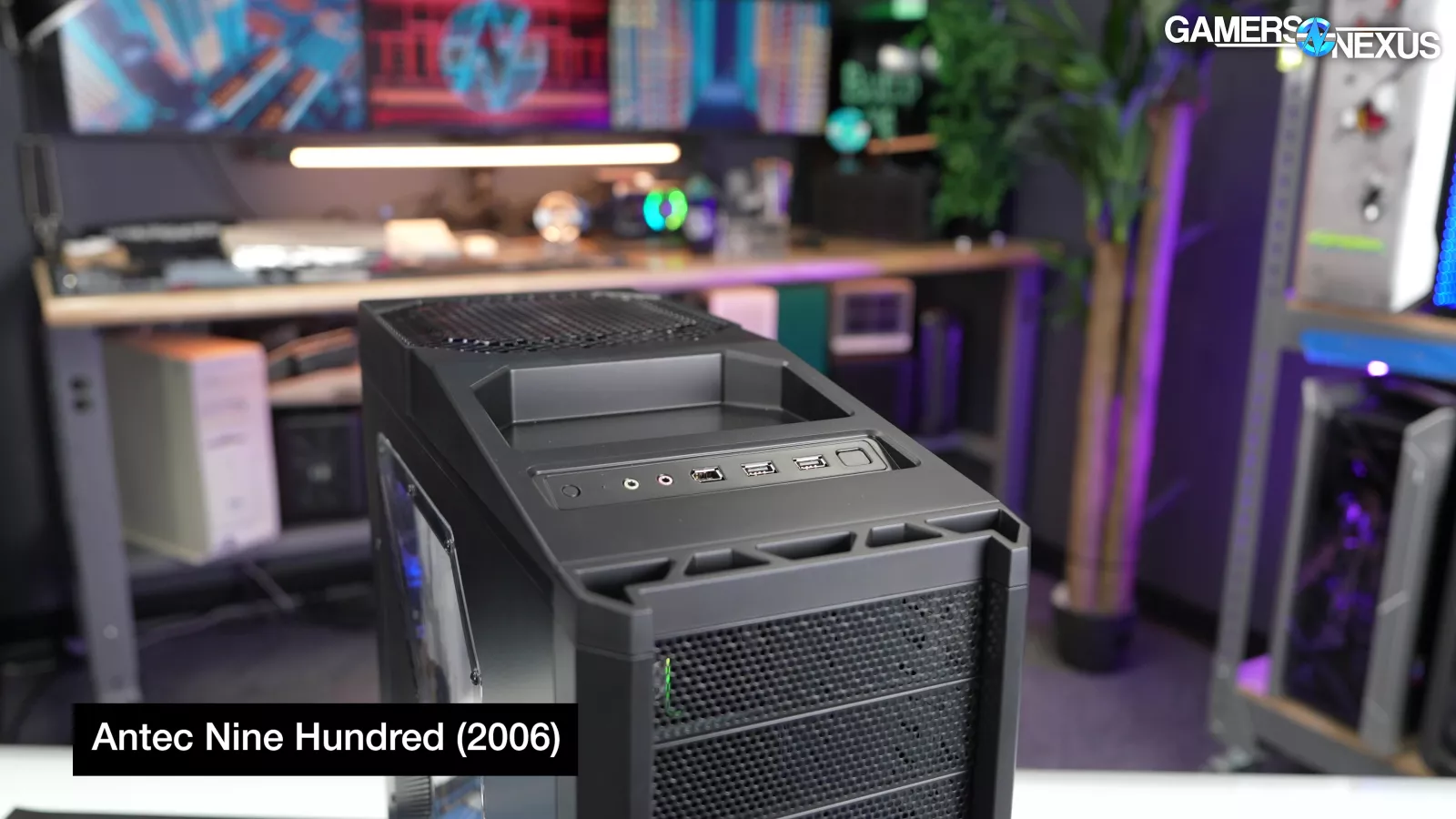
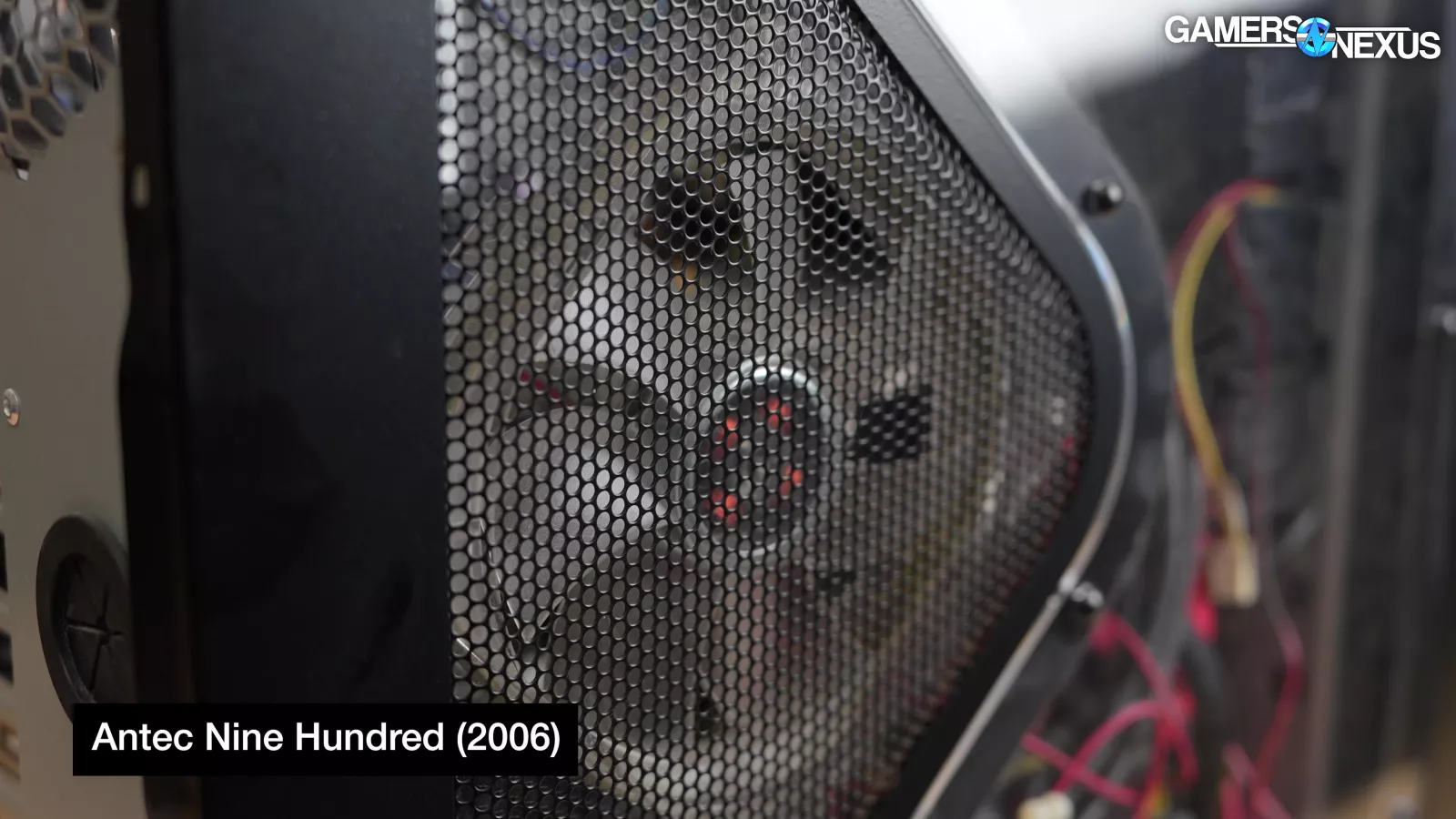
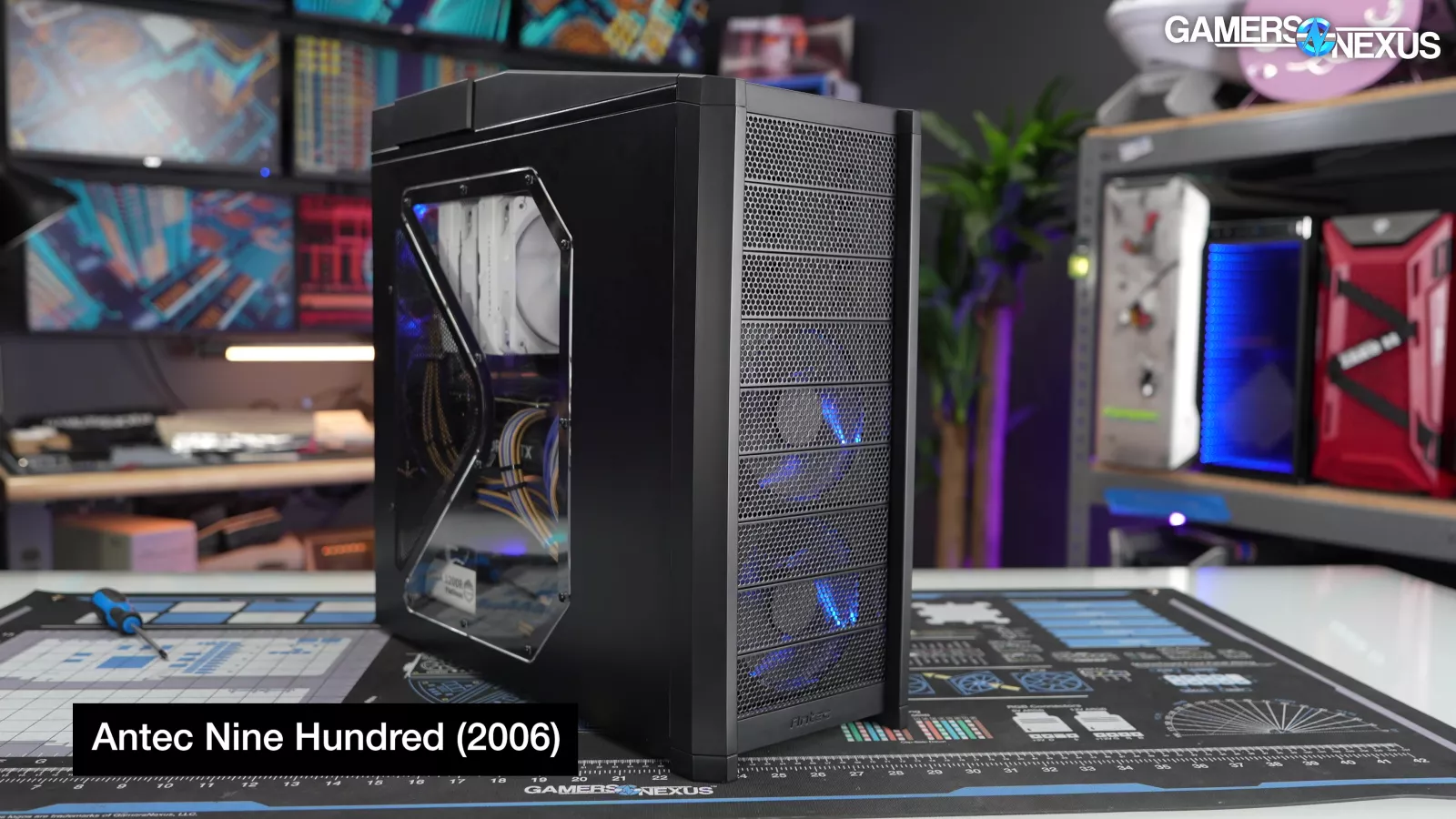
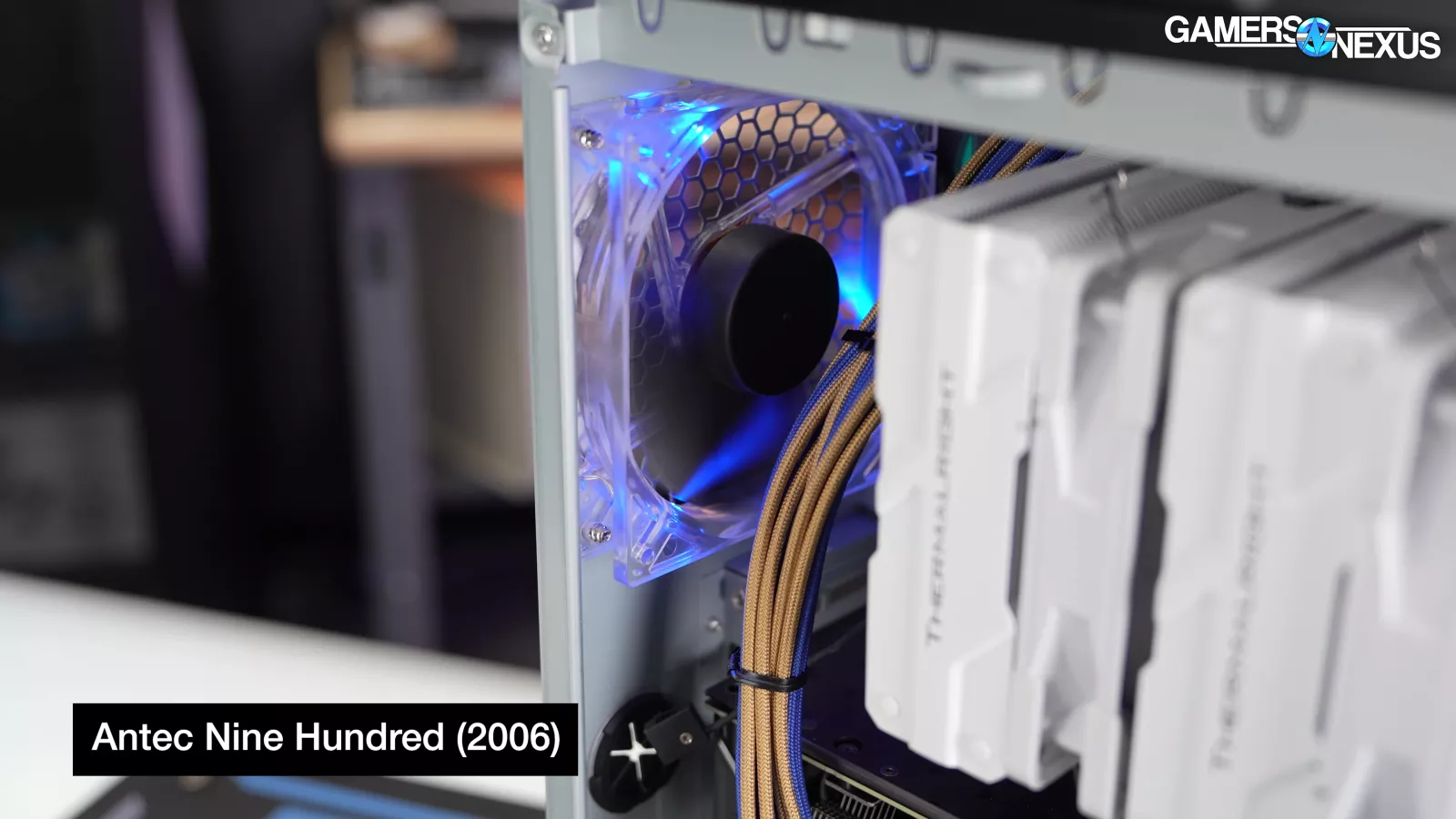
It sold for over 14 years and solidified Antec’s position as the leading case manufacturer of the 2000s and early 2010s. The 900 was ahead of its time for what then would have been considered a high airflow design, featuring a fine mesh front, a large 200mm rear exhaust fan that gave it a defining and unique shape, a side mount fan, and even some blue LEDs in an era that pre-dated RGB LEDs.
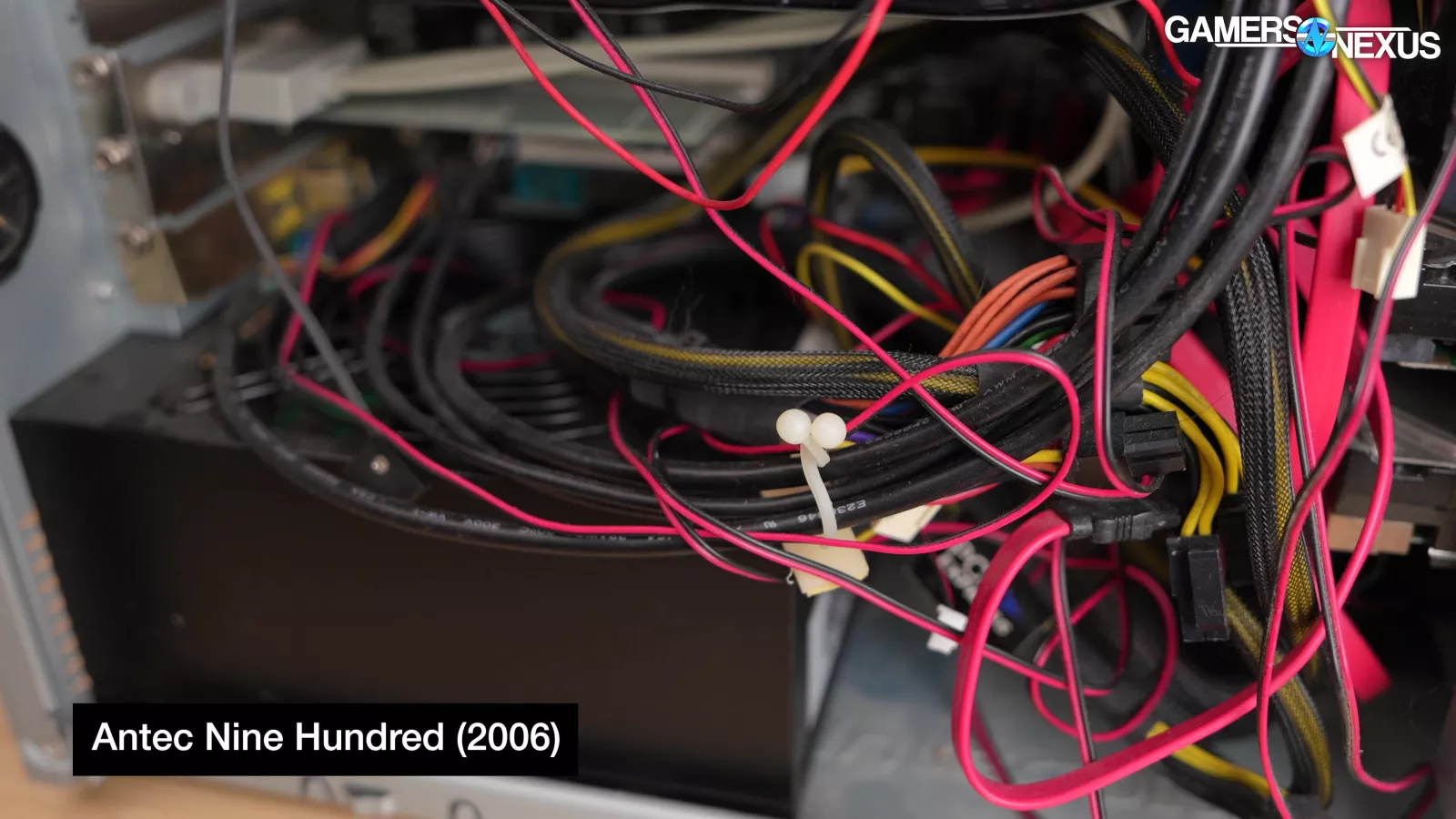
The early 900 revisions lacked cable management and took big risks by moving the power supply to the bottom of the case, but it paved the way for today’s cases.
That brings us to today.
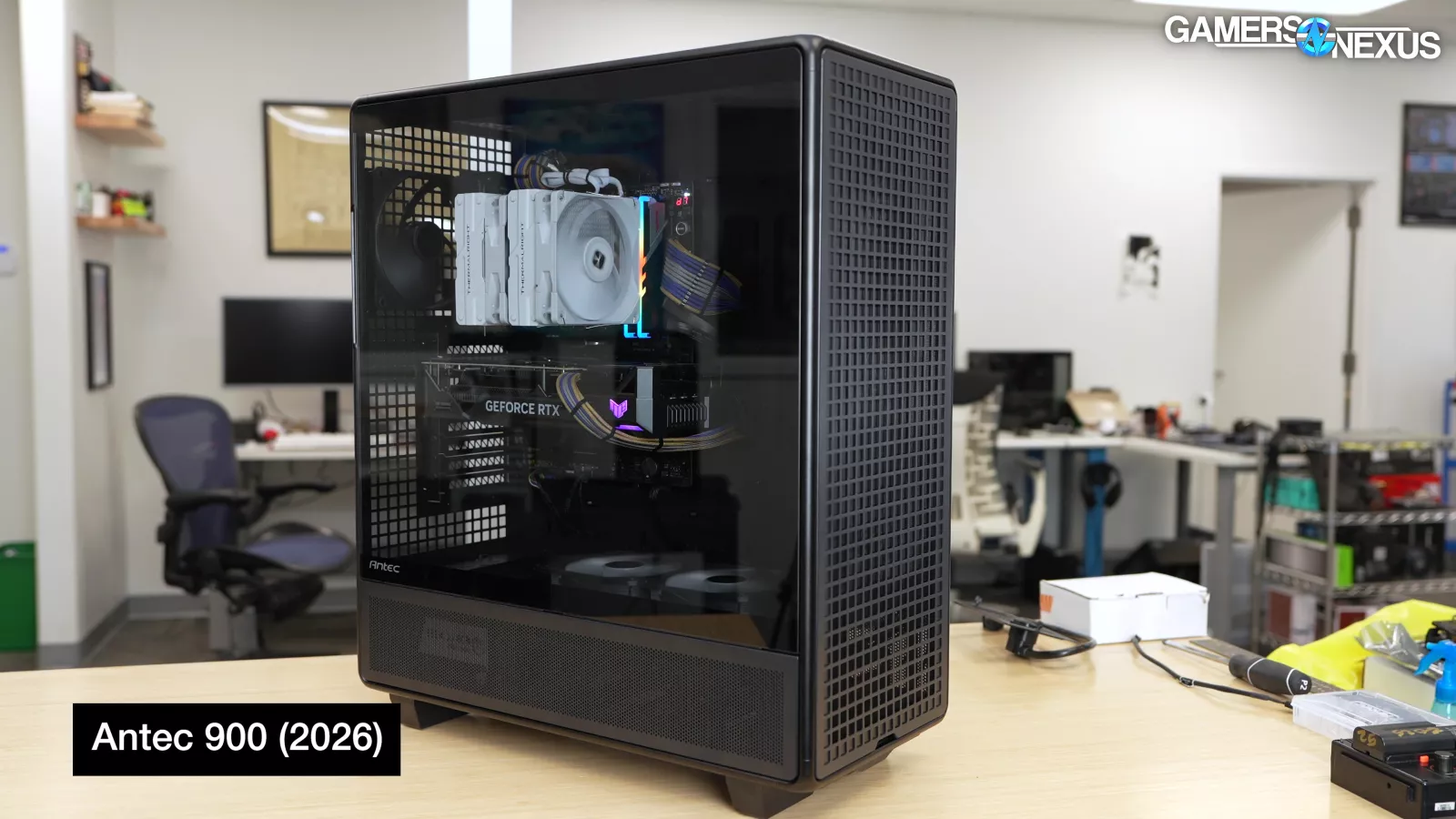
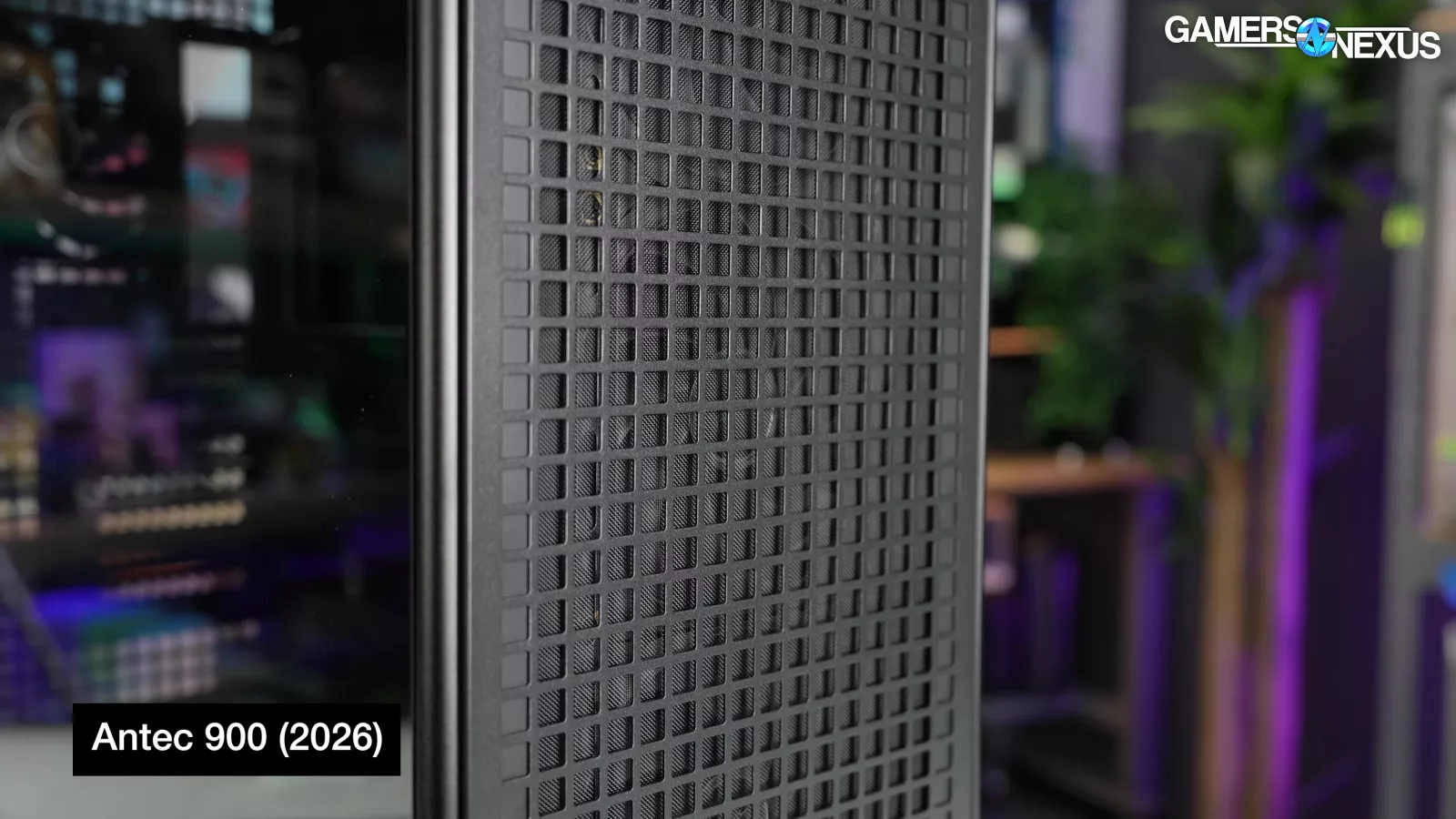
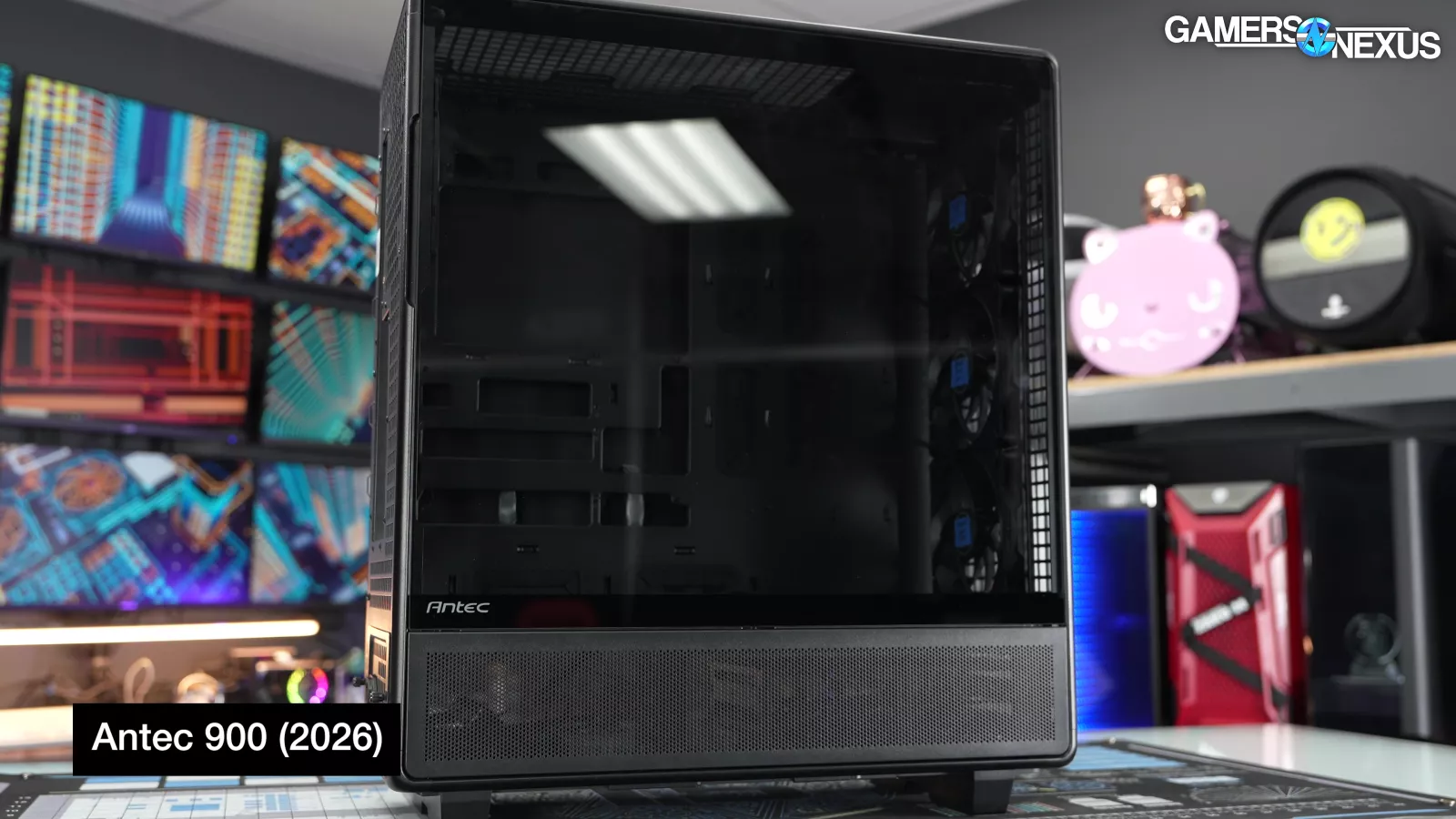
This new Antec 900 shares a name with the most legendary Antec case. The new 900 is a big, expensive box with some holes and some fans in it. So, it's a modern case. It moves to tempered glass instead of the acrylic that you saw on the old cases back before tempered glass was strapped to the side of a computer case.
Antec was still a major name in computer cases when GN was founded in 2008, but it fell off the radar through the 2010s as the CEO’s son took over the company and changed its focus -- mostly to bluetooth speakers and battery packs.
A couple years ago, the company abruptly returned to cases with surprisingly refined designs like the Antec C8 (read our review) and the Antec Flux (read our review), with the Flux Pro (read our review) being one of the best-performing cases we’ve ever tested.
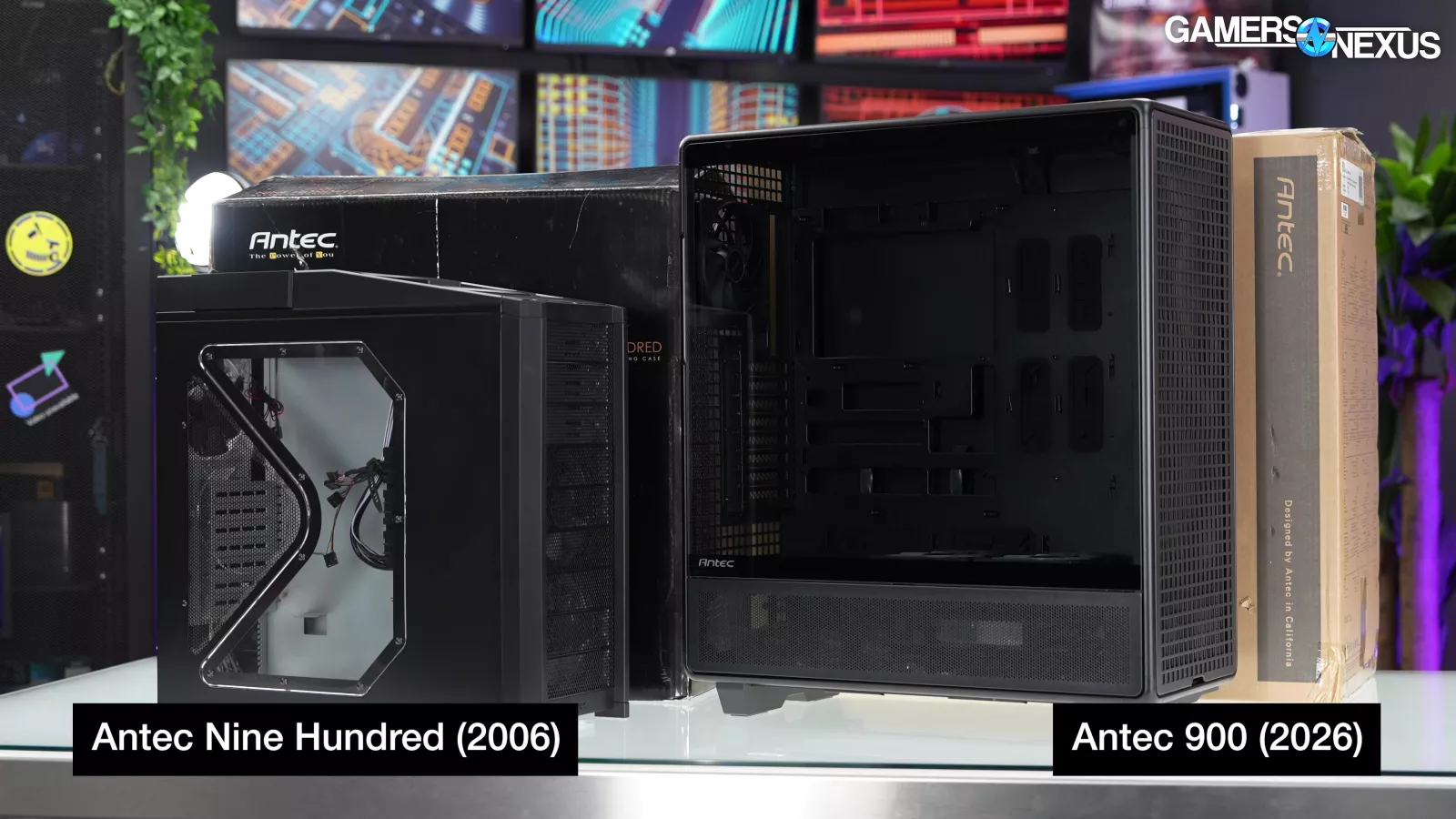
Now, the company is taking the next step to reclaim its legacy with a new Antec 900 -- this time, written as a number, not a word.
This is a combined revisit and review: The original 900 was a legendary case, so we’ll take the opportunity to walk our nostalgic viewers through it while covering some history of why it was so definitive.
The second computer that Steve built was in an Antec 900, which he still has -- but it’s worn-out and tired, and its fans have long since been replaced.
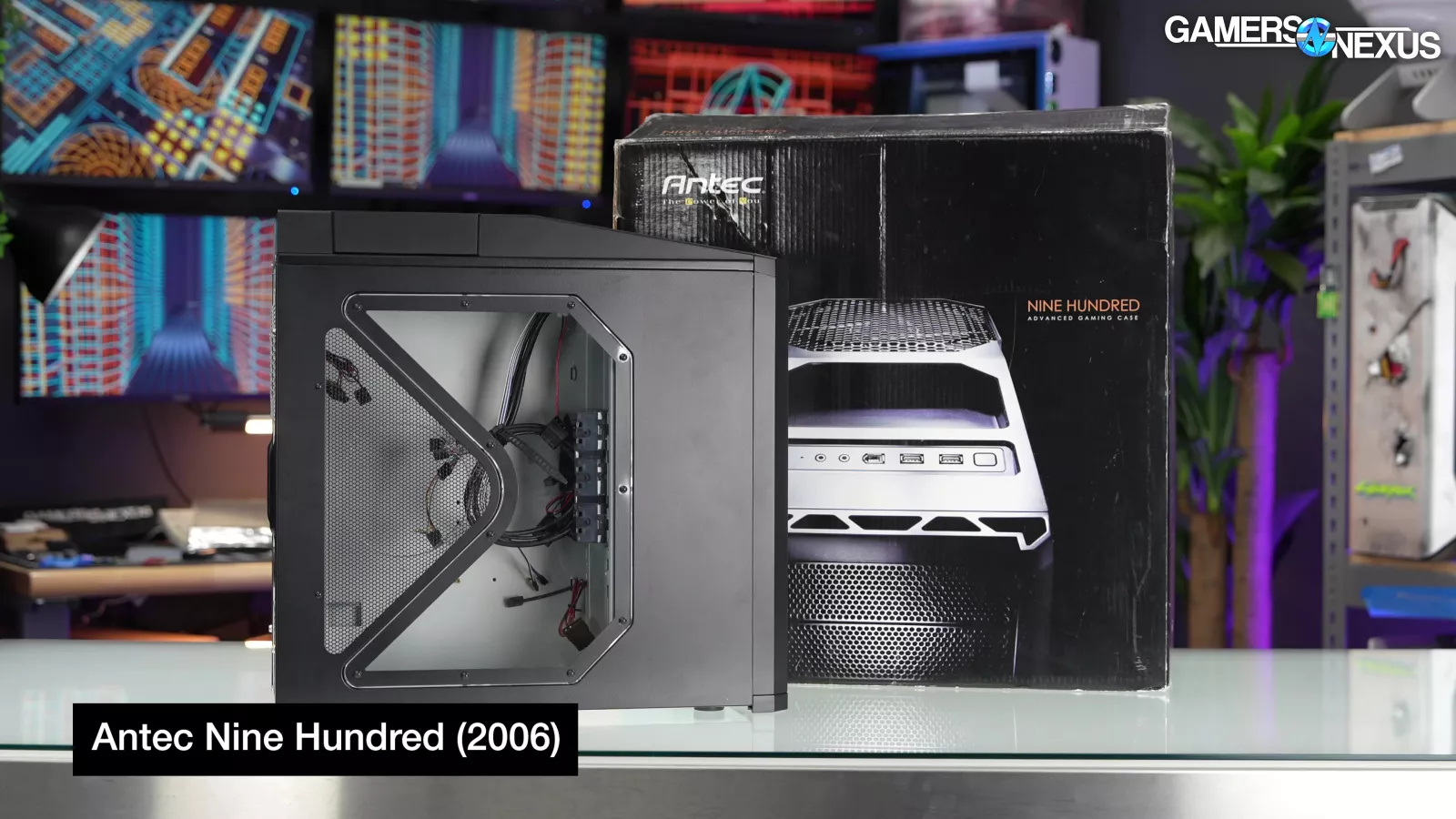
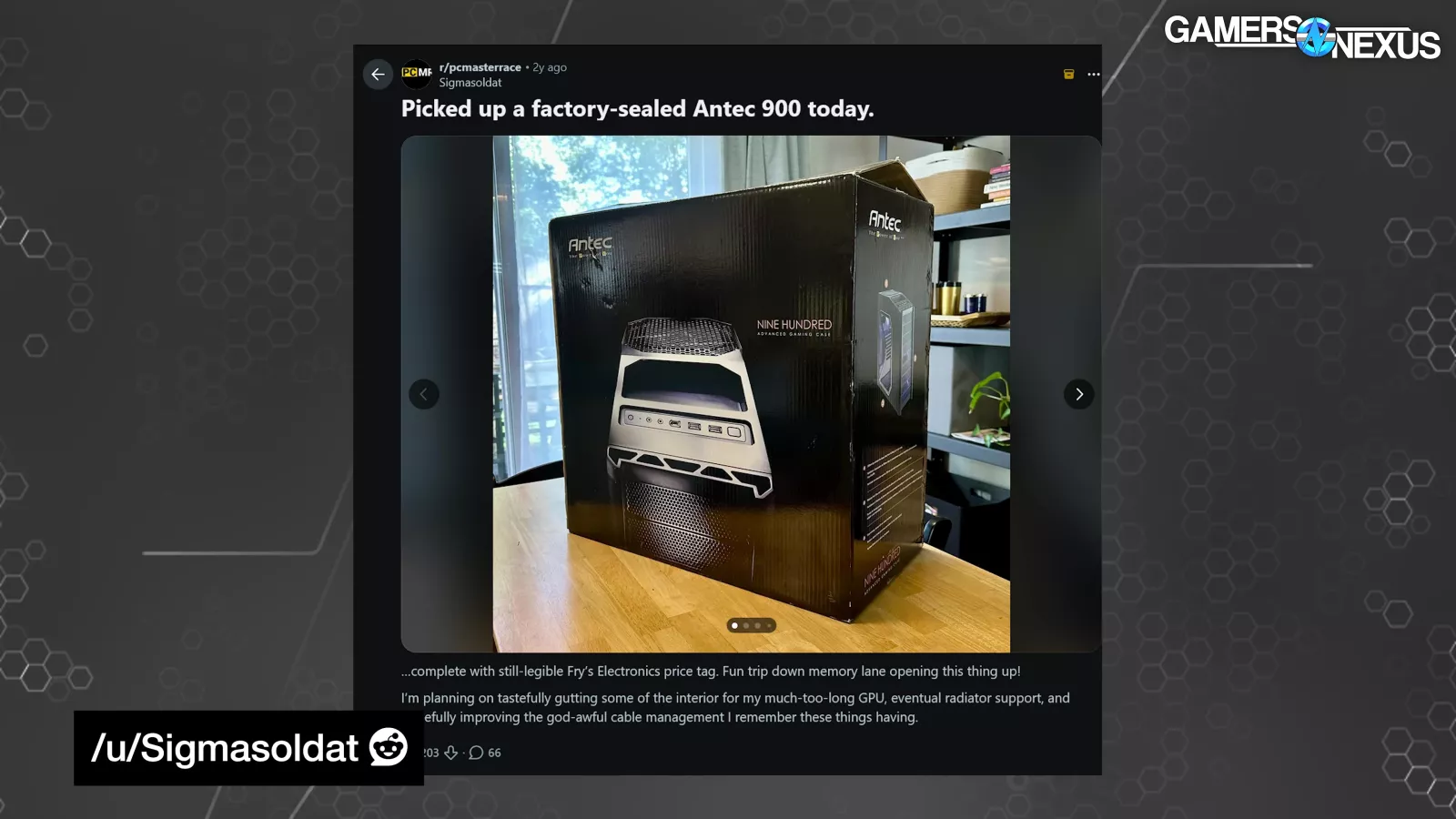
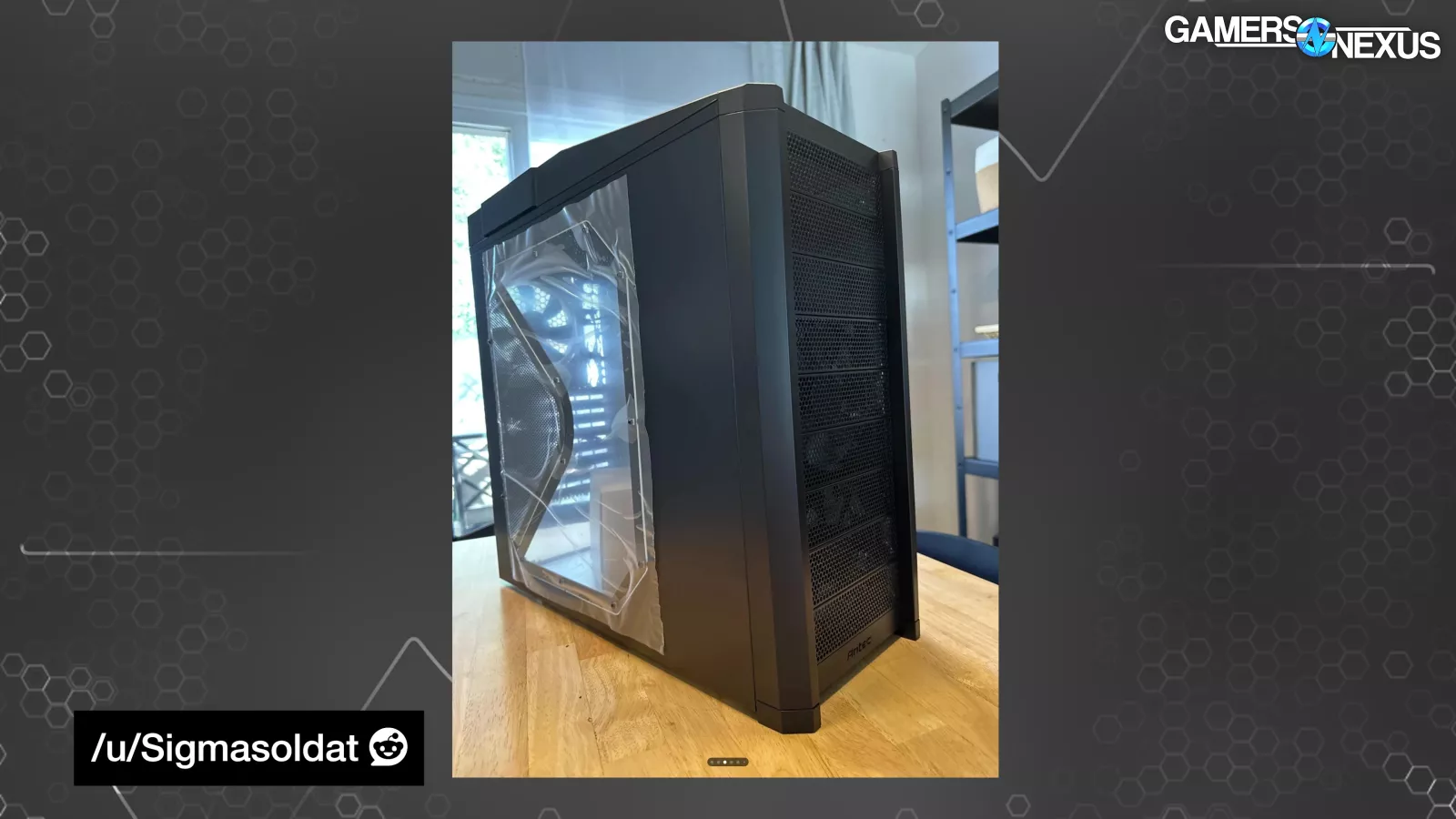
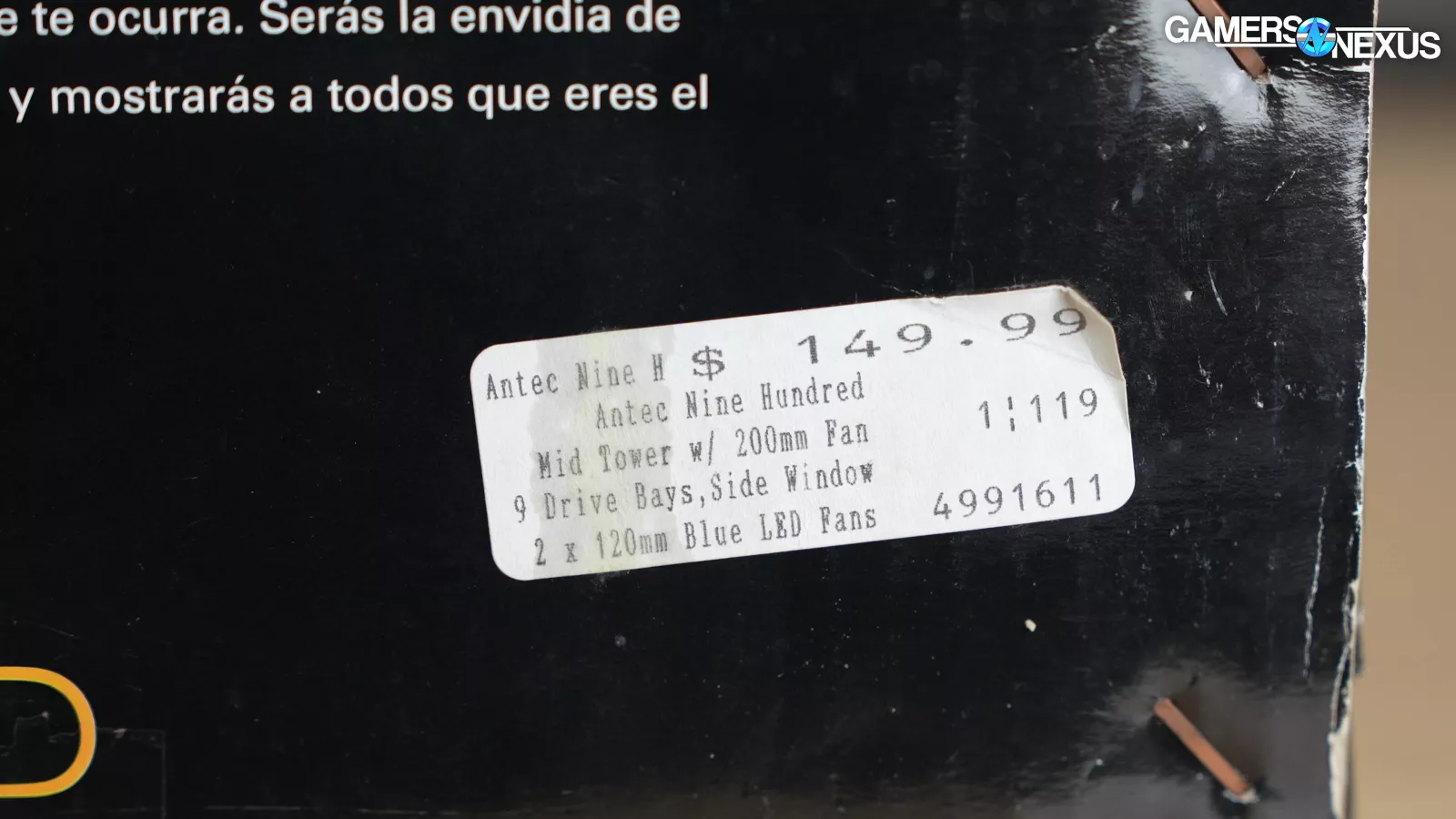
To do this revisit justice, we have a factory-sealed, original Antec Nine Hundred thanks to viewer Tyler, who bought the factory-sealed original Antec Nine Hundred complete with original MSRP sticker ($150). The new 900 costs twice as much, at $300. Even though there are lot of very good $150 cases today. Antec did not revisit that part of the 900.
Let’s get into this nostalgia hit/review combination.
Specs (for 2026 model)
| Motherboard Support | ATX, E-ATX, SS-CEB,SSI-EEB |
| Form Factor | Full Tower |
| Material | Aluminum + Steel + Plastic + Glass |
| Mainboard Support | ATX, E-ATX, SS-CEB,SSI-EEB , Threadripper, (Supports Back-Connect Motherboards) |
| Side Panel | 4mm Tempered Glass |
| Top Access & Controls | Power, USB 3.0 x 2, Type-C 10Gbps x 1, Headphone/Mic Combo Jack |
| Dimensions (DxWxH) | 547 x 250 x 622 mm |
| Expansion Slots | 8 |
| 3.5" / 2.5" | 4/4 |
| 2.5" | 5 |
| Front Fan Support | 2 x 200mm / 3 x 140mm / 3 x 120mm |
| Top Fan Support | 2 x 140mm / 3 x 120mm |
| Power Supply Shroud Fan Support | 2 x 120mm |
| Rear Fan Support | 1 x 120mm / 1 x 140mm |
| Included Fans | 3 x 140mm at the front + 2 x 120mm reverse fans at the PSU shroud + 1 x 140mm at the rear |
| Front Radiator Support | 120 / 140 / 240 / 280 / 360 / 420mm (52mm thickness) |
| Top Radiator Support | 120 / 140 / 240 / 280 / 360mm (52mm thickness) |
| Max GPU Length | ≤ 495mm (≤ 465mm with front fans installed) |
| Total GPU Thickness + CPU Cooler Height | ≤ 190mm |
| Max GPU Thickness | ≤ 160mm (cable excluded) |
| Max CPU Cooler Height | ≤ 190mm |
| Max PSU Size | ≤230mm (cable excluded) / ≤ 170mm (side mount) |
| Dust Filter | Front, Top, Bottom |
| Net Weight | 15 kg |
| Gross Weight | 17.5 kg |
| Warranty | 2 Years |
| UPC | 0-761345-10272-8 |
| MSRP | $300 |
Original Antec Nine Hundred
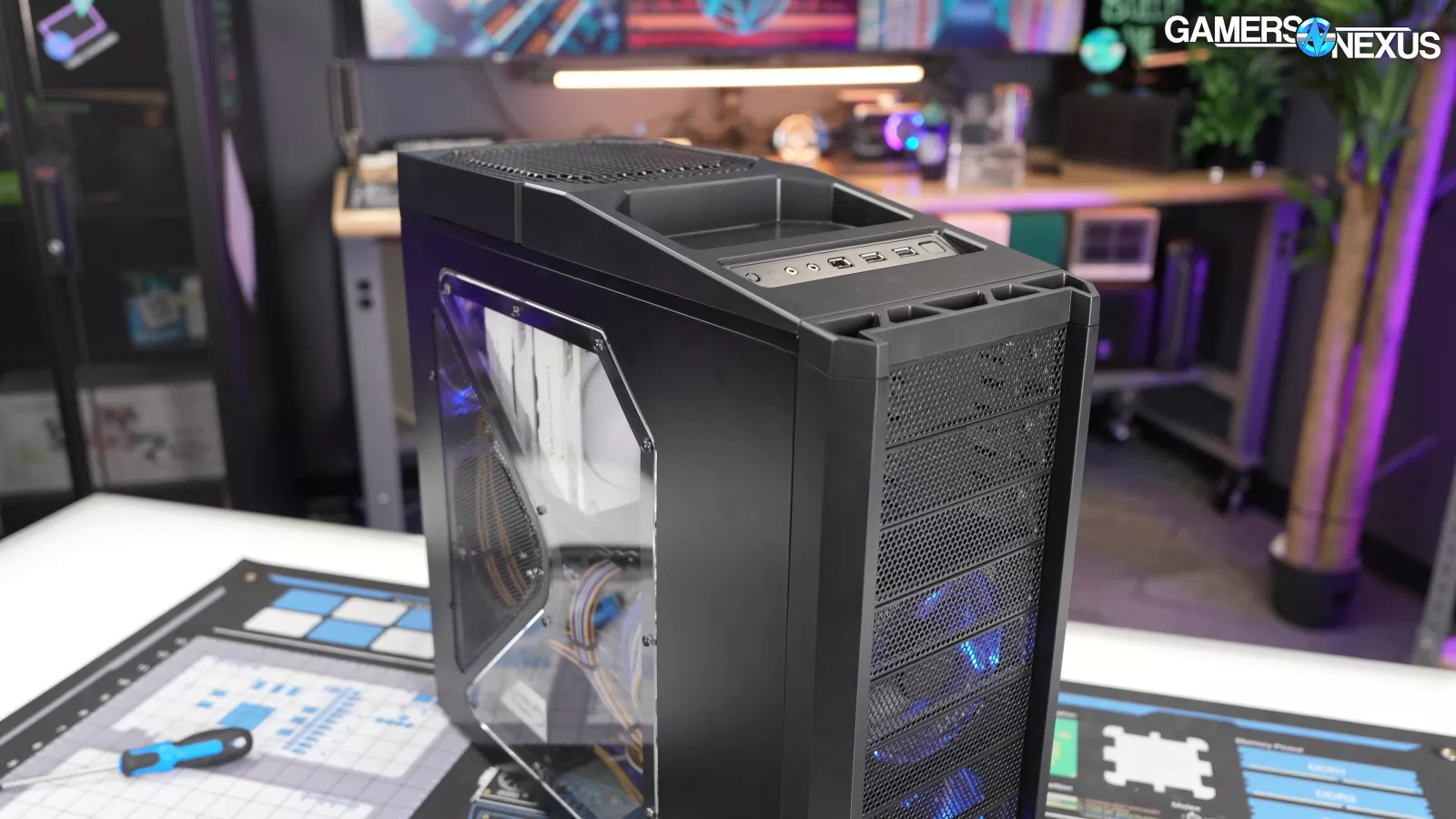
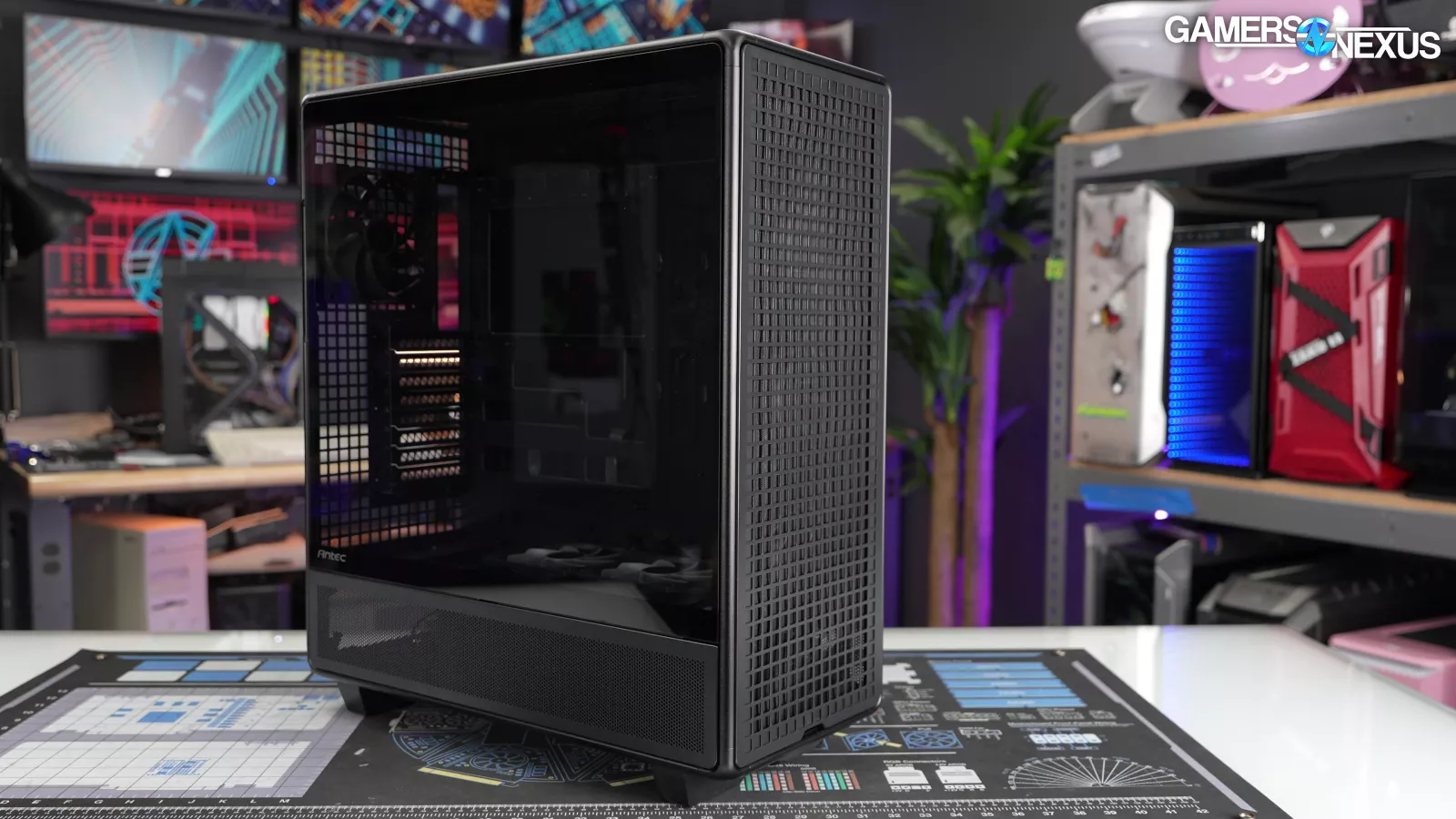
The new Antec 900, visually, is nothing like the original Antec Nine Hundred. It doesn’t carry the iconic hexagonal shaping and boxy body design, but it does focus on performance and has a brutalist approach to the aesthetics.
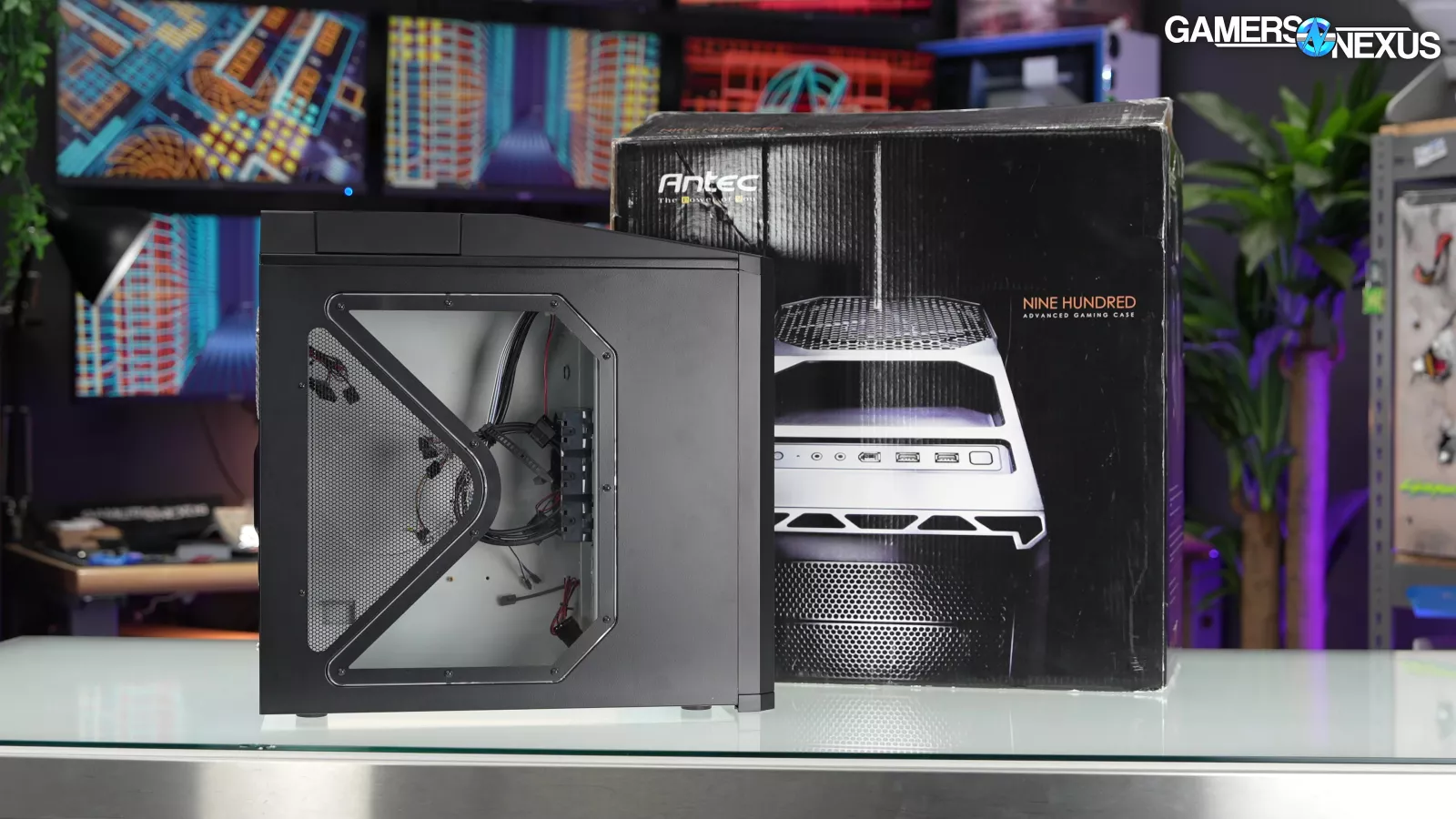
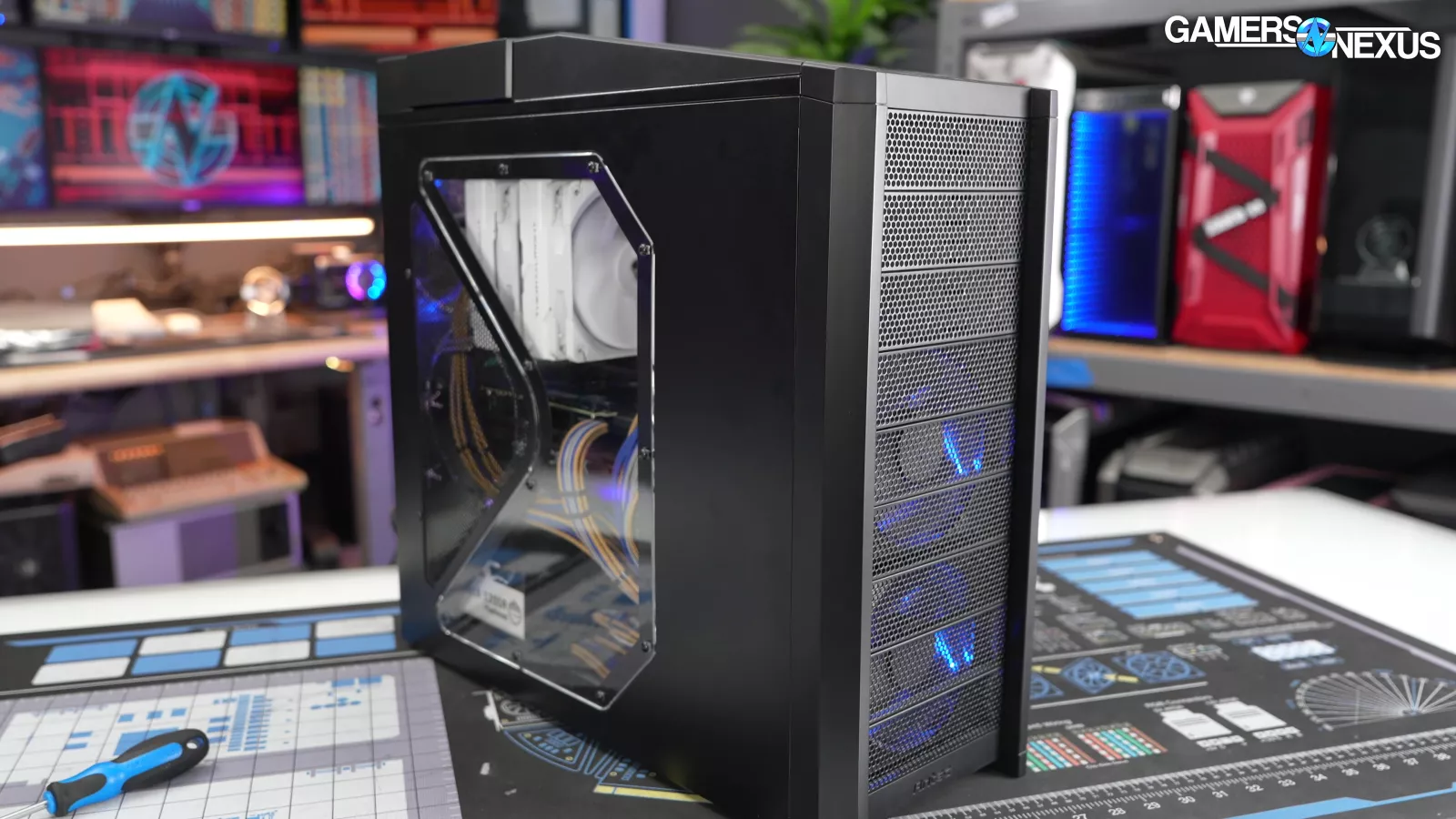
It's hard to imagine the Nine Hundred in context, because it was so influential that it became generic. A design that was cutting-edge in 2006 now looks like every cheap ripoff from 2014, and that’s because every cheap ripoff was ripping off the Nine Hundred.
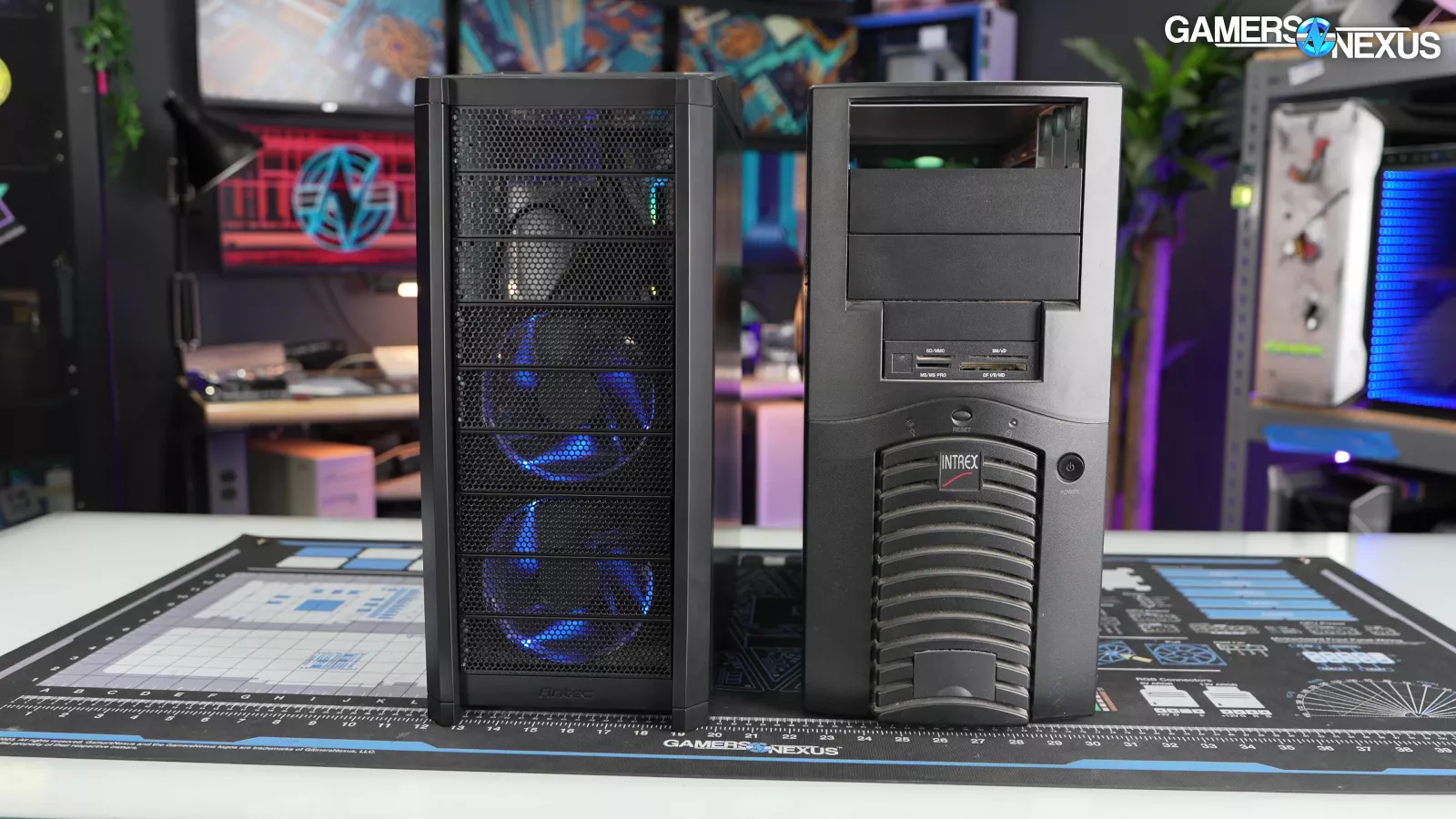
Before the Nine Hundred, the mainstream gaming case archetype from companies like Antec and Chieftec had curved front vents, minimal airflow, and maybe a hinged door to cover the 5.25" and floppy bays.
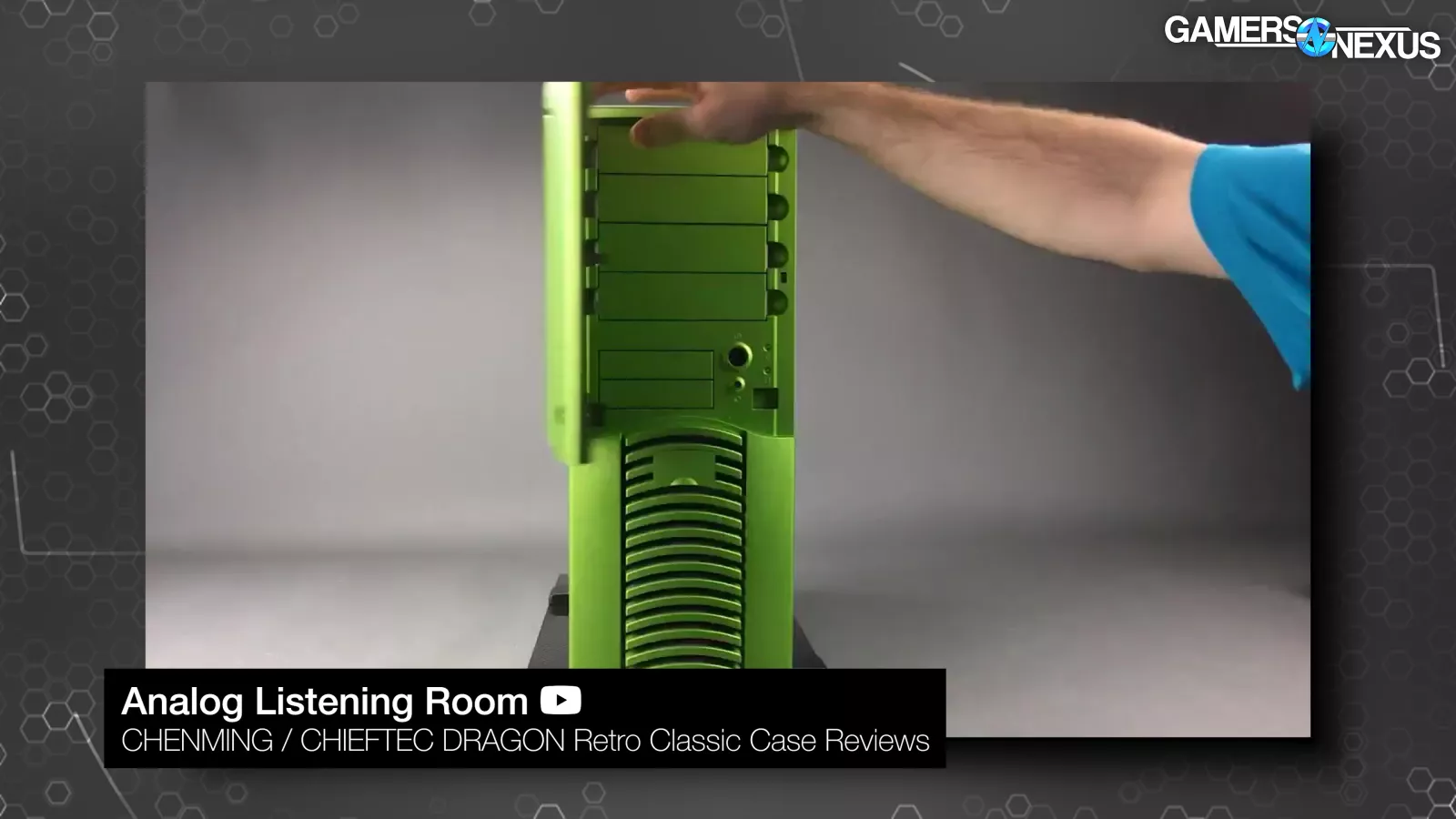
If you graduated from a beige tower, you were probably replacing it with a case that looked like one of these.
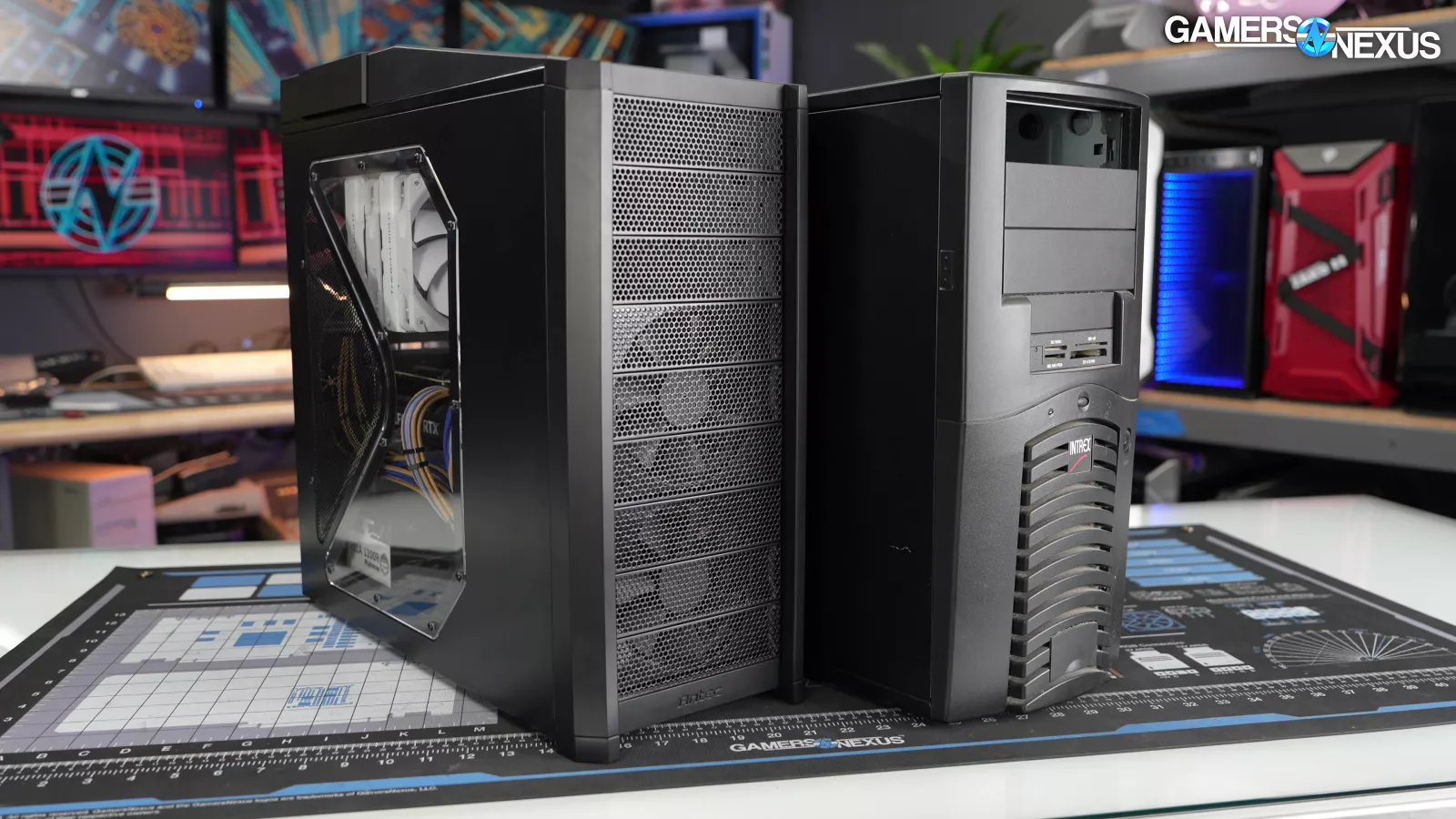
The matte, angular, mesh-fronted Antec Nine Hundred didn't look like anything on the market: contemporary reviews call it "futuristic" and a "radical departure;" Hexus called it "the ‘bastard son’ of a set square."
This “tacti-cool” aesthetic would become extremely common from other companies, all clearly following in Antec’s footsteps, but in particular Cooler Master and Rosewill mimicked this.
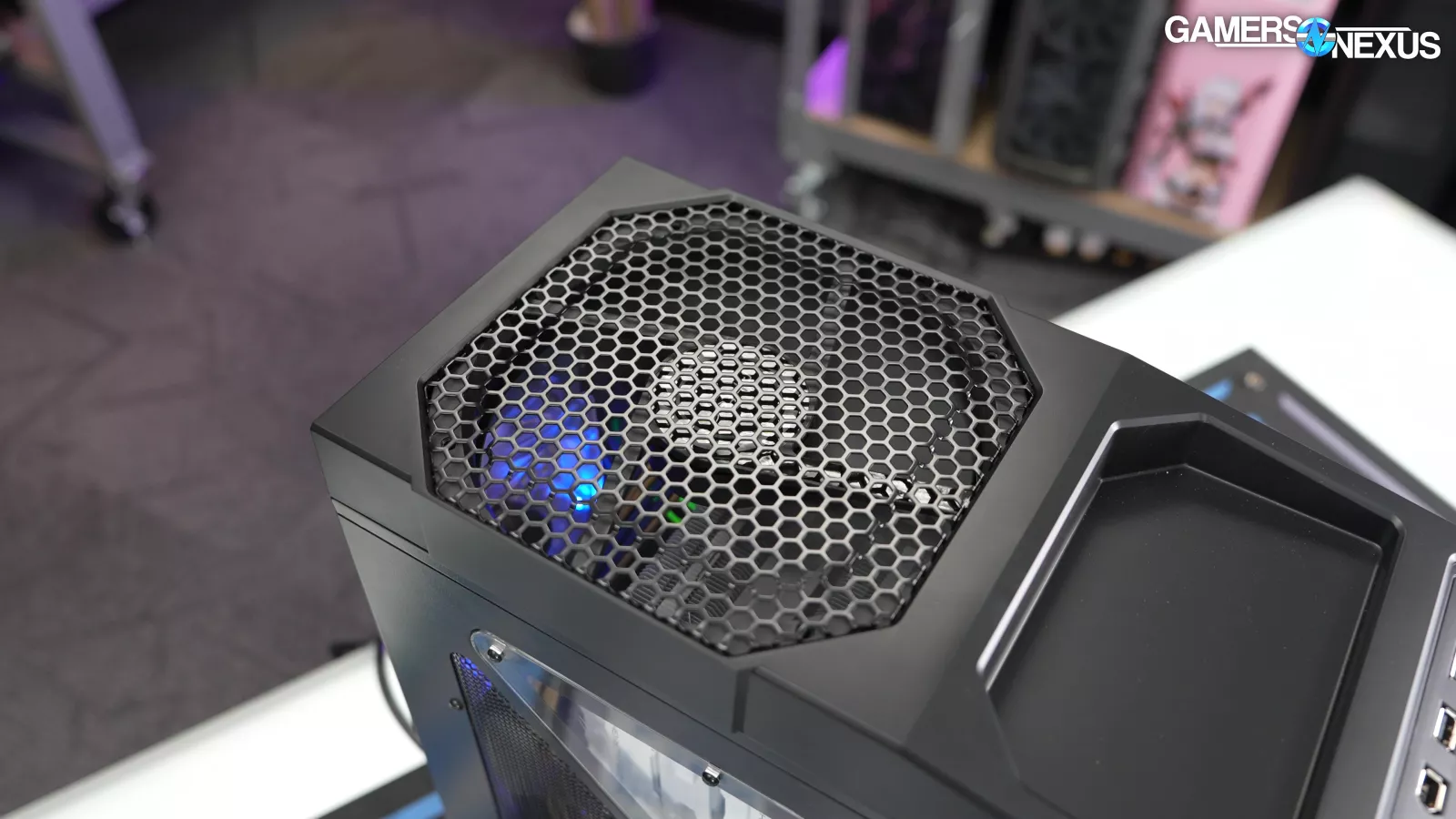
It wasn't just looks that made the Nine Hundred different and desirable, though. There were few cases that took airflow so seriously at the time.
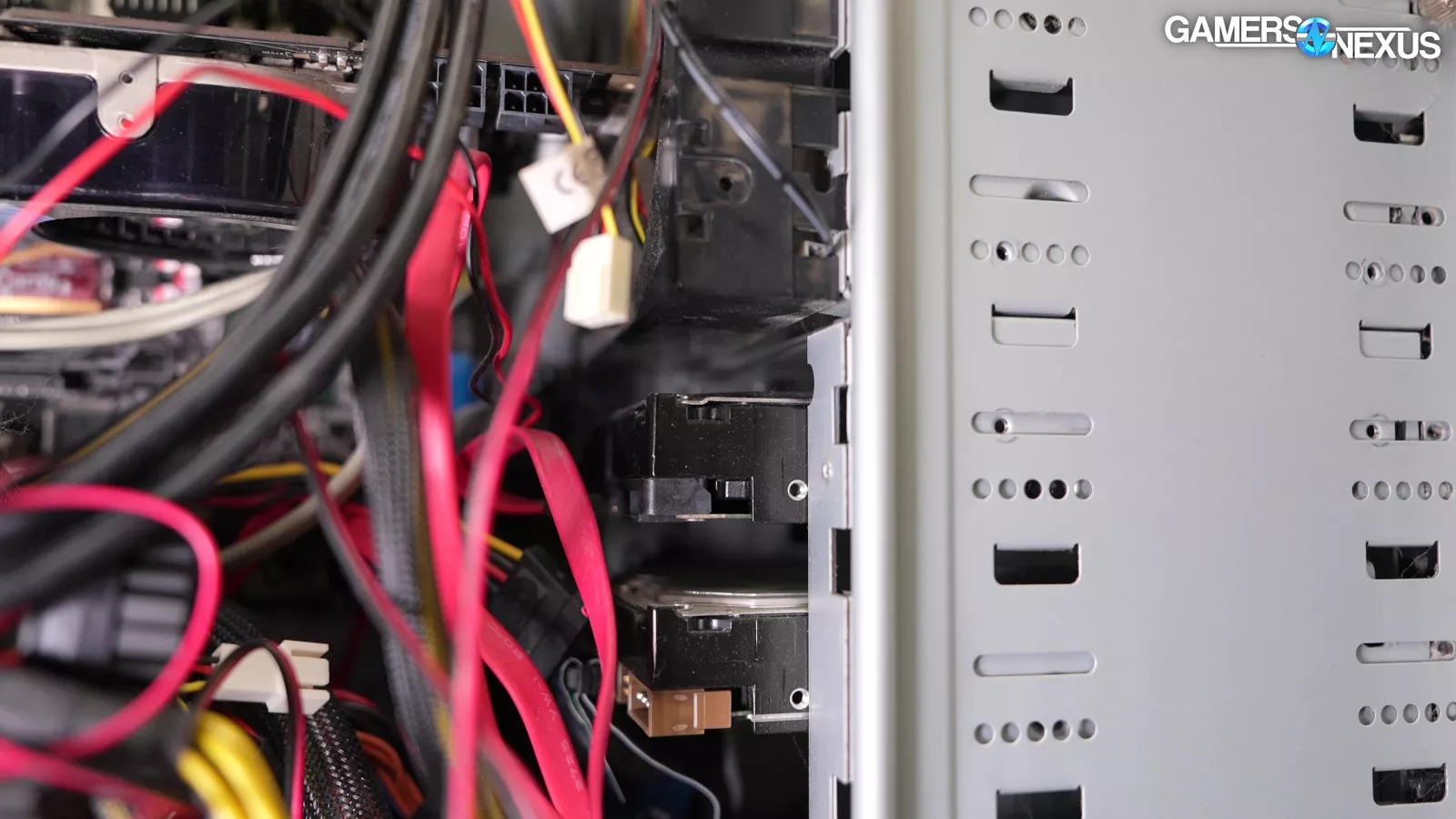
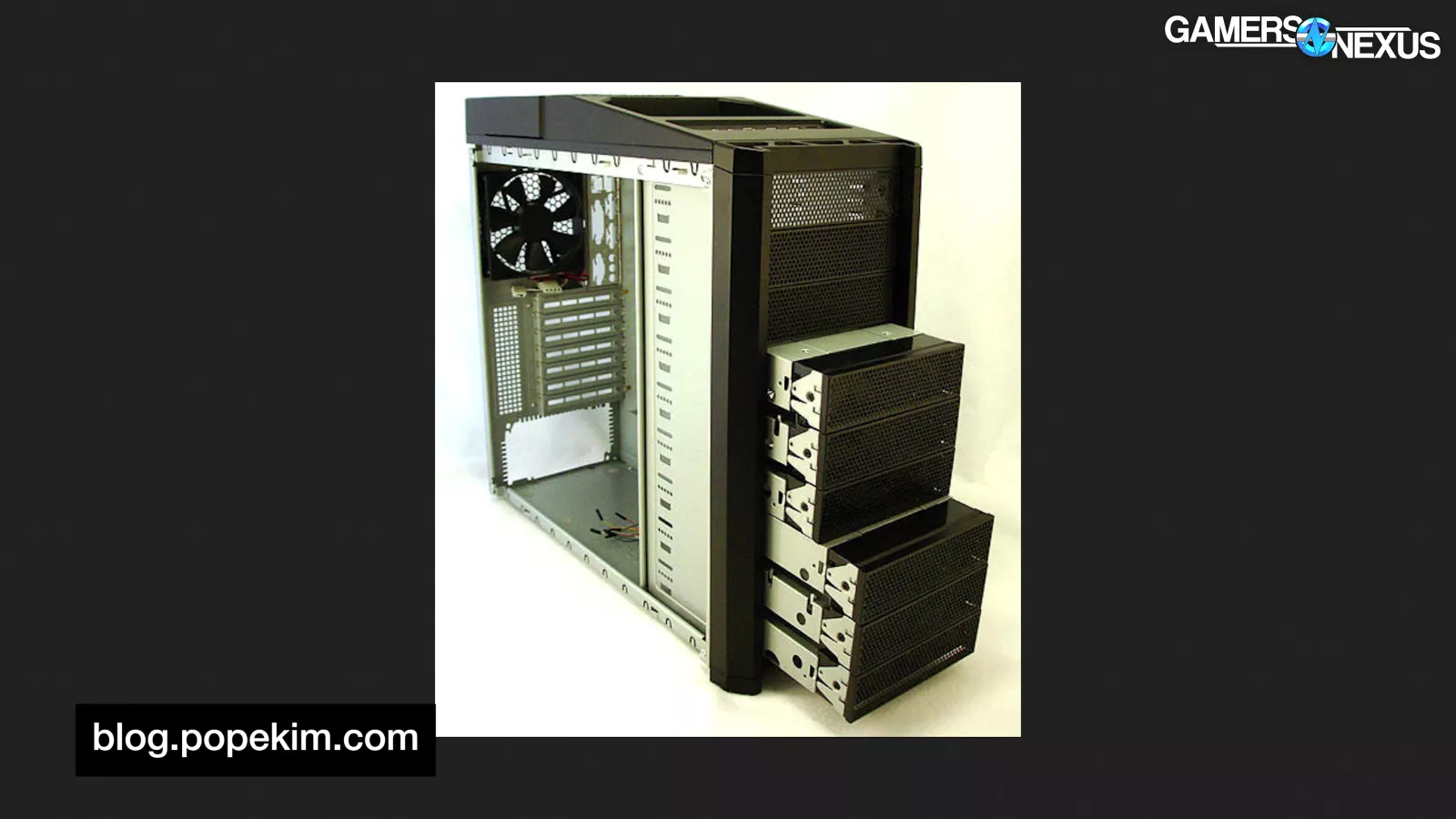
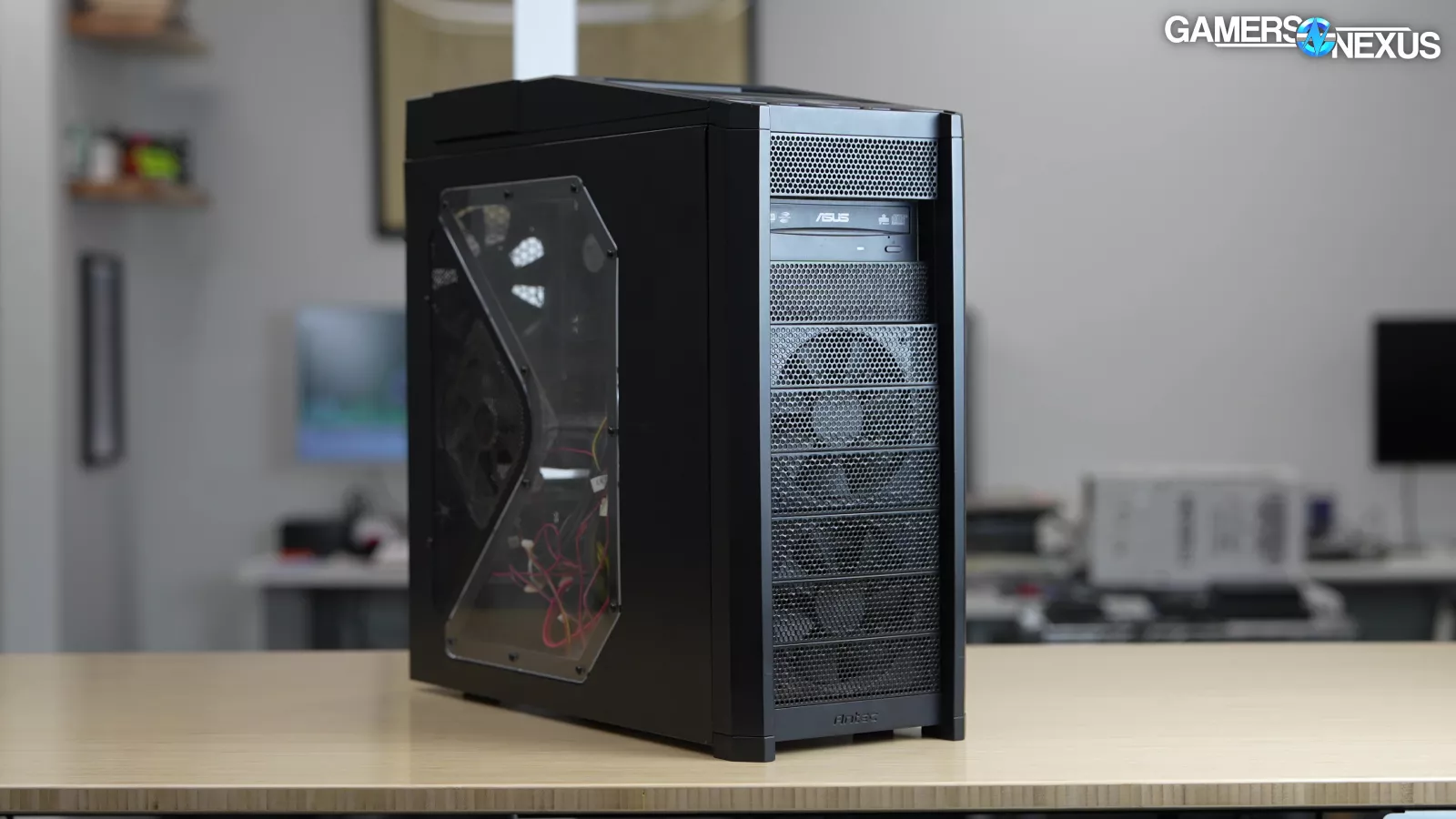
Part of the reason for that was that stacking a ton of drives with ribbon cables (optical, floppy, HDDs) didn't leave room for fans, another part of the reason was that systems didn't draw as much power yet, and part of the reason was that nobody had really figured things out yet.
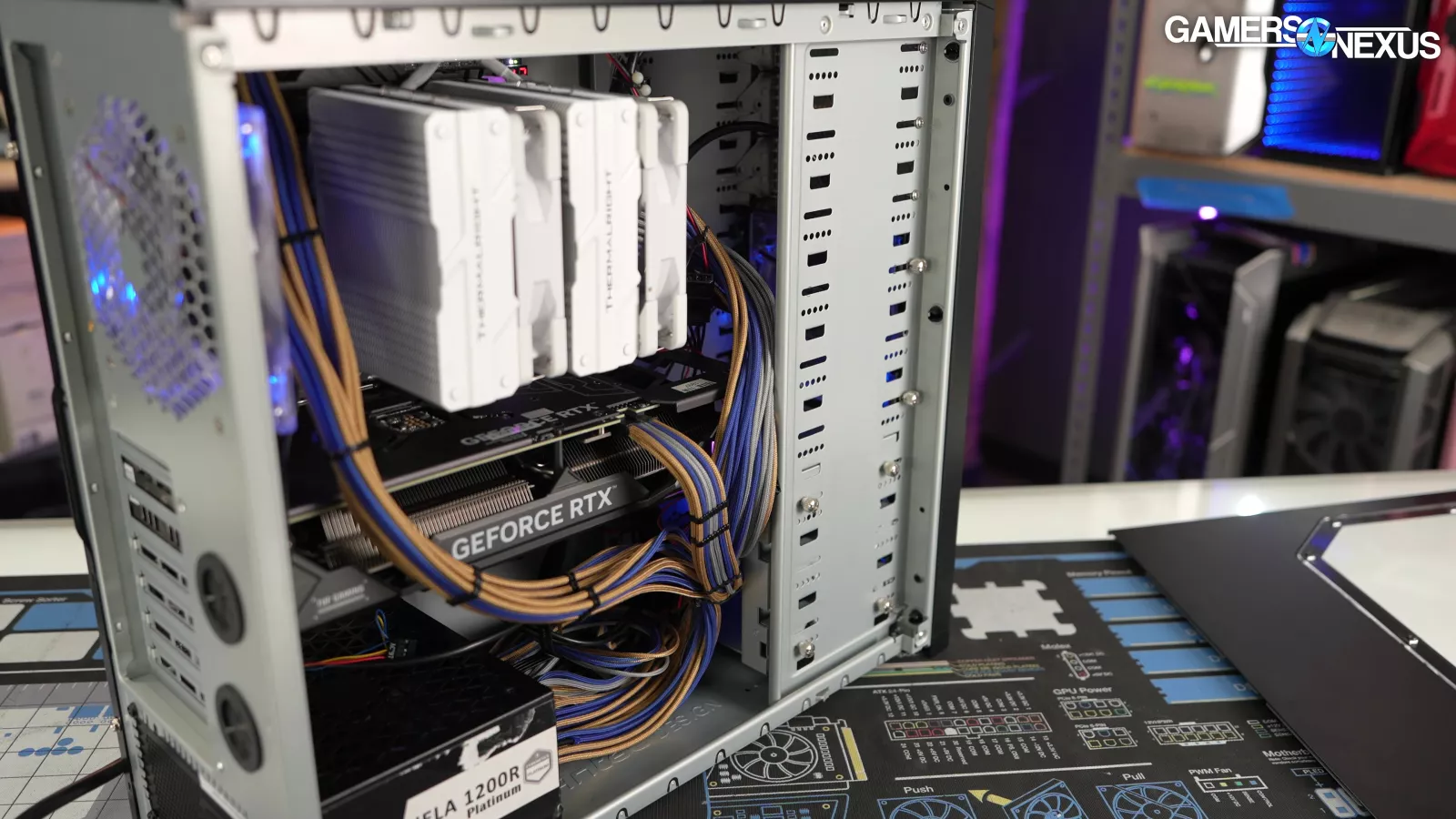
The Nine Hundred included four fans which, for the time, was on its own abnormal. In TechRadar's words, the Nine Hundred had "more fans than a Geisha convention.”
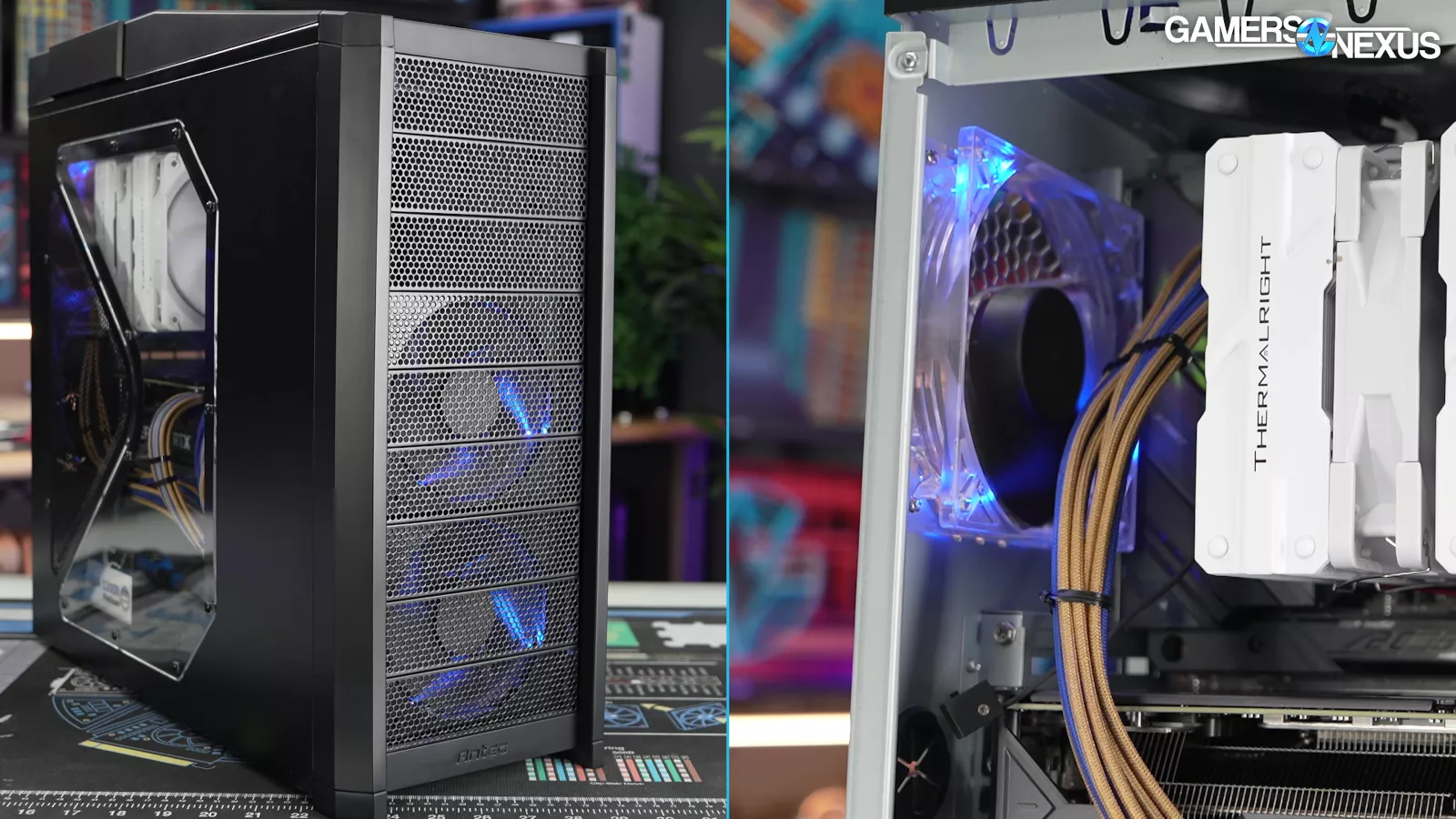
3 of them are 120mm, which remains a standard today; however, back then, some cases still ran smaller 80 or 93mm fans (although most had begun moving to 120s).
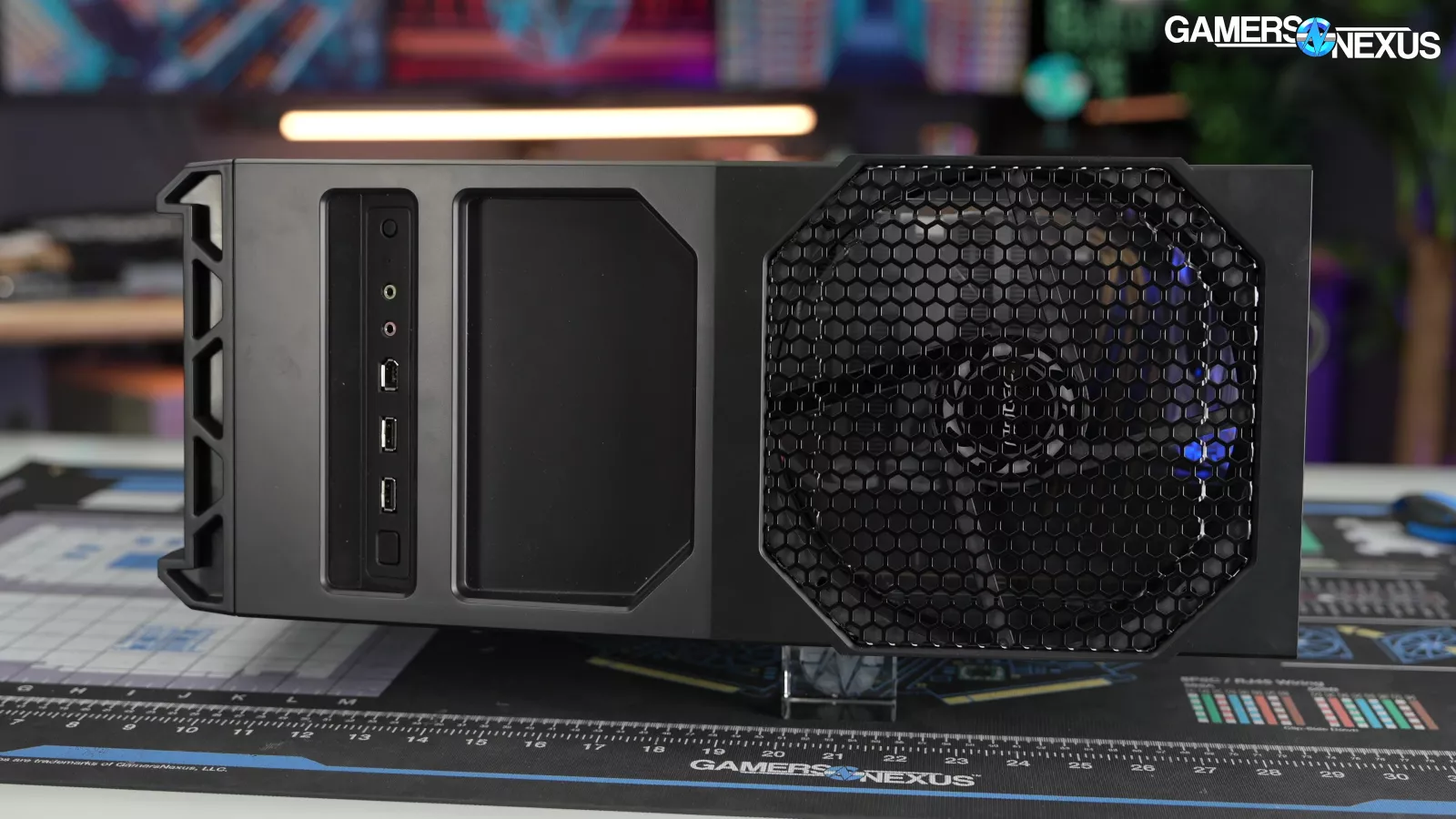
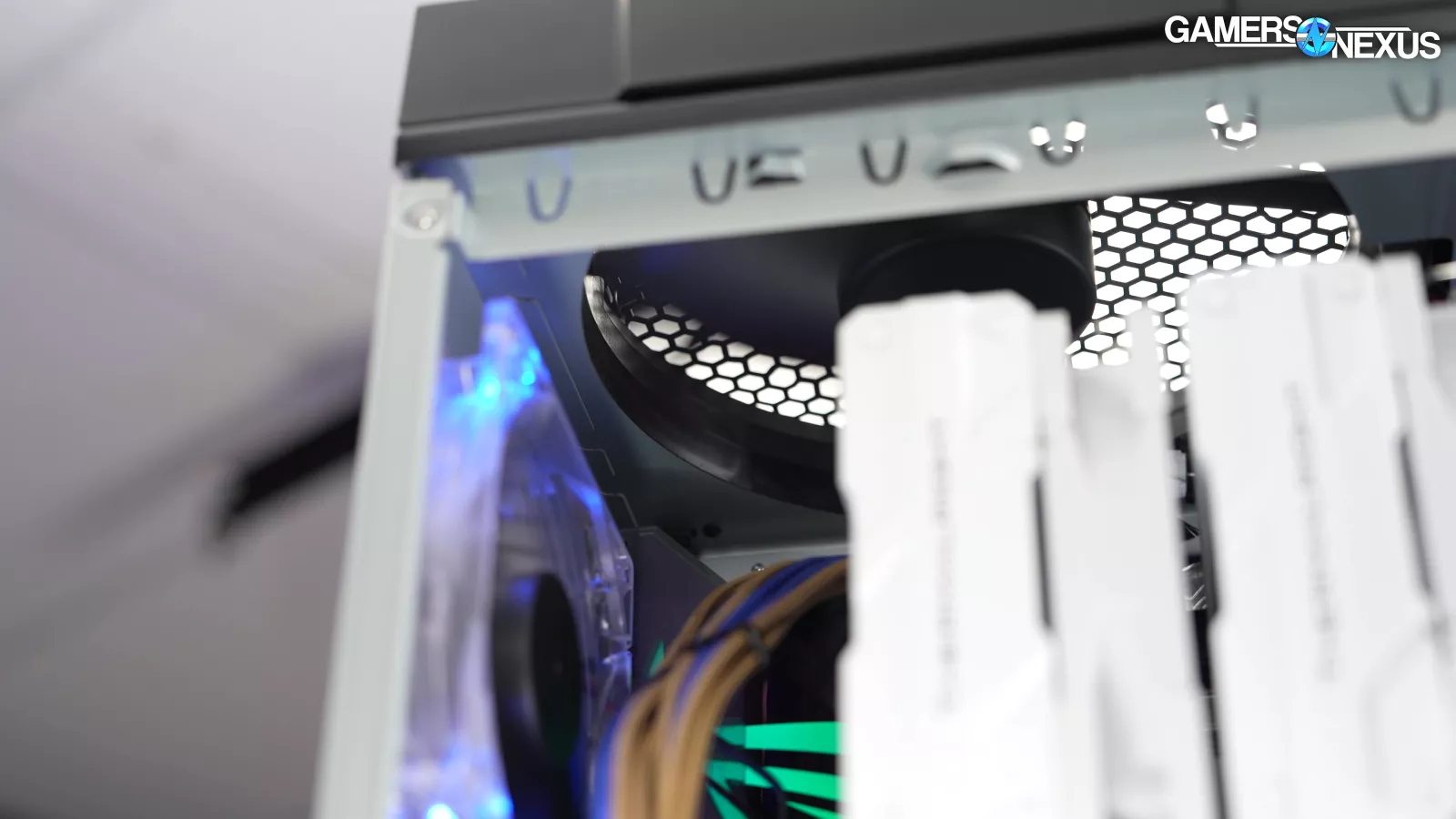
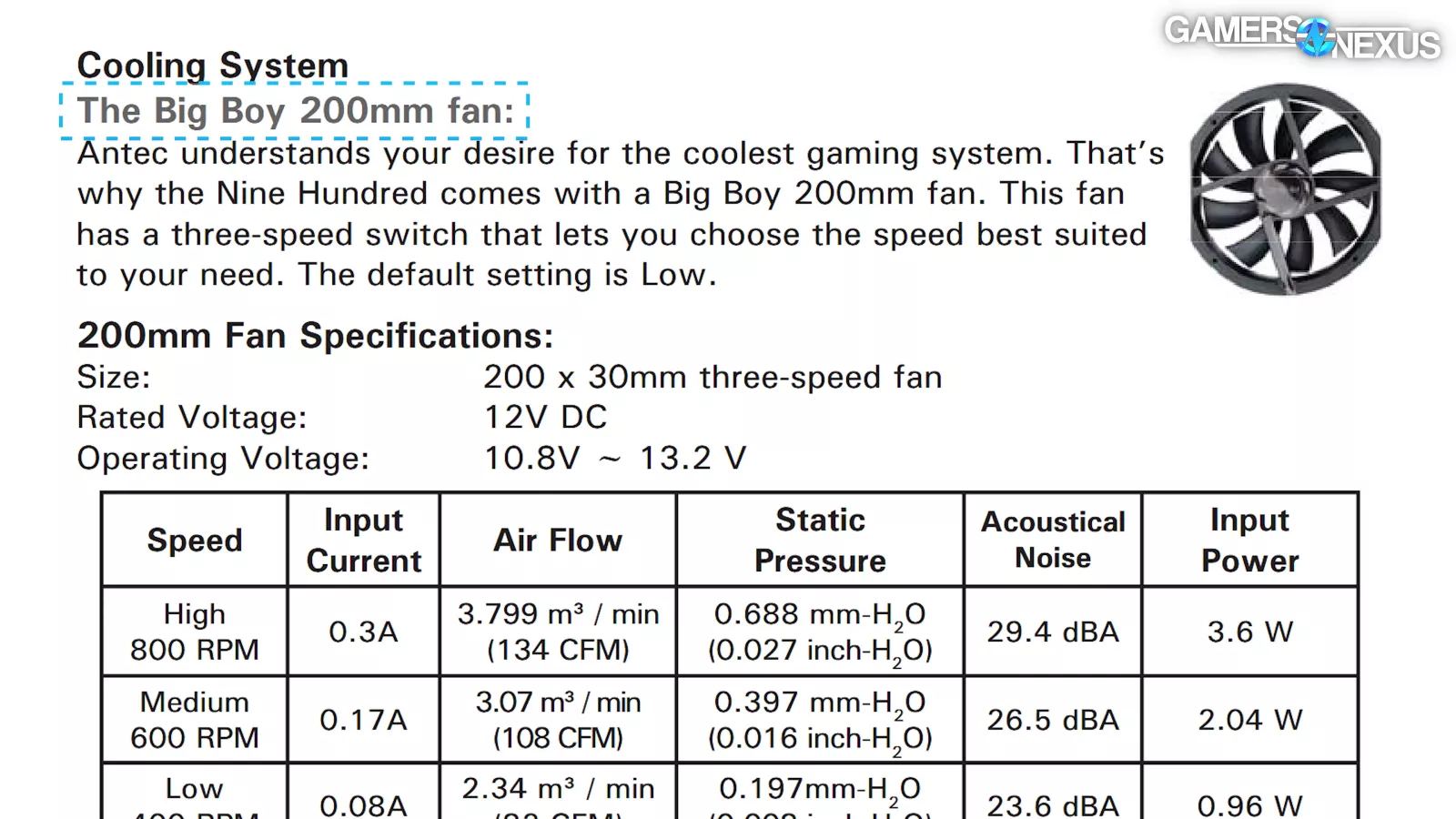
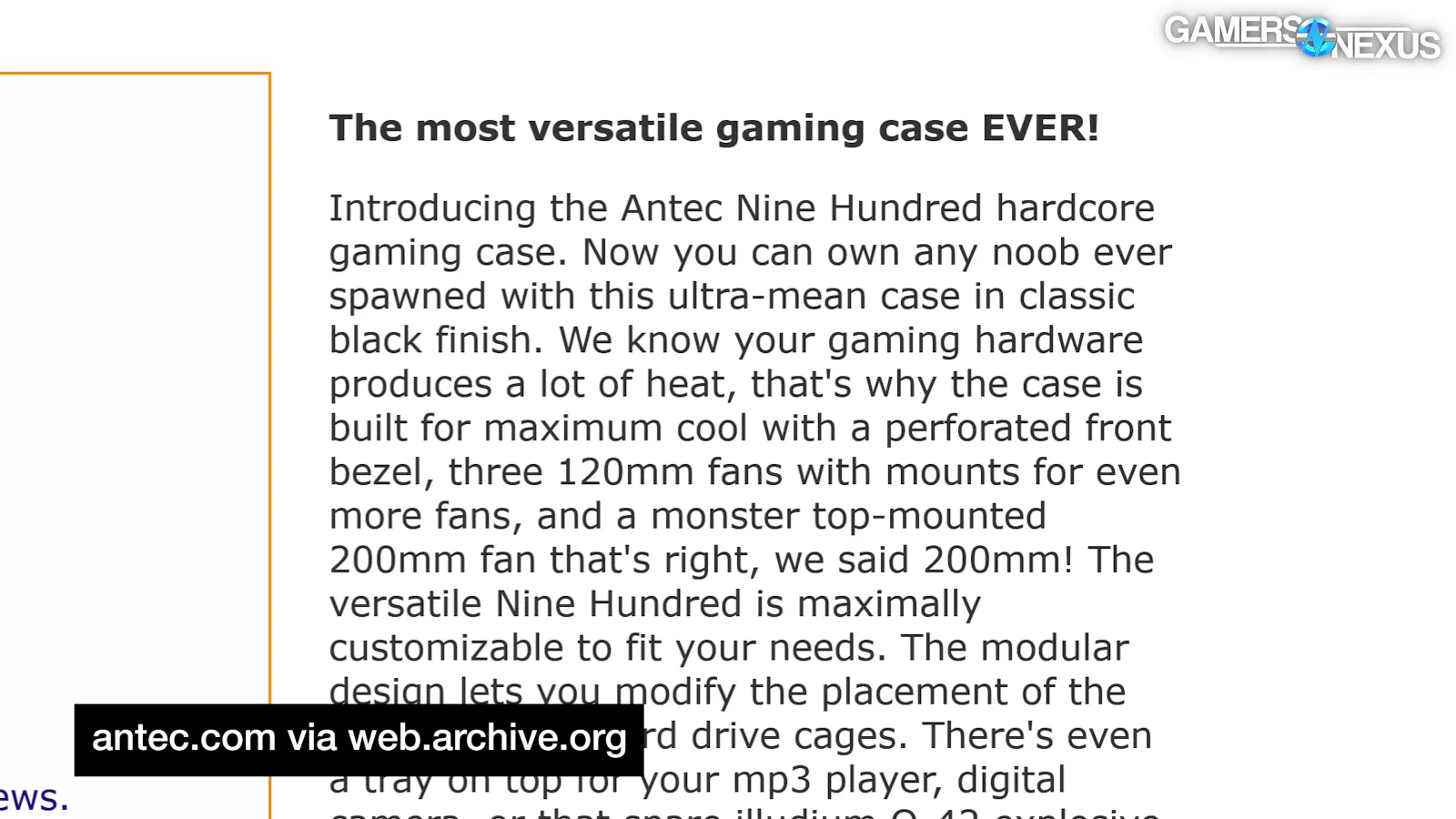
On top of that, Antec included one gigantic 200mm fan, but not just any -- Antec had branded it the "Big Boy 200." Antec's pitch said the case was "the most versatile gaming case EVER!"
And Antec knew the language that’d sell cases -- the whole thing reads like it took out a Maximum PC magazine ad:
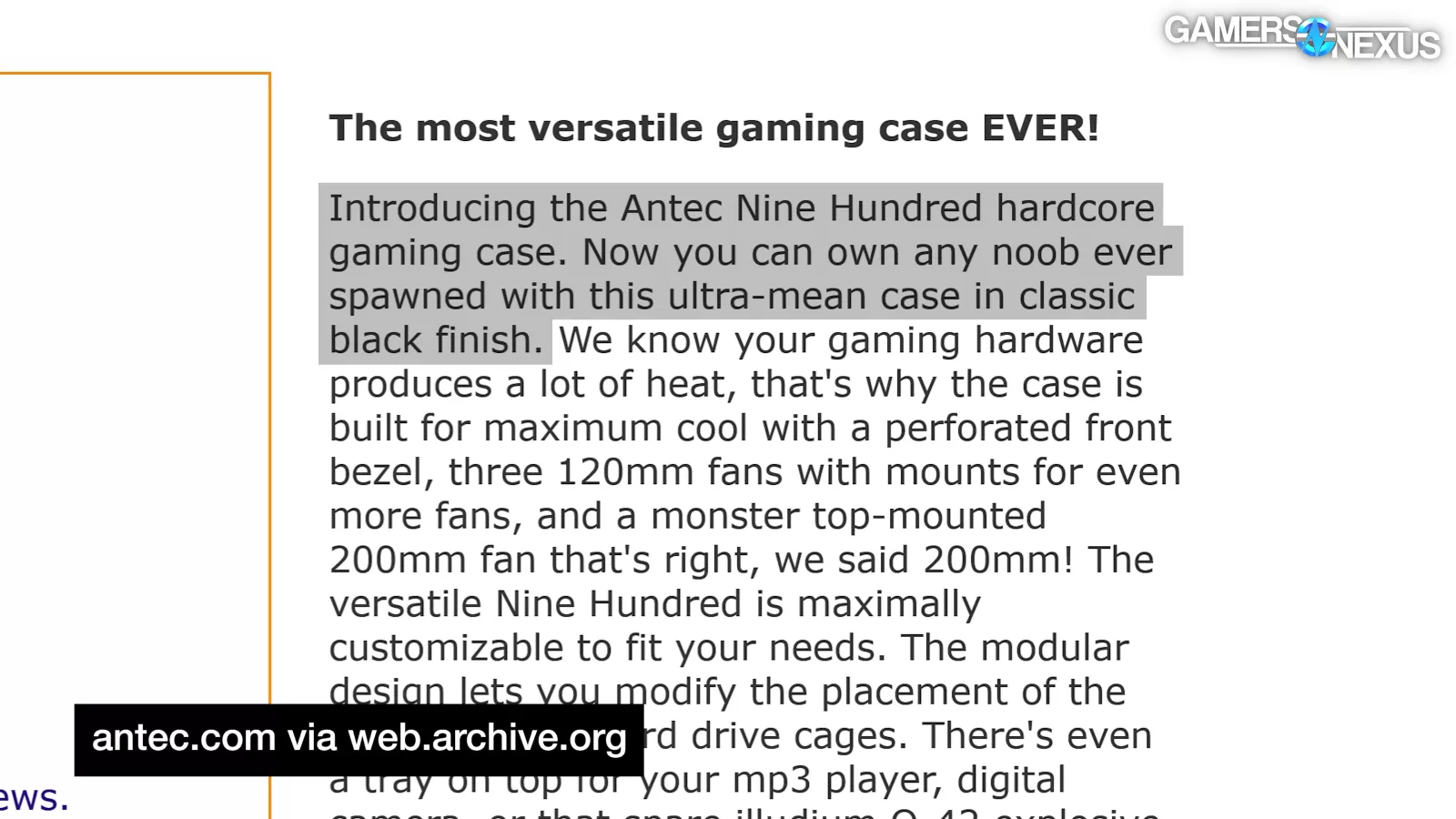
"Introducing the Antec Nine Hundred hardcore gaming case. Now you can own any noob ever spawned with this ultra-mean case in classic black finish.” For that time, painting a case black was, on its own, still relatively uncommon. Its description continues, “We know your gaming hardware produces a lot of heat, that's why the case is built for maximum cool with a perforated front bezel, three 120mm fans with mounts for even more fans, and a monster top-mounted 200mm fan that's right, we said 200mm! The versatile Nine Hundred is maximally customizable to fit your needs. The modular design lets you modify the placement of the front fans and hard drive cages. There's even a tray on top for your mp3 player, digital camera, or that spare illudium Q-42 explosive space modulator that you have lying around. Be the envy of everyone at your next LAN party, impress your friends, and just generally show everyone that you are the ultimate master of all time with the Antec Nine Hundred!"
It’s really not nostalgia. Times were so much better. PC hardware companies hadn’t even dreamt of hardware-as-a-service yet.
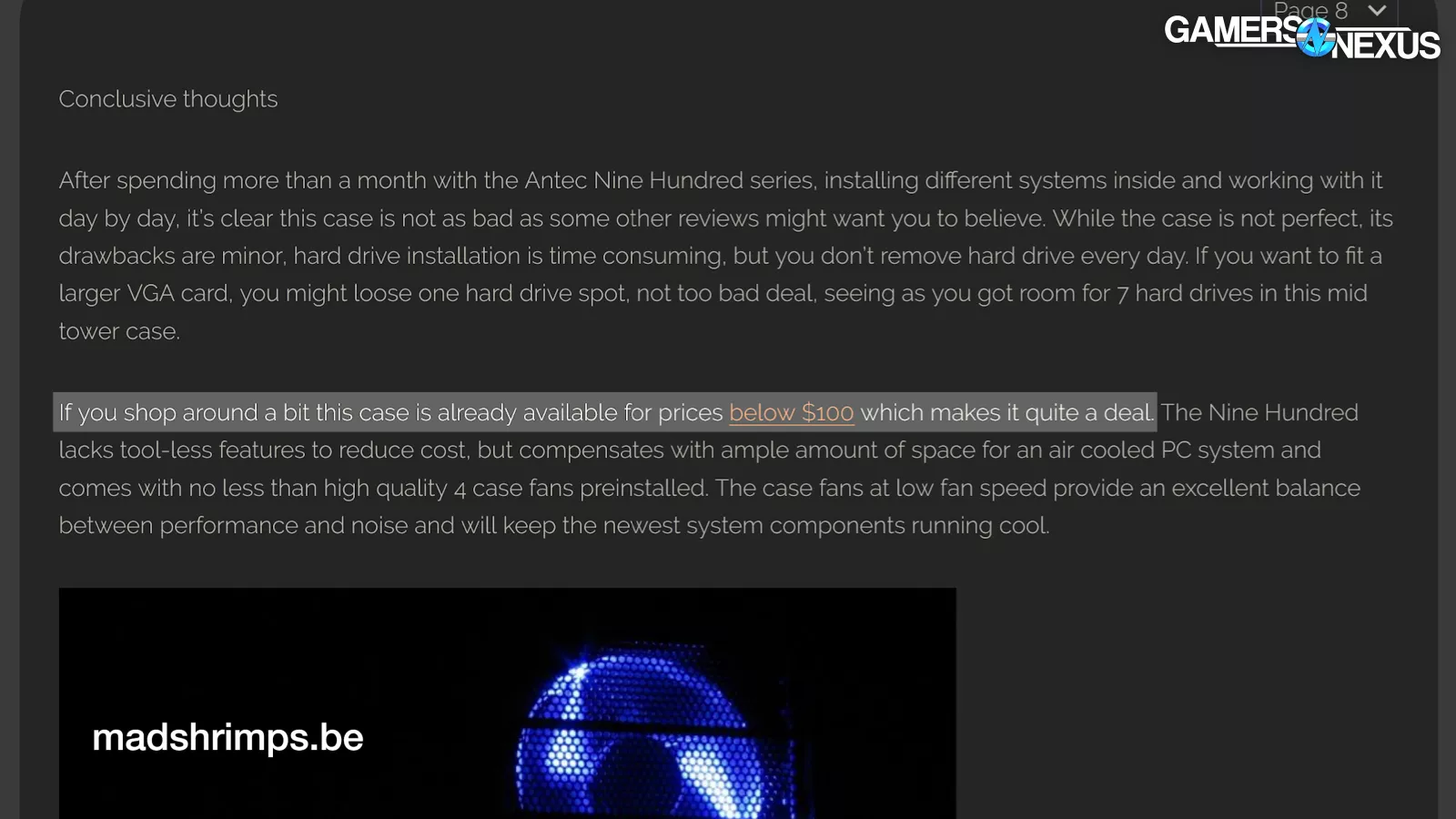

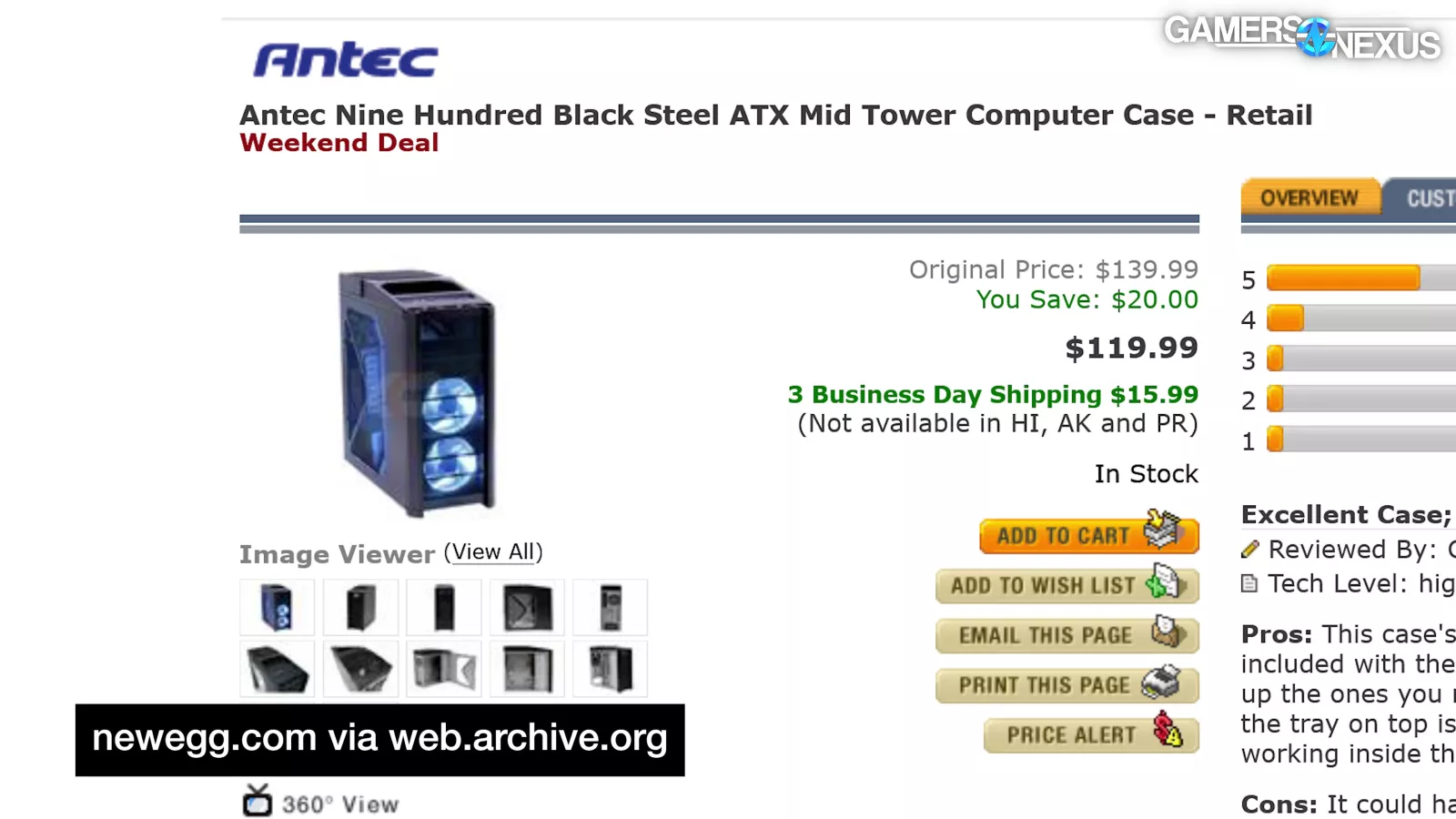
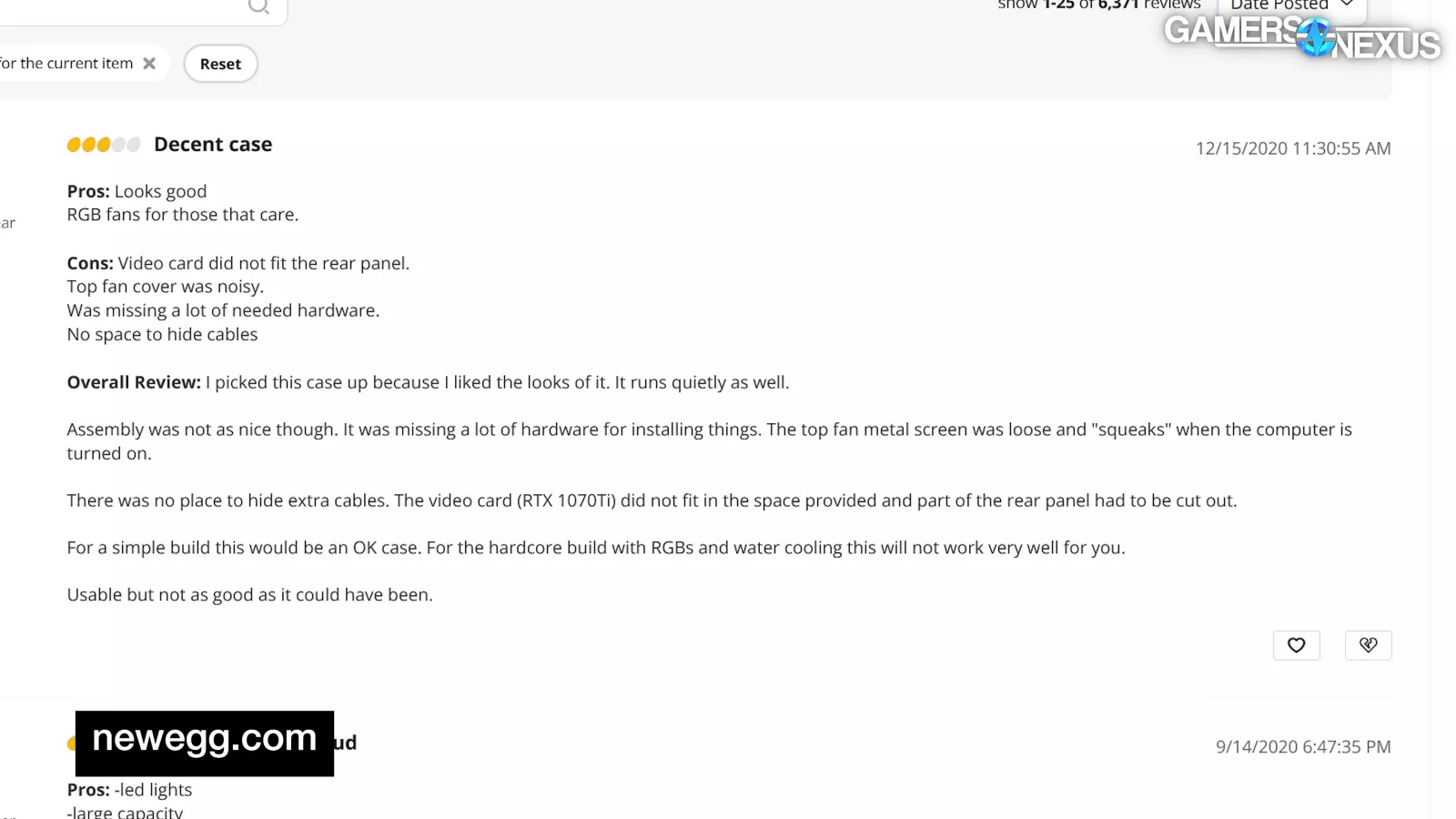
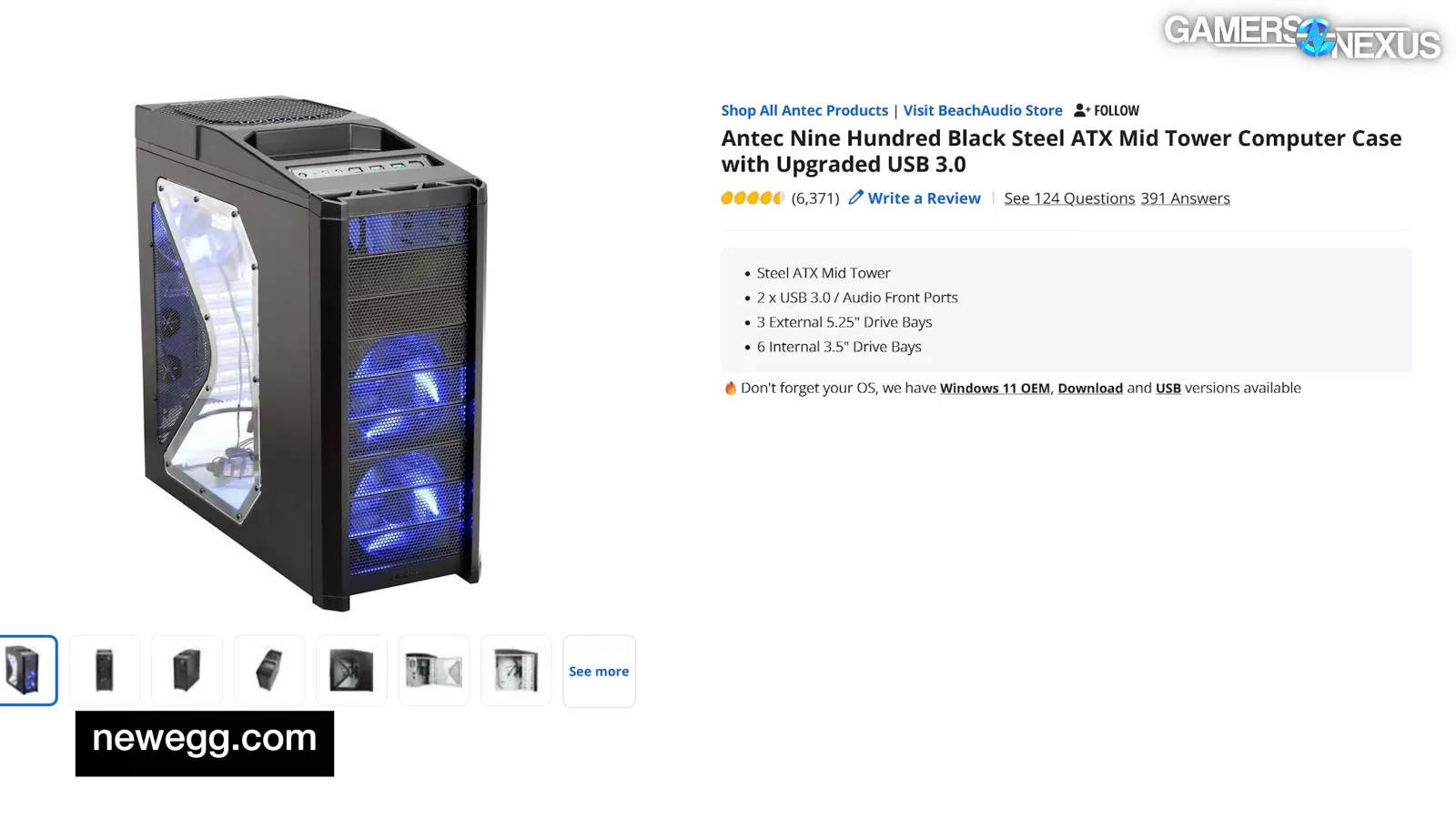
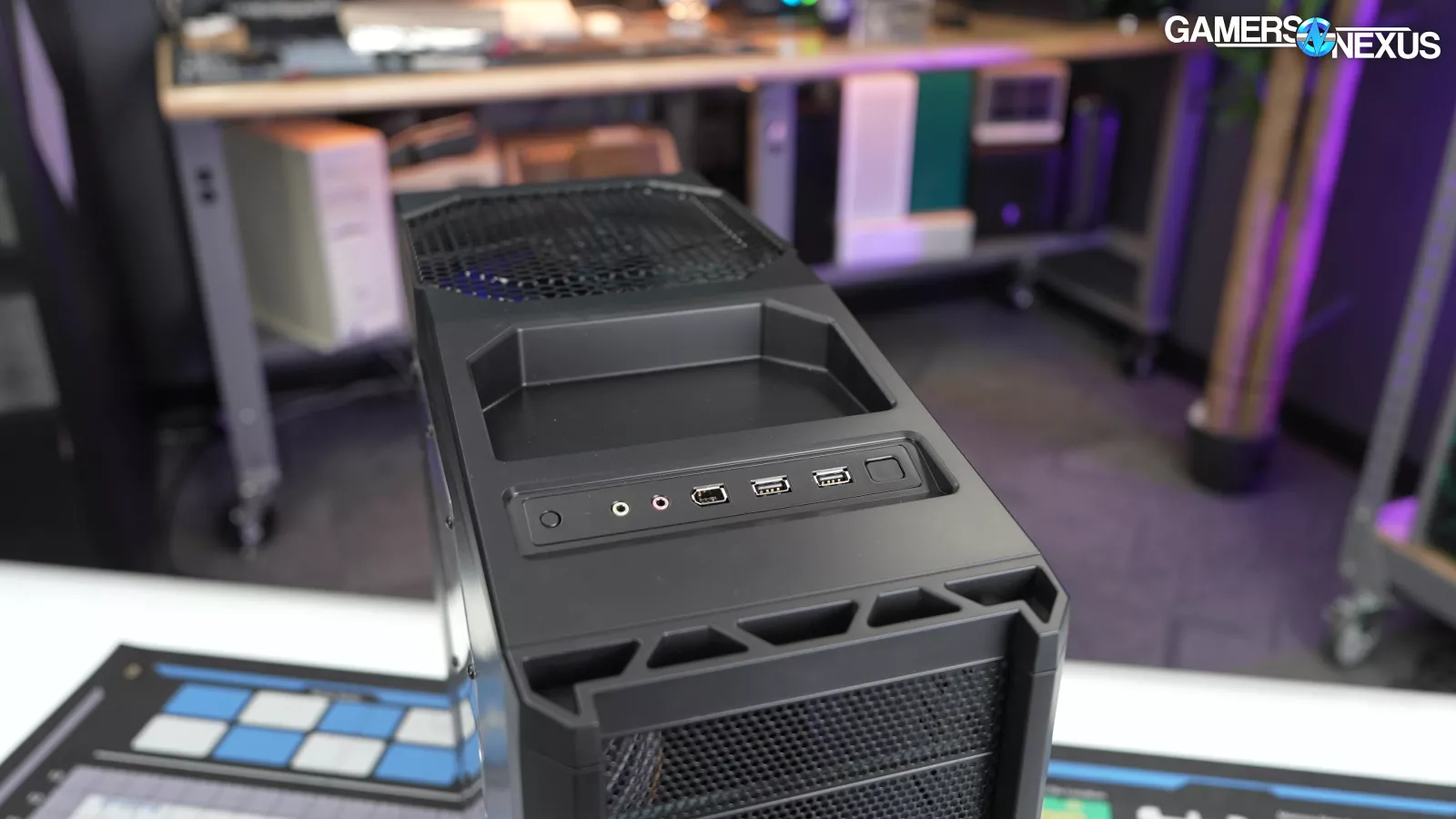
The Nine Hundred had an extremely long lifecycle. By early 2007 Madshrimps claimed the case was already available for less than $100, and we were posting sale links for the case in 2014. The Internet Archive has Newegg's in-stock page archived from March 2007 through October 2019 with the last reviews posted in late 2020, 14 years after it launched, and with only minor modifications (USB 3 added, FireWire removed).
The Build
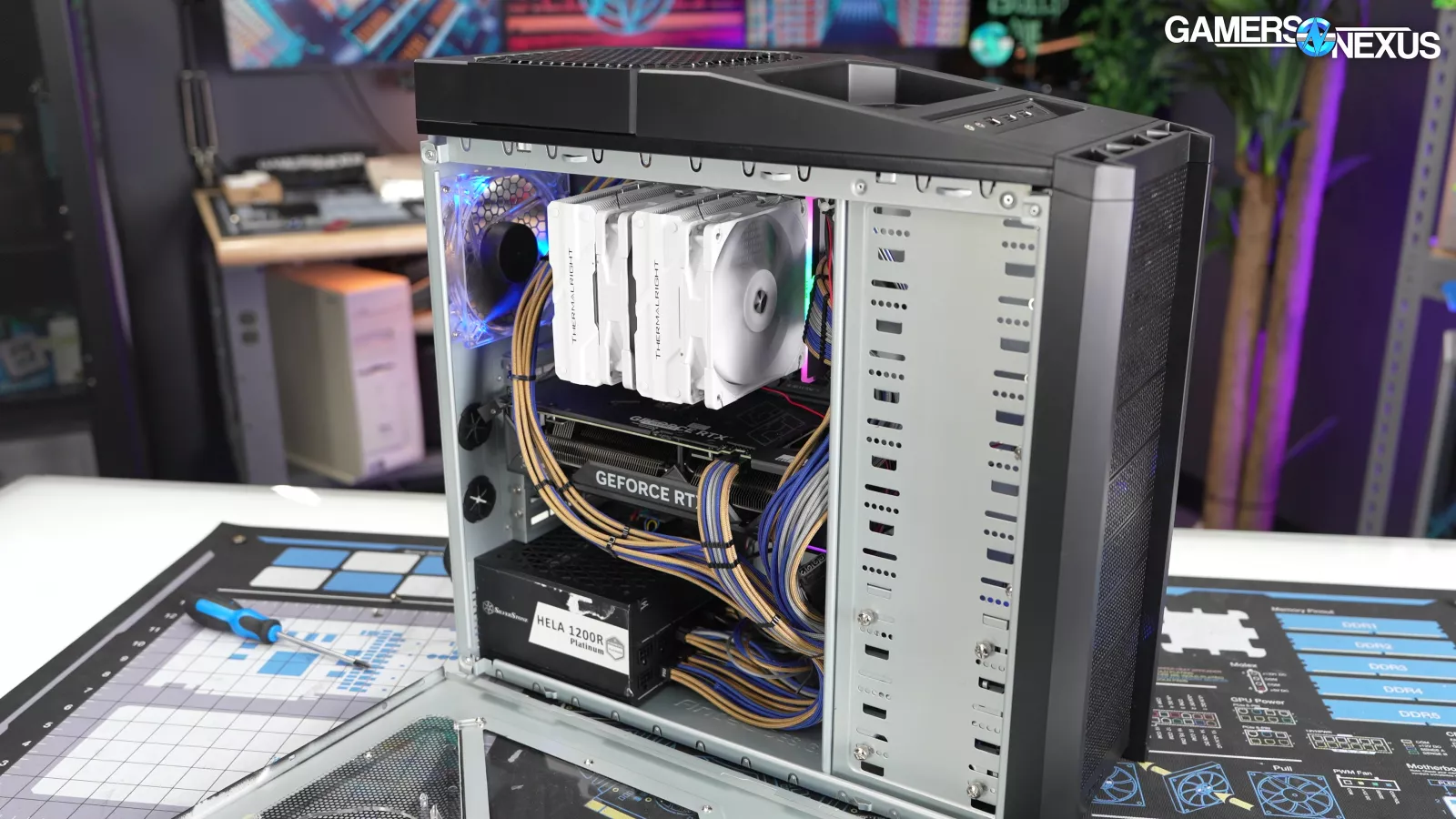
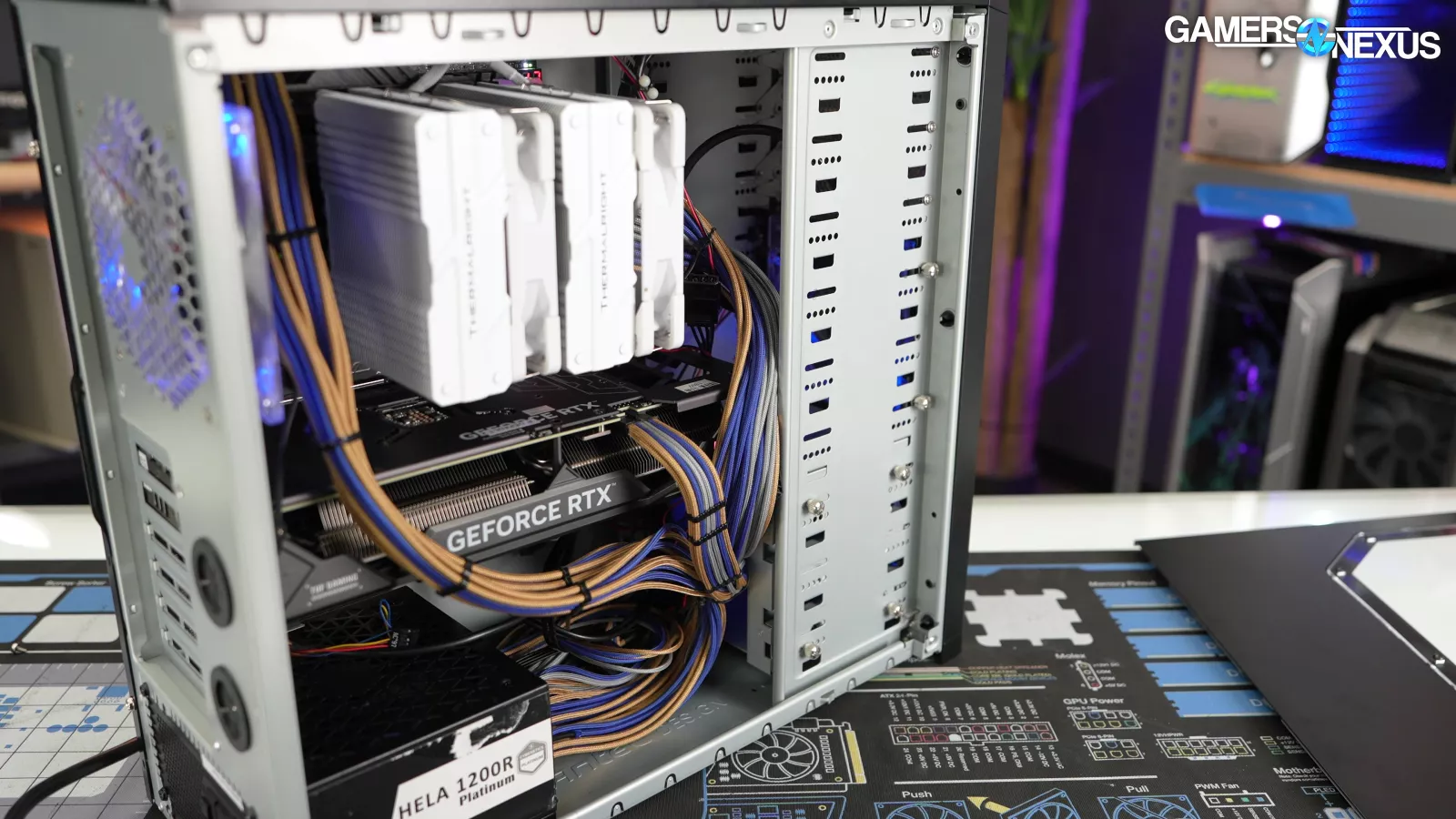
And just like our modern case reviews, we’ll do a full build with our modern case test bench in it, which barely fits. The old Nine Hundred was designed before the cards were called “RTX.” And actually, even “GTX” had only just become a name, and it was a suffix.
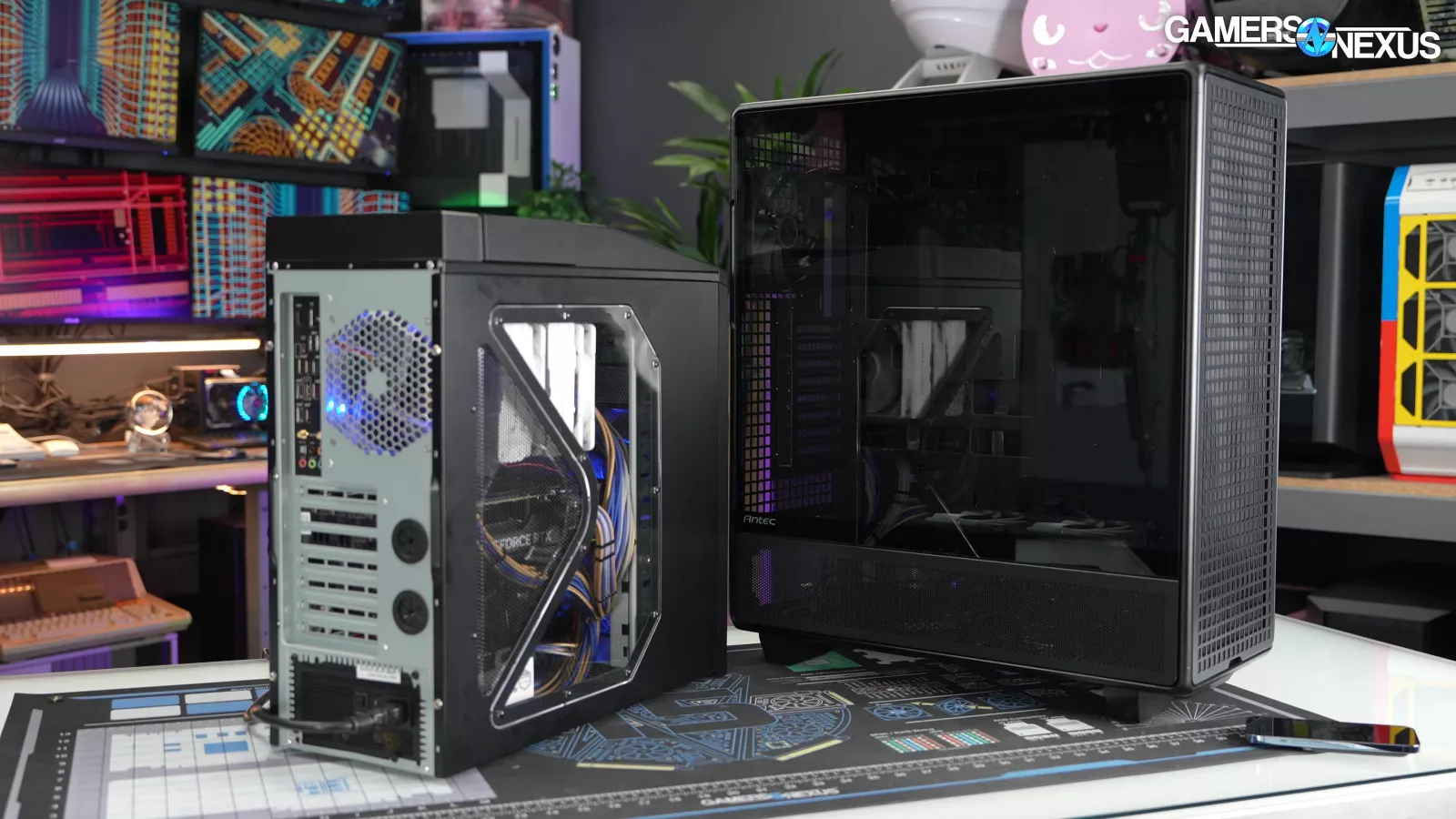
We’ll do a build in both the new and old 900s and talk build quality.
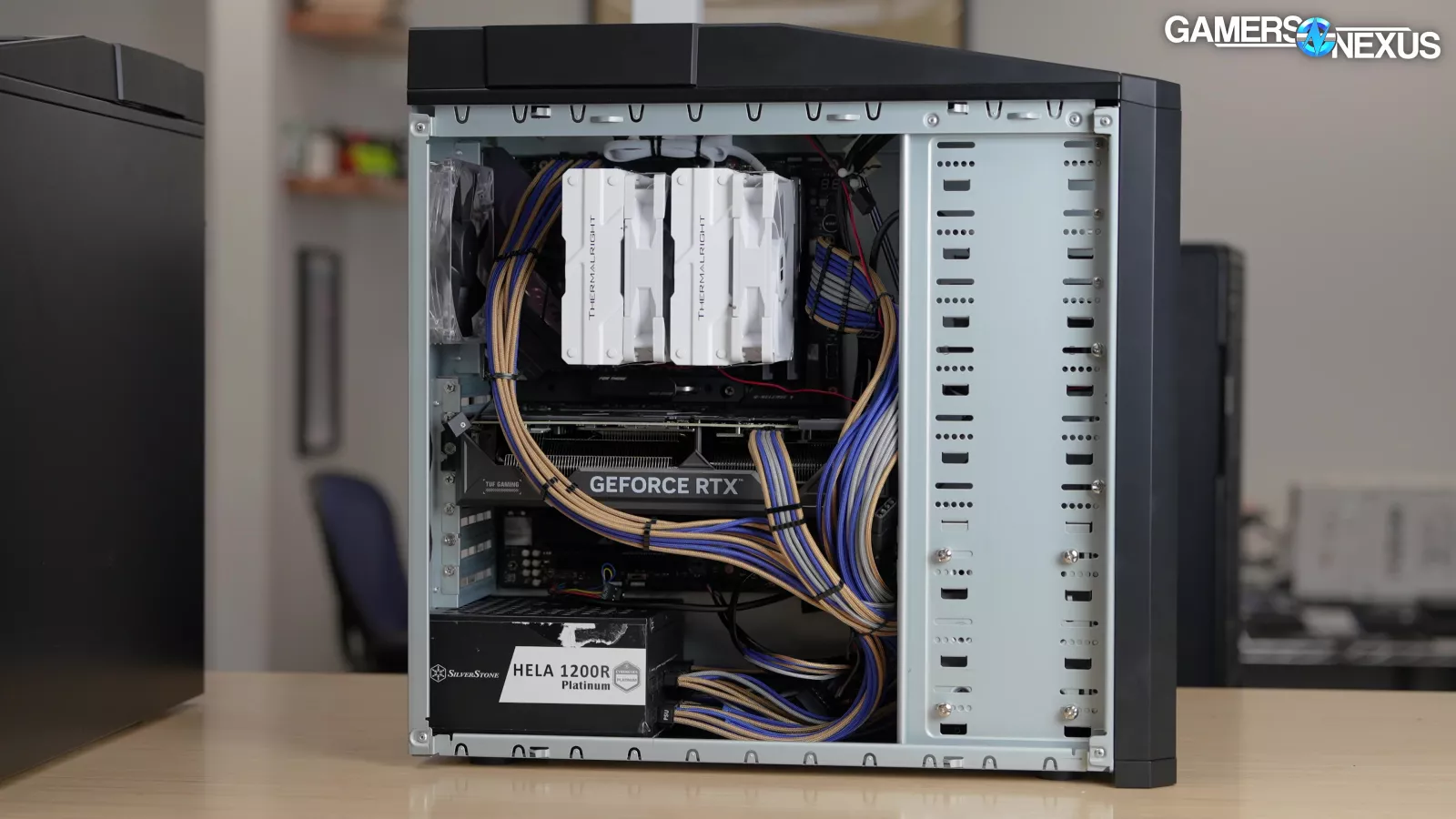
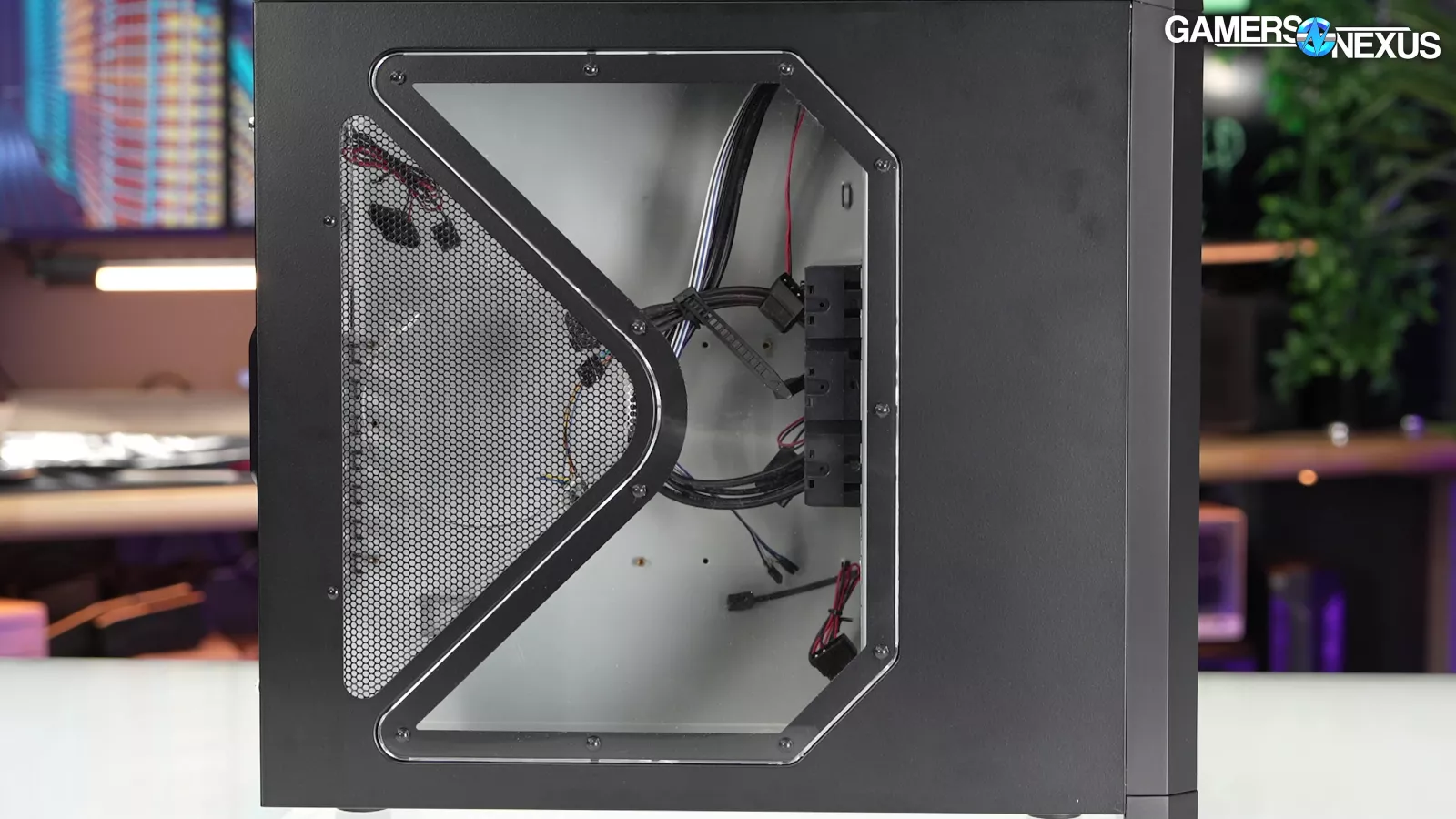
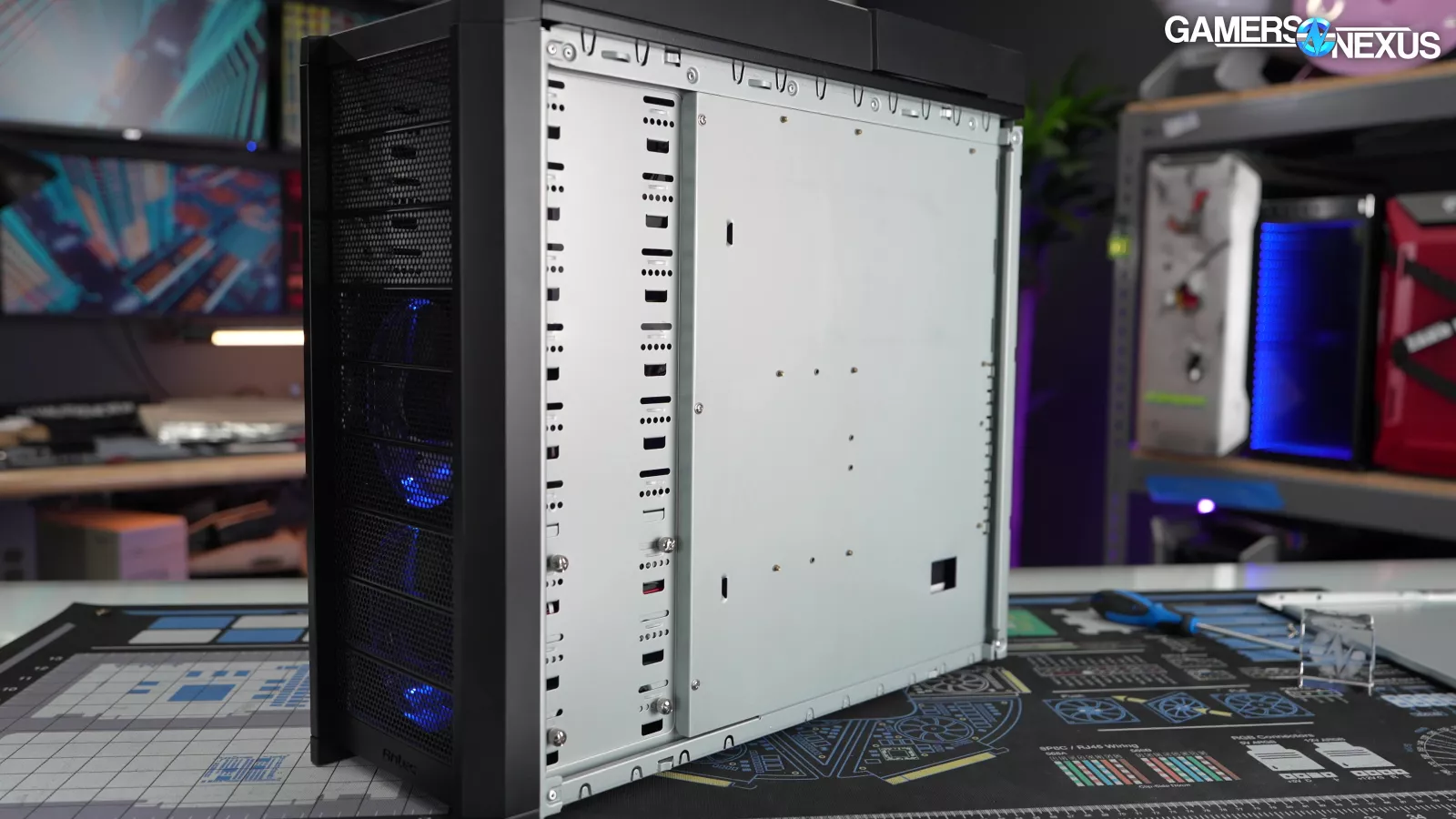
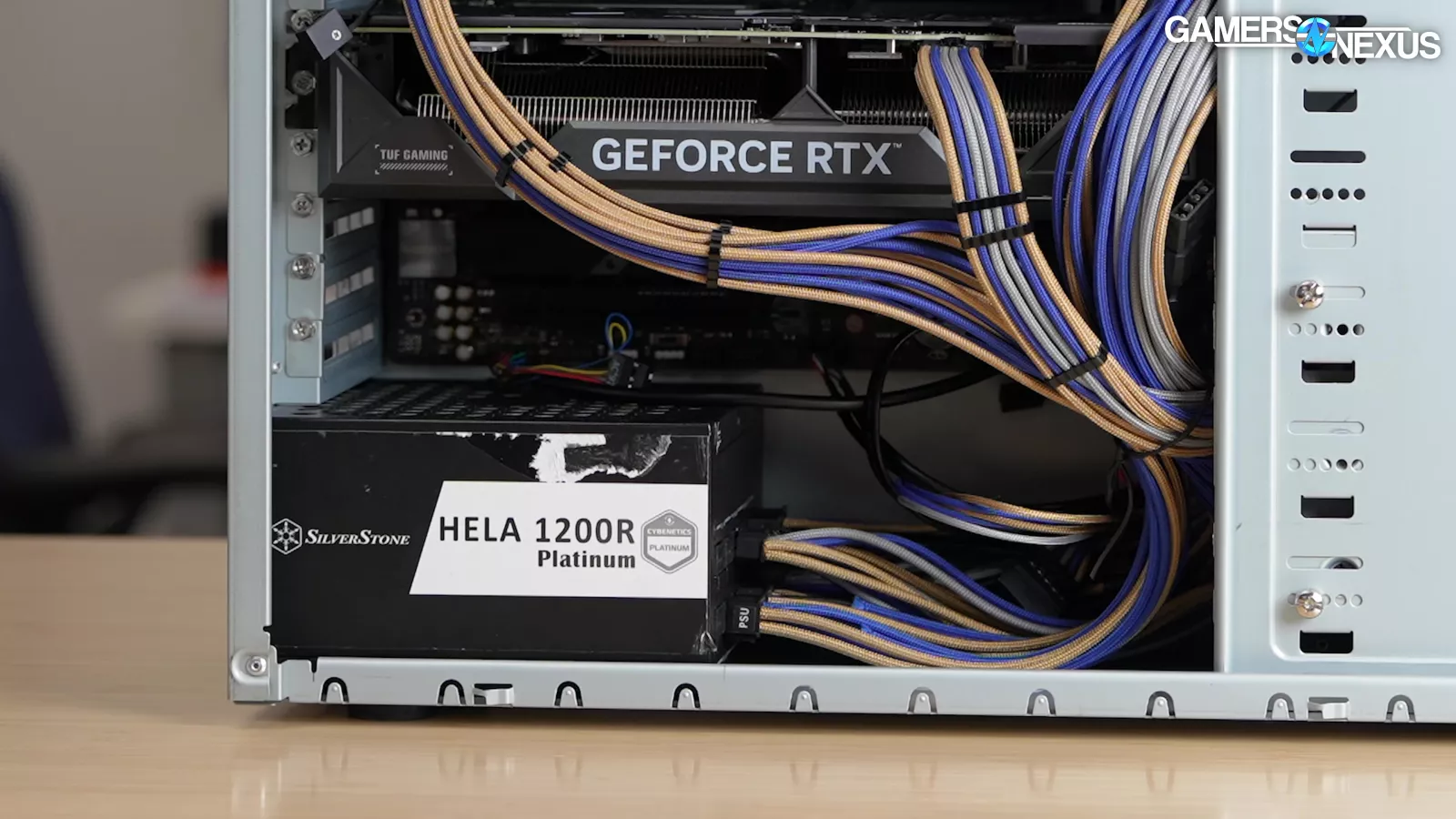
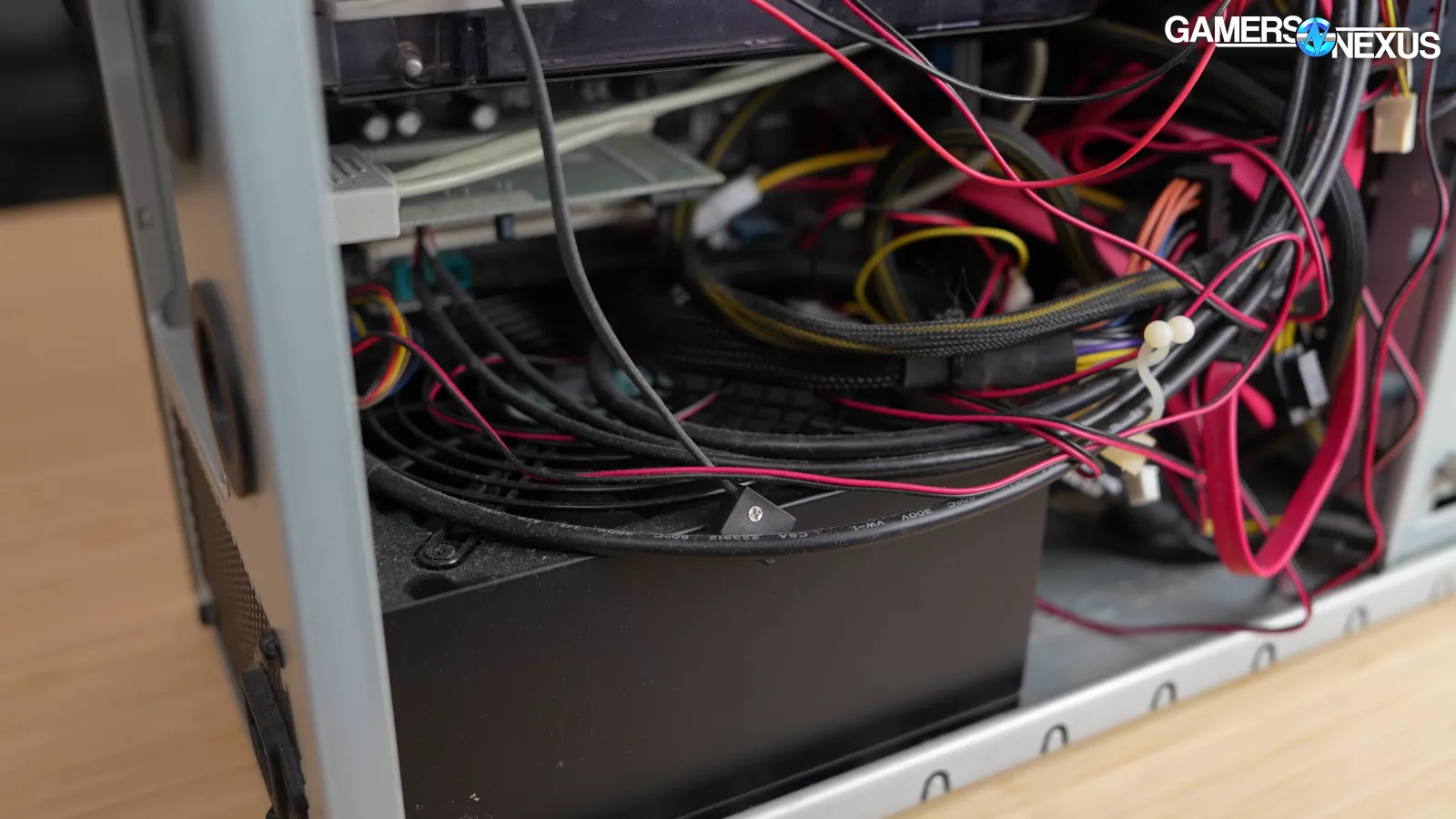
Building in the Nine Hundred, it's surprising how little things have changed. The main differences from a modern case are the unpainted interior, the easily-scratched acrylic side window, the number of drive mounts, and the complete and utter lack of cable management. This also predated the PSU shroud (at least in any popular form), which the Cooler Master HAF X began popularizing and which product designer Rob Teller’s NZXT H440 cemented as the modern meta.
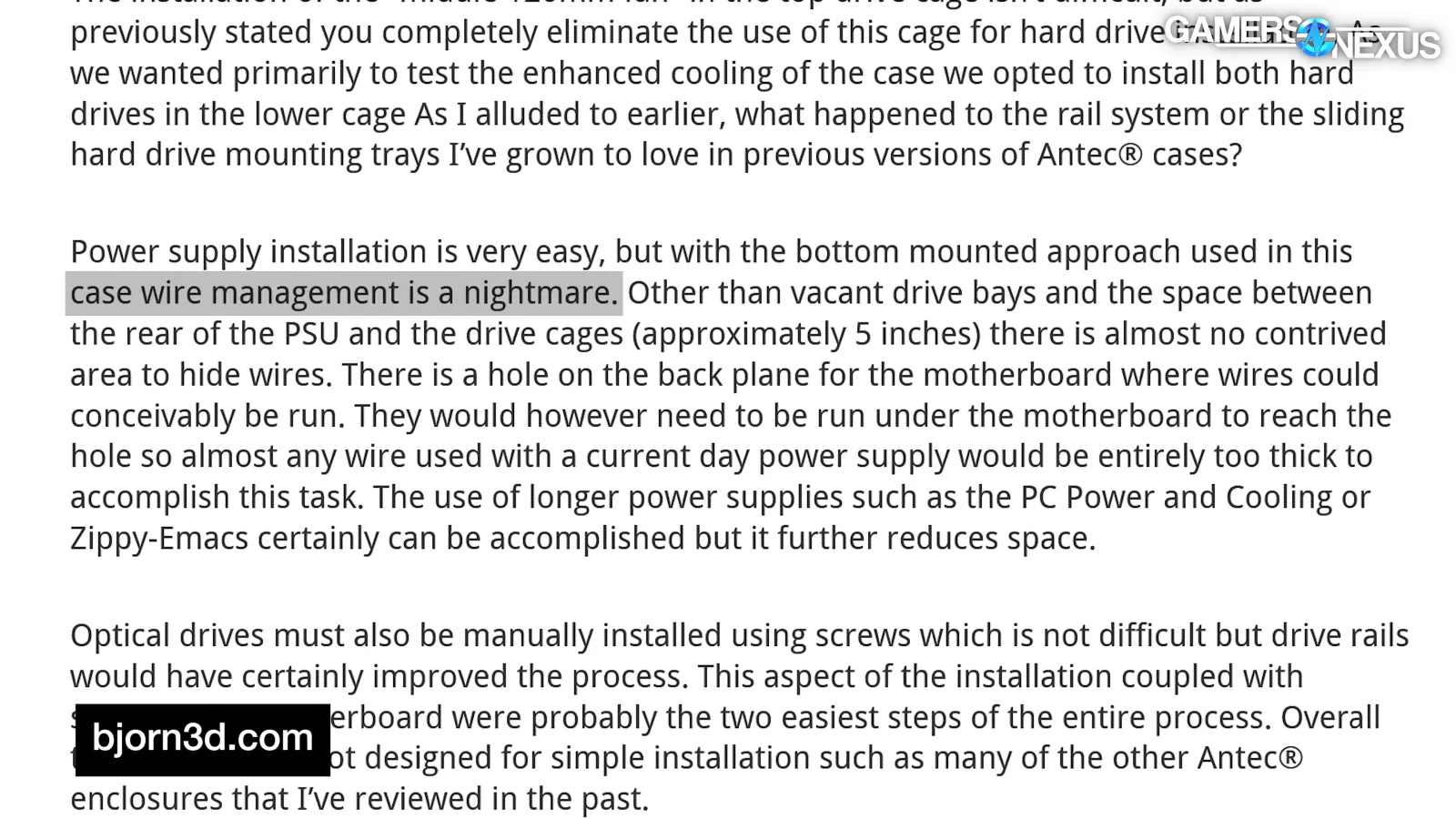
Even in 2006, Bjorn3D noted that "case wire management is a nightmare" and "there is almost no contrived area to hide wires."
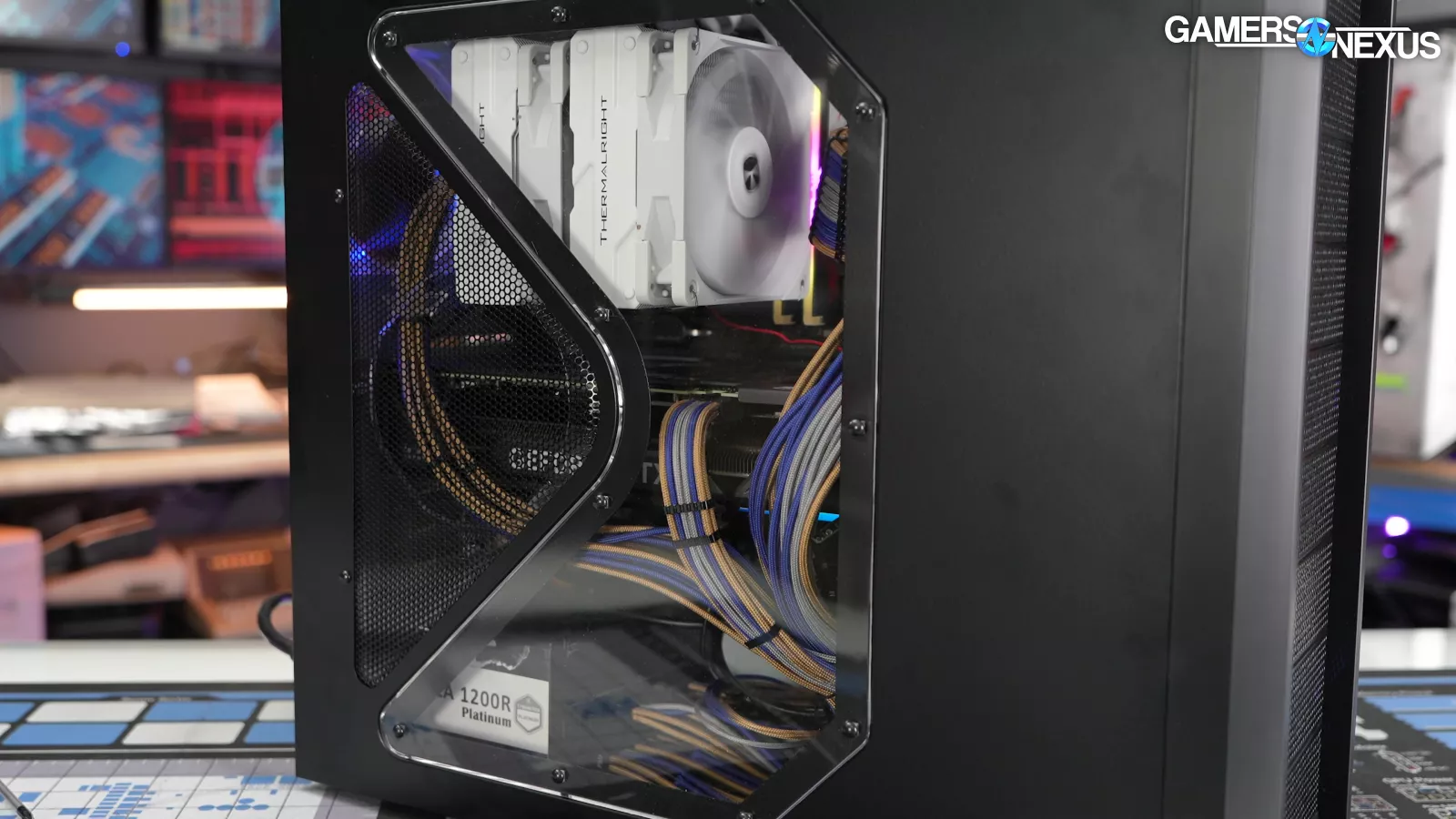
Part of this was due to bottom-mounting the PSU (which was unusual) to make room for a top fan, and part of it was because Antec didn't bother to add any cable cutouts whatsoever.
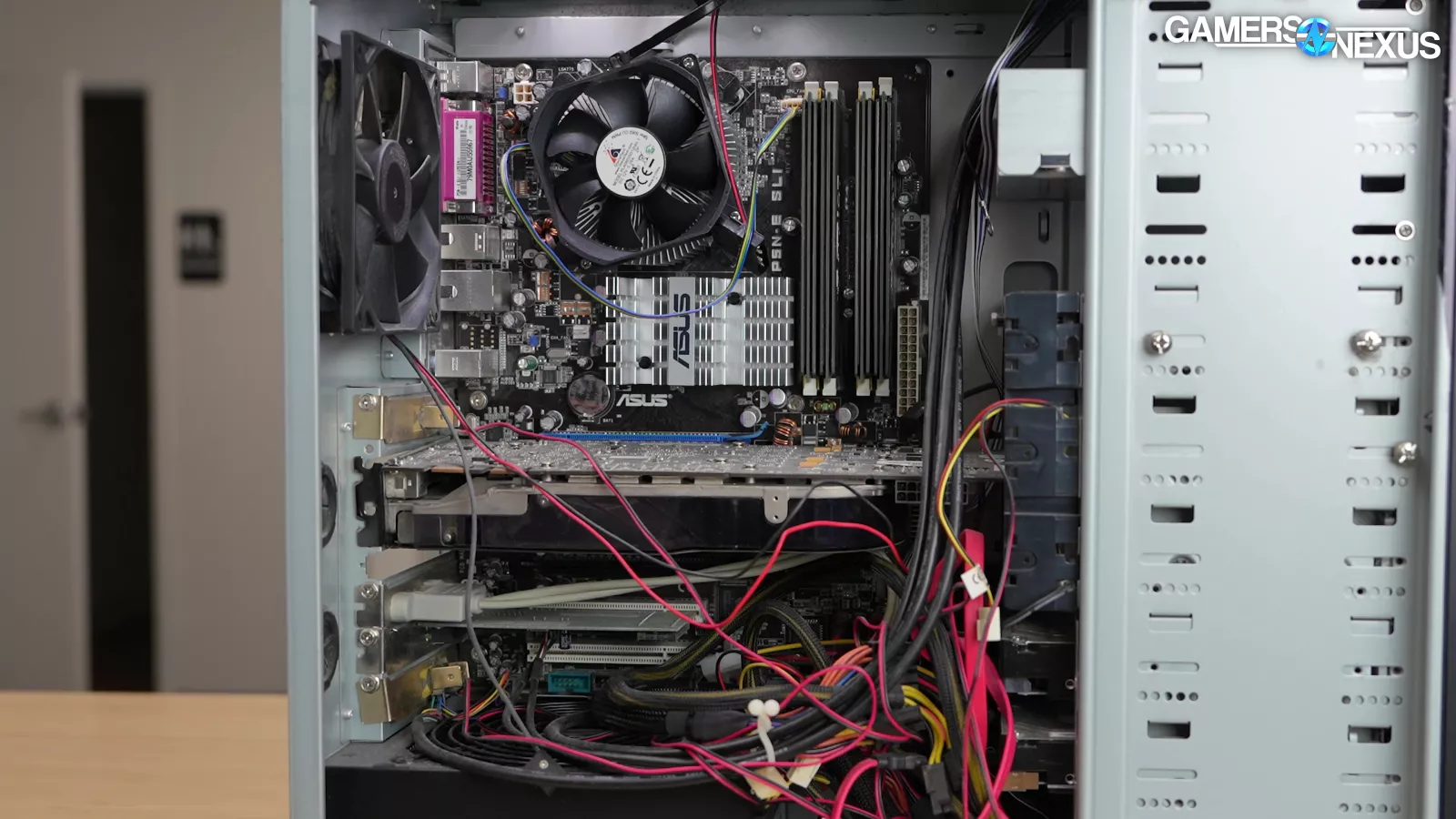
CPU power connectors were appearing on motherboards by then (EPS12V wasn’t as prevalent as it is today), but position wasn’t standardized and usually they were inconveniently placed for bottom-mounted PSUs, as Techgage pointed out in its review.
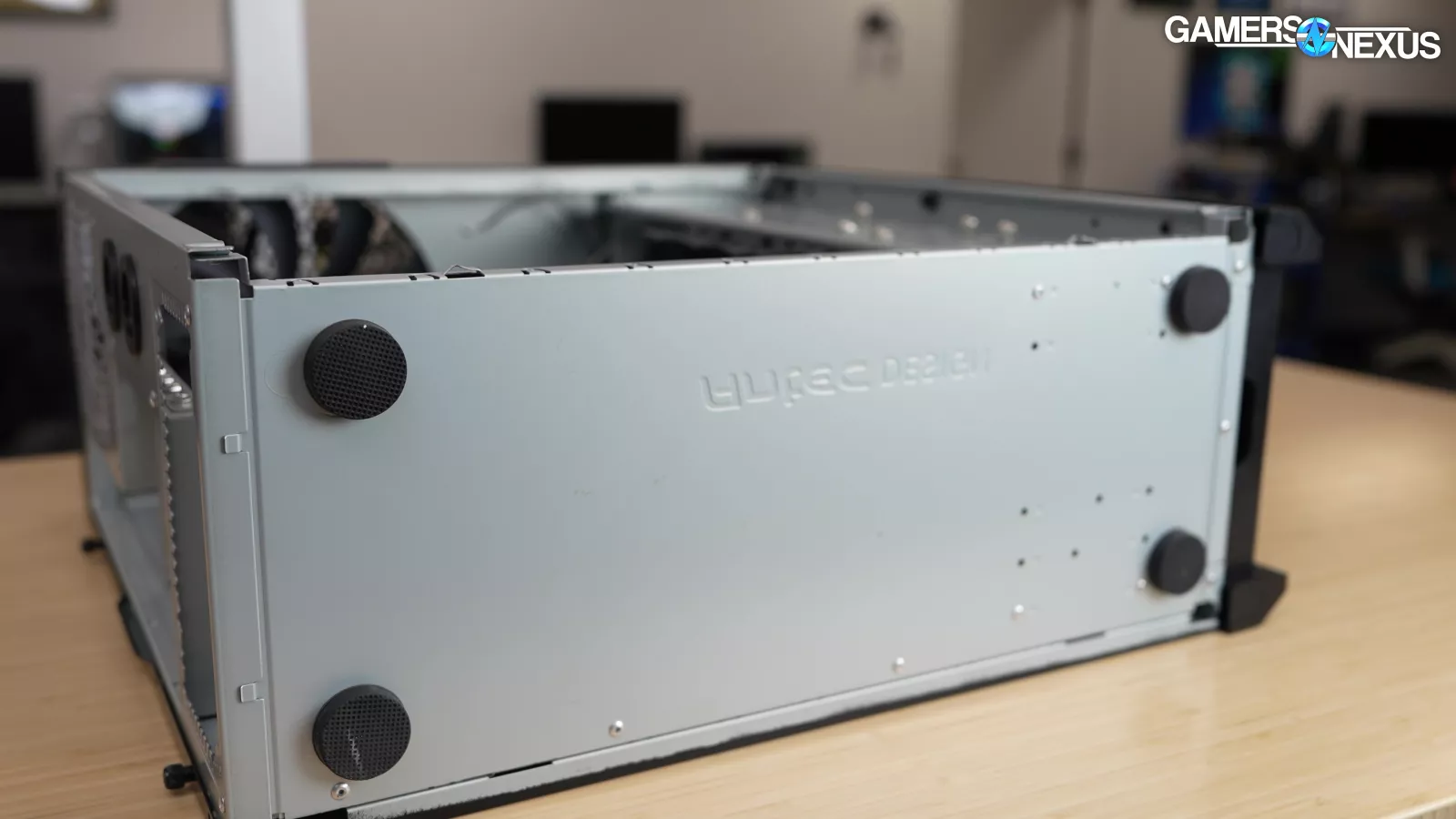
Antec also hadn't figured out ventilation for the bottom of the case yet, so PSUs had to go fan-side-up internally.
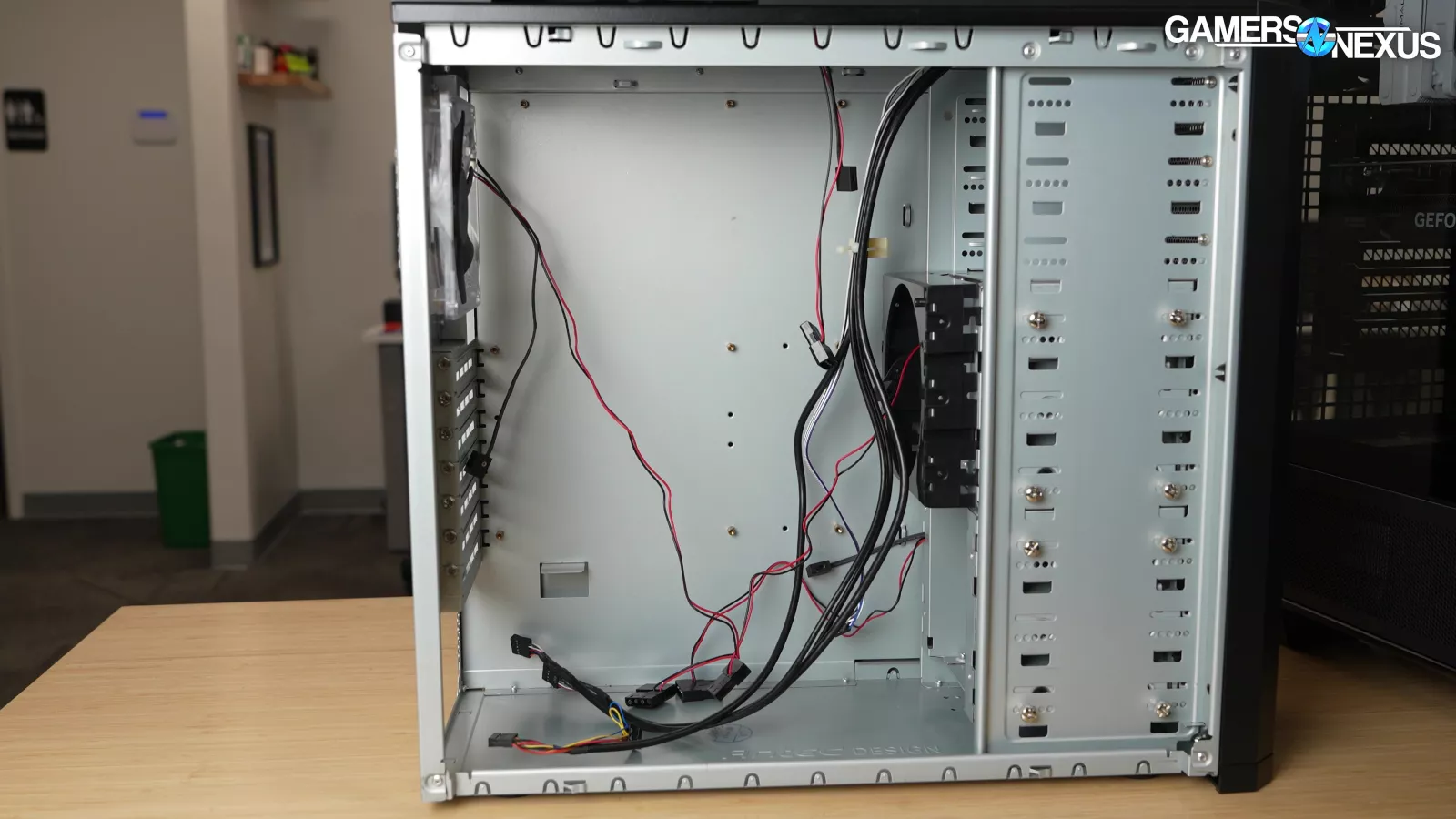
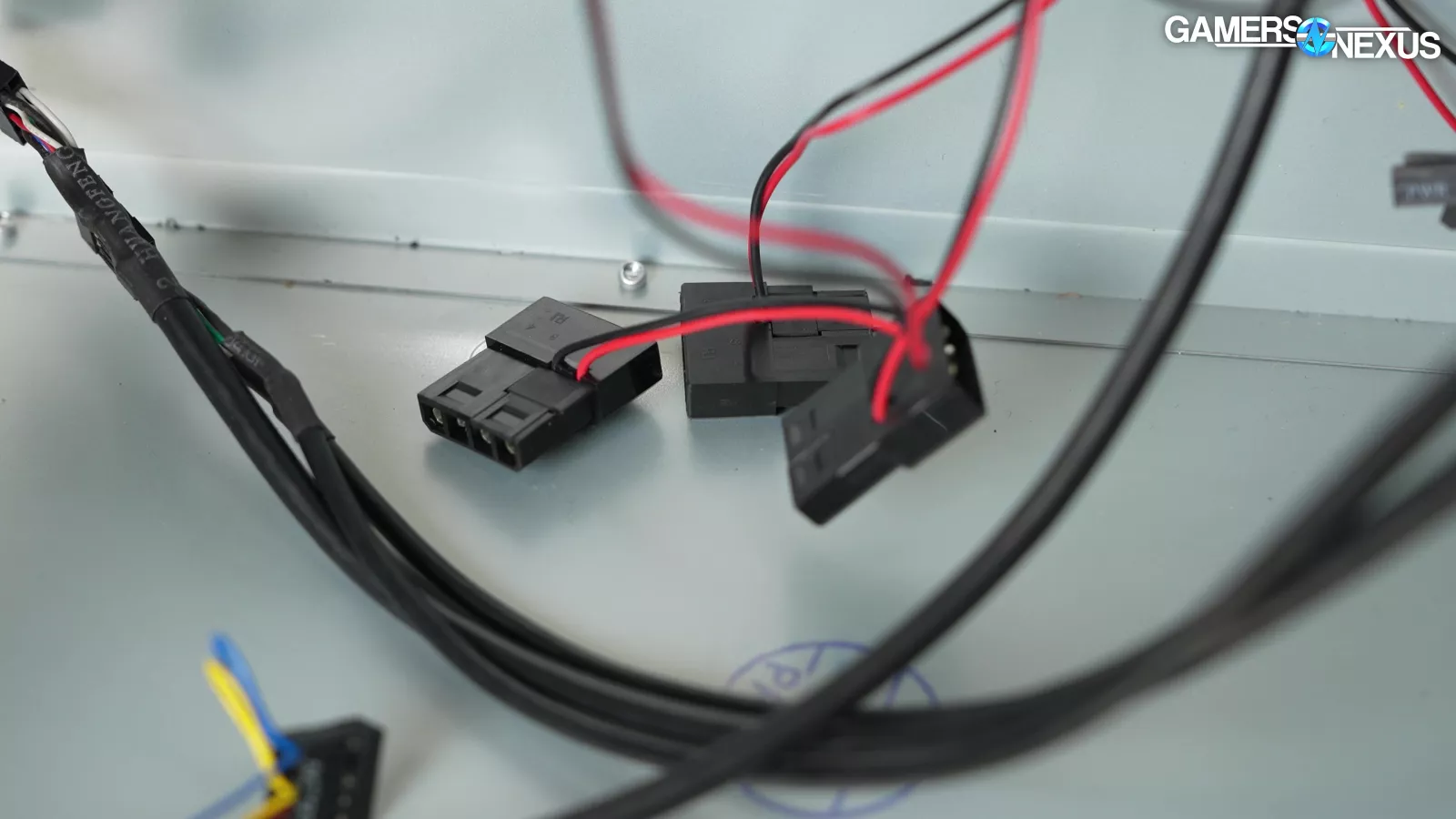
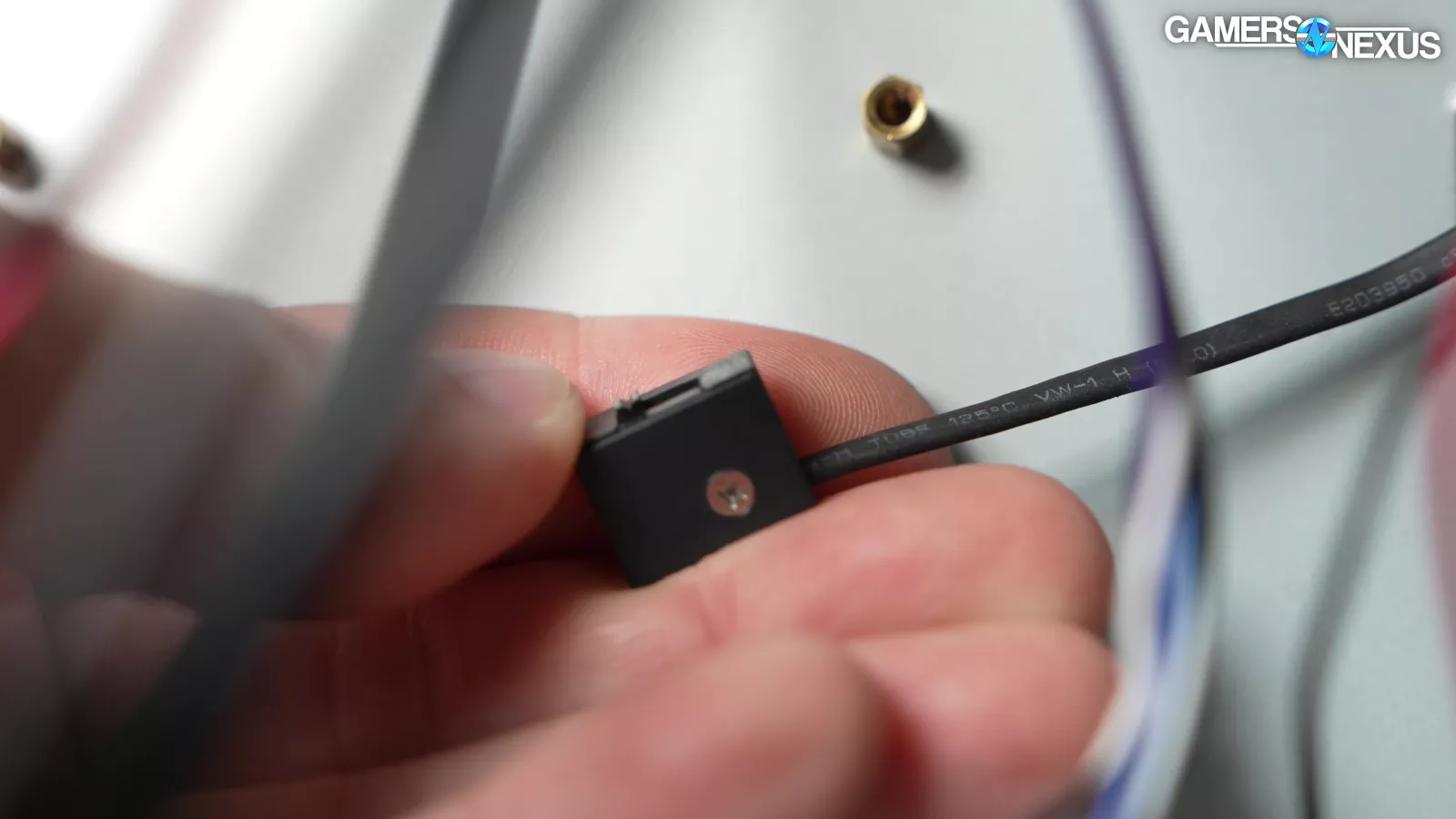
The four stock fans all take four-pin Molex power, with speed control only possible through switches connected to each fan (or a vintage fan controller).
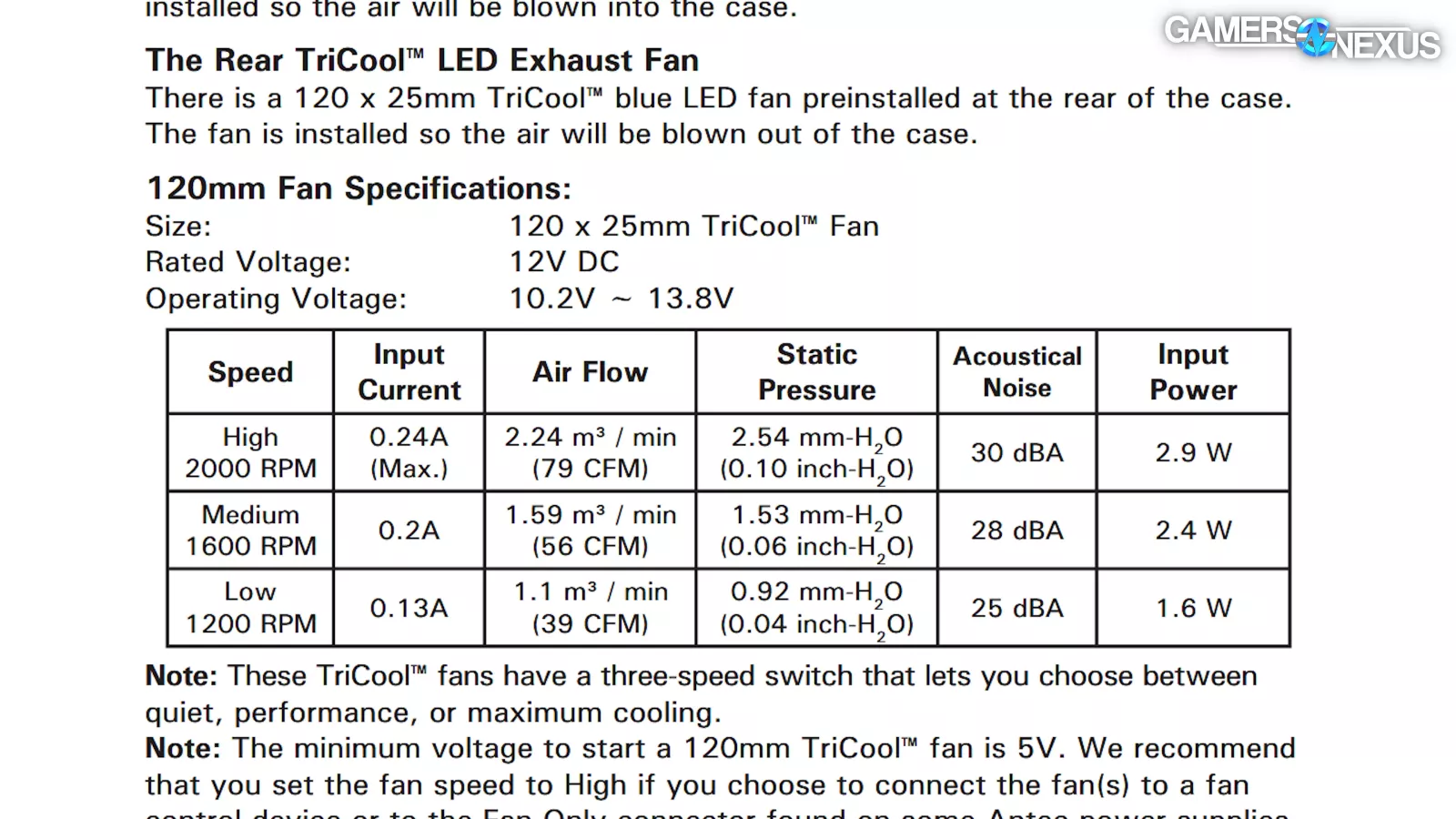
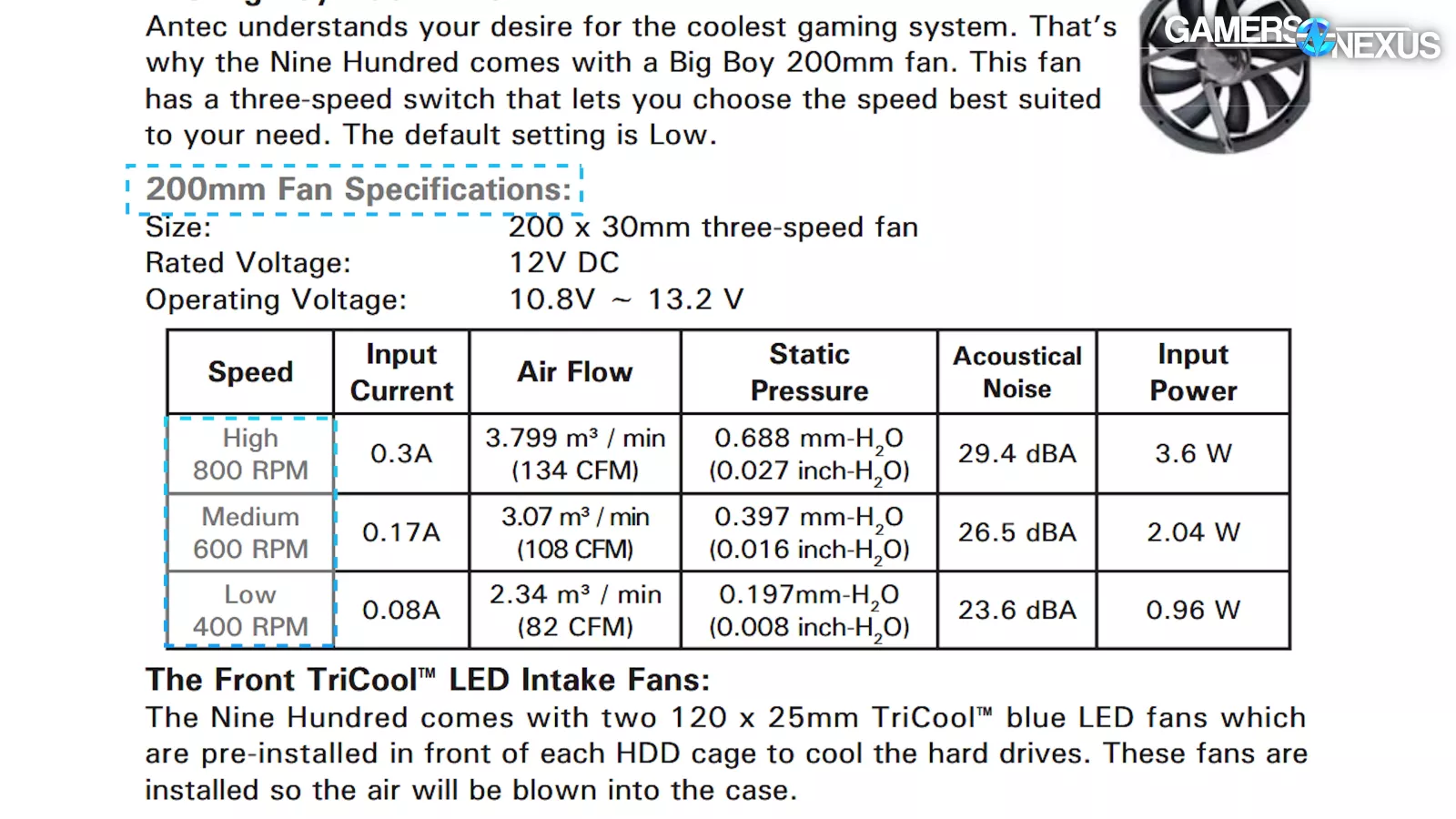
According to the manual, these switches can set 1200/1600/2000RPM for the 120mm fans and 400/600/800RPM for the 200mm fan.
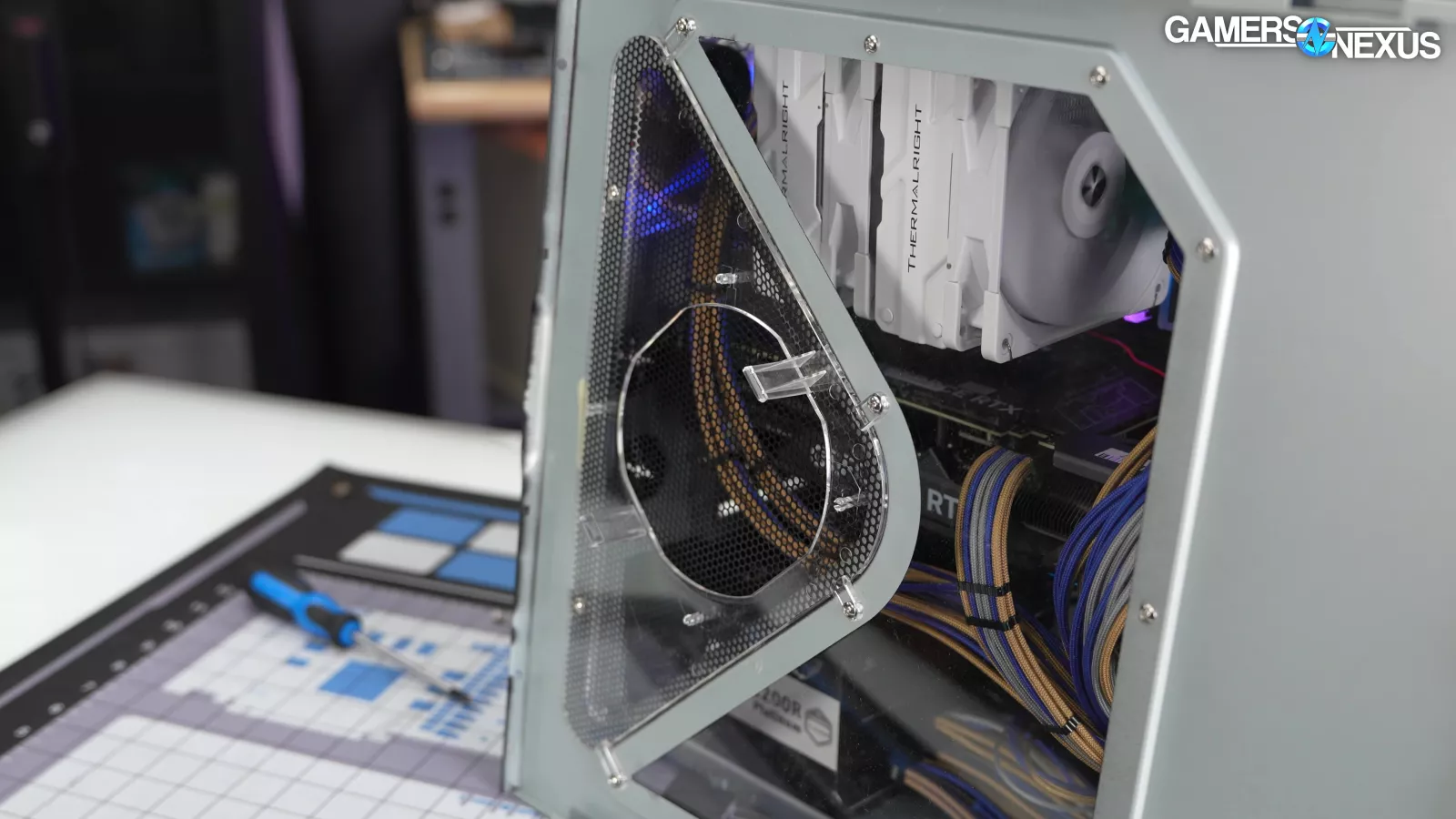
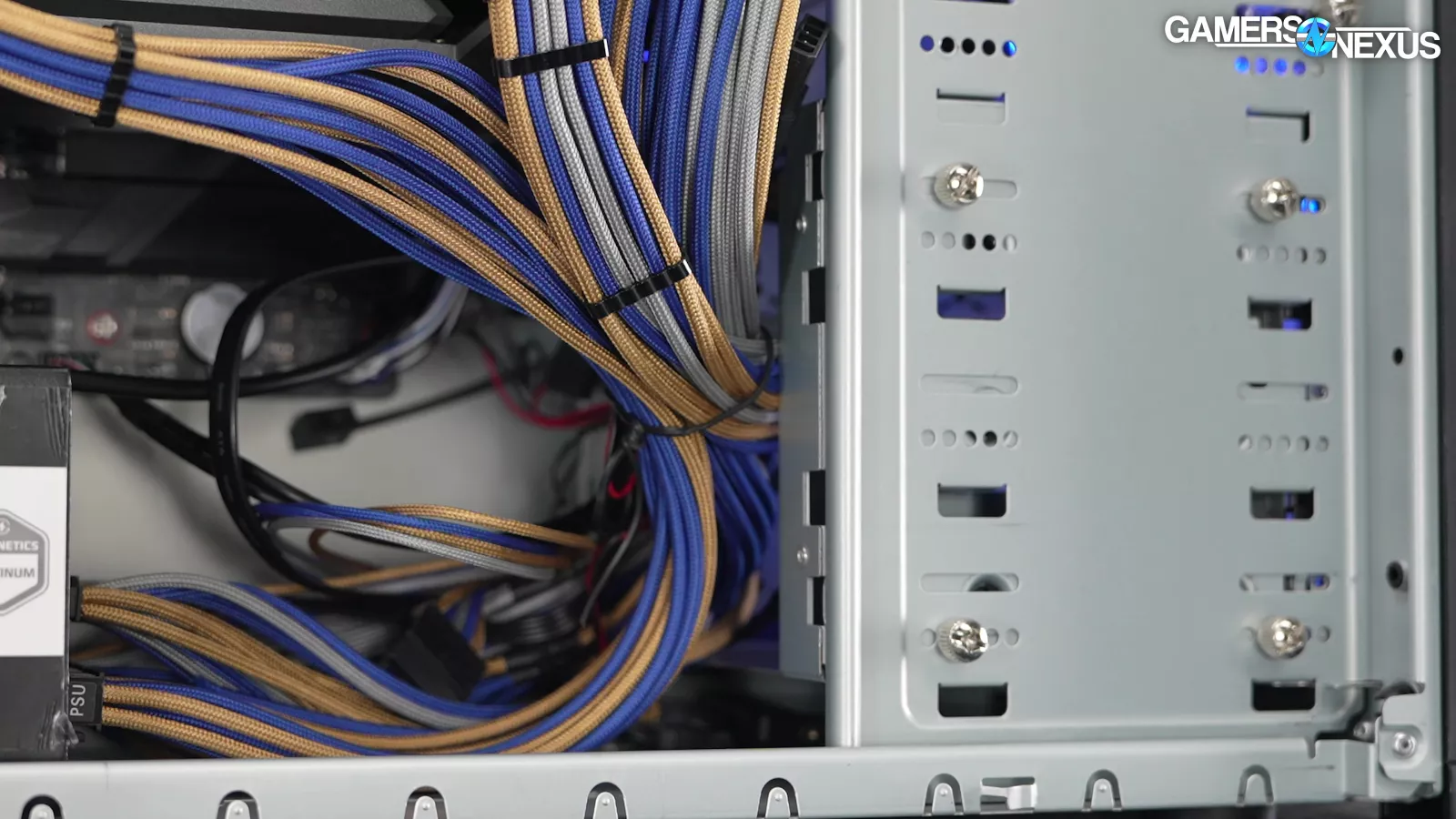
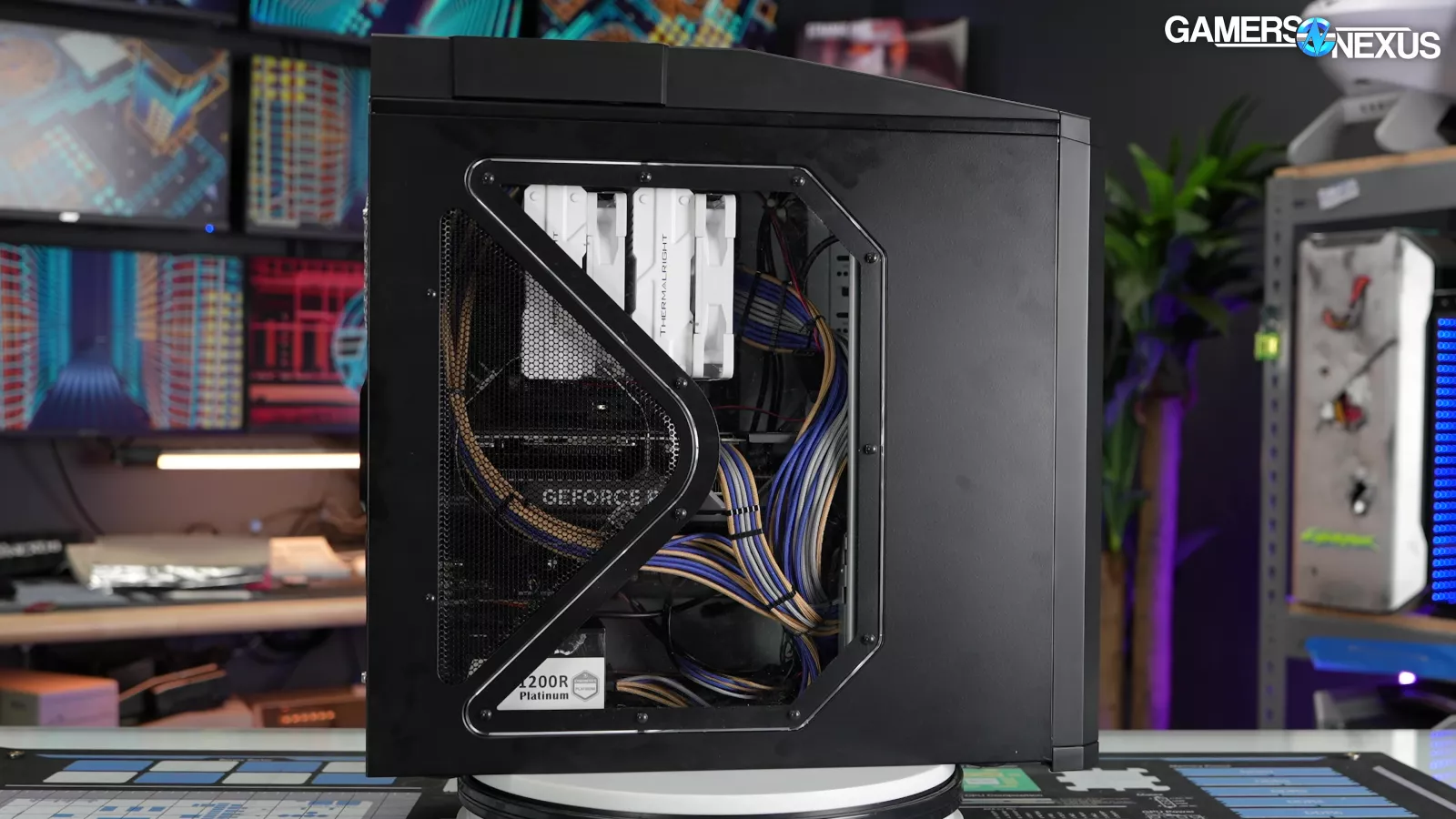
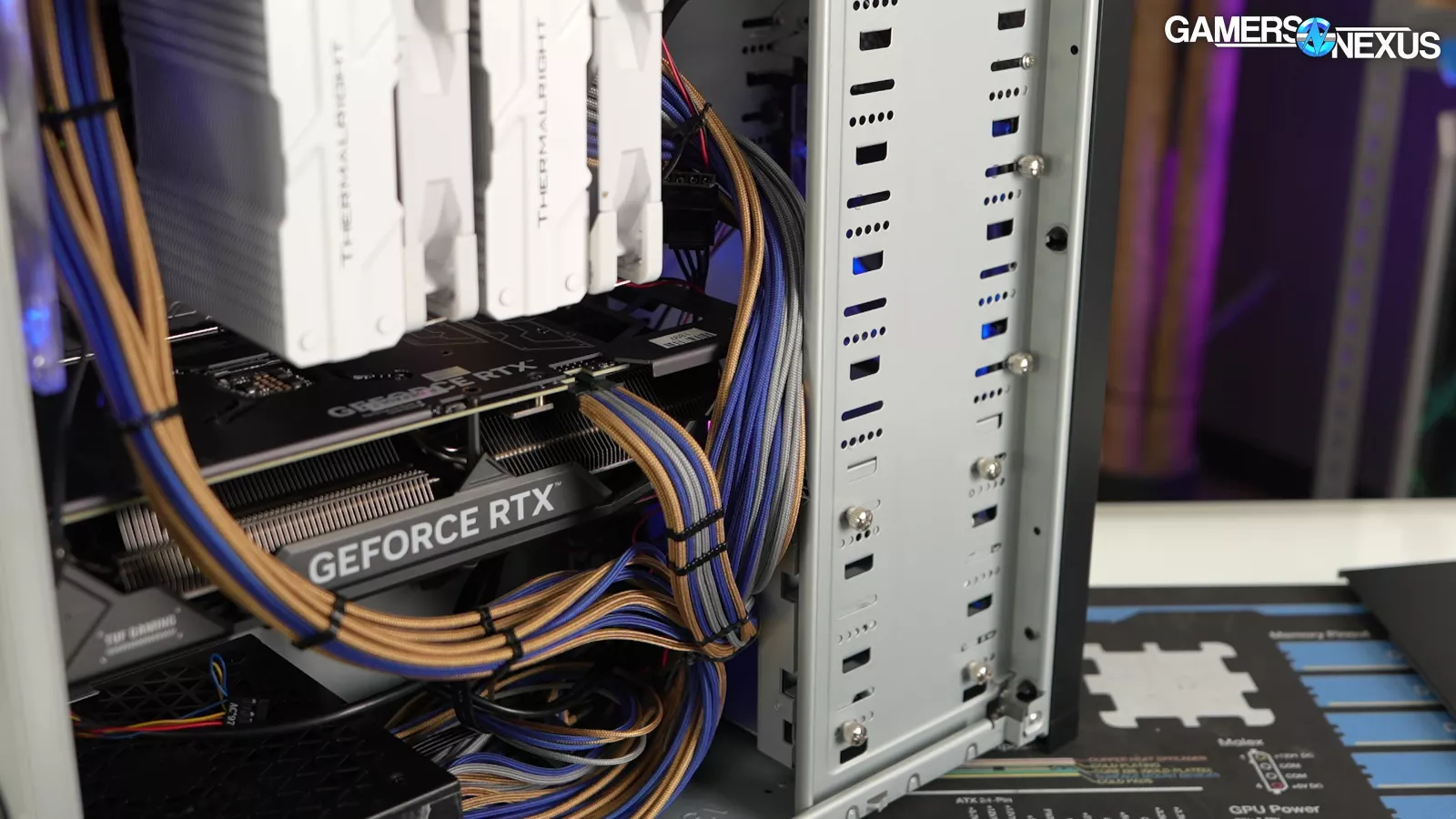
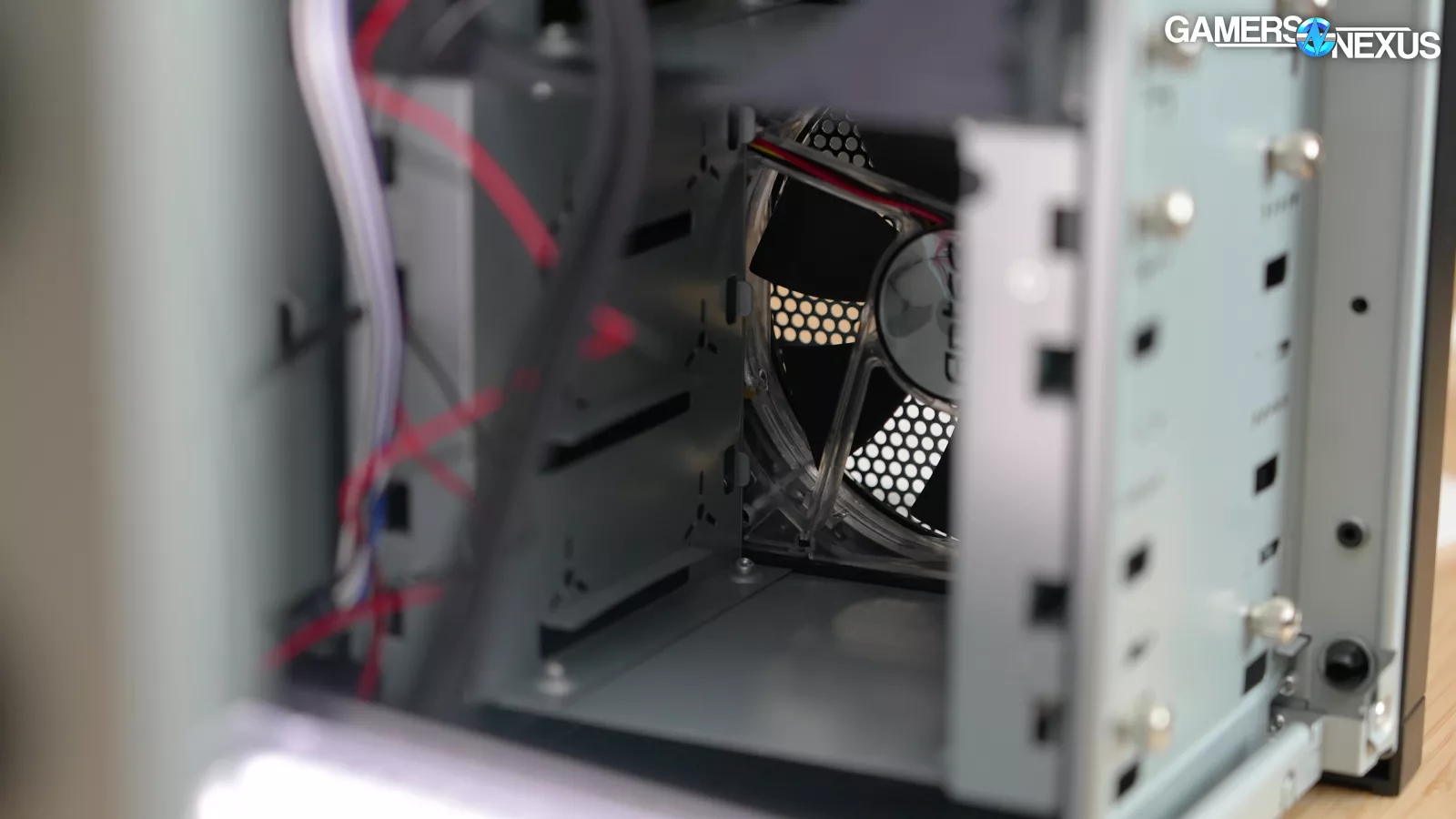
There are additional 120mm fan mounts on the side panel and on the back of one of the HDD cages, but both of these are unusable with our test hardware due to clearance issues. Modern tower coolers don’t allow the side fan to fit and modern video cards don’t leave clearance for the drive cage fan.
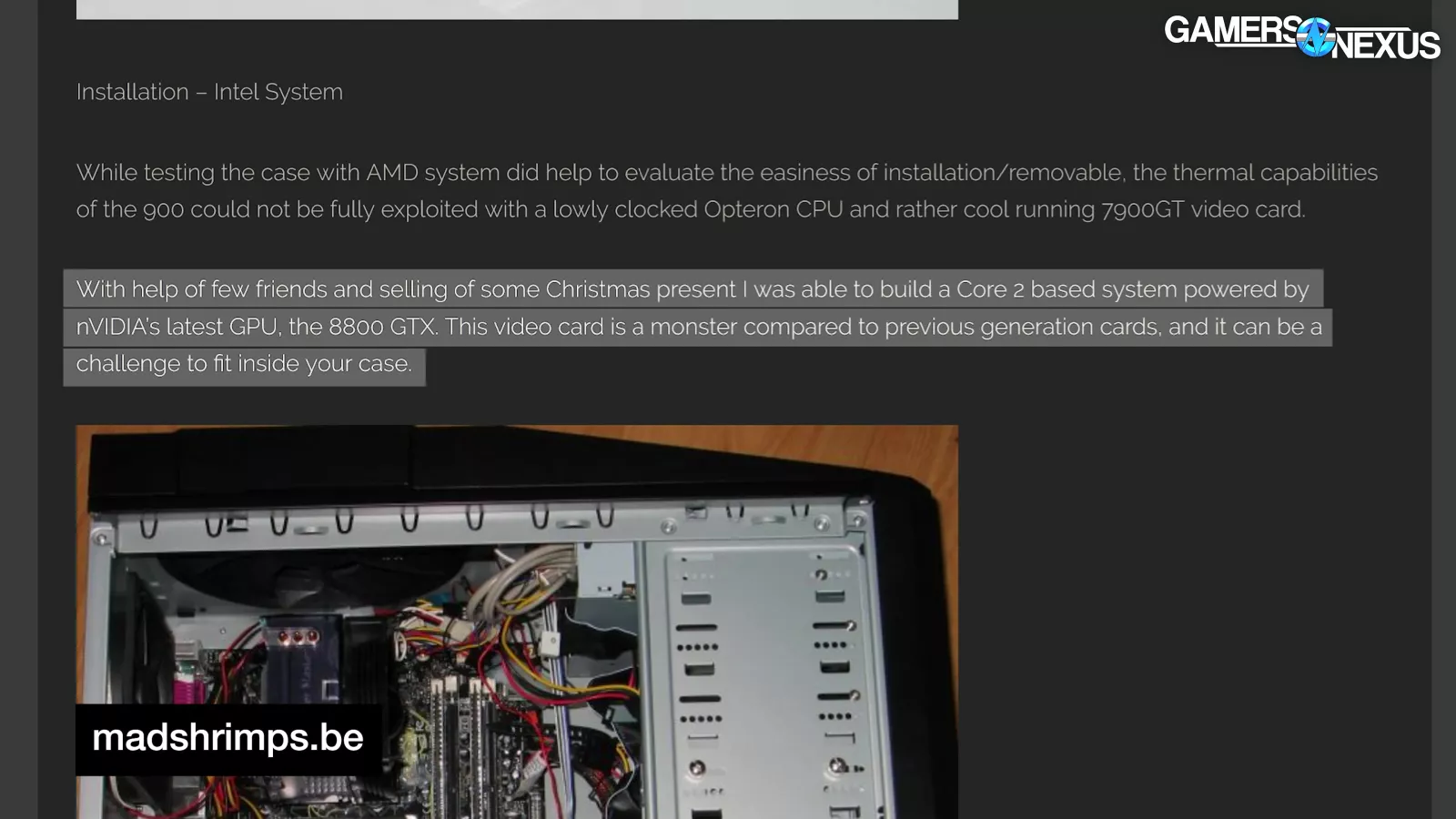
But, according to Madshrimps, this was an issue even back then with an 8800 GTX.
Interestingly, and we didn’t know this before researching for this revisit, Antec apparently had to recall and relaunch the Nine Hundred. There were also multiple revisions of the case that made small tweaks.
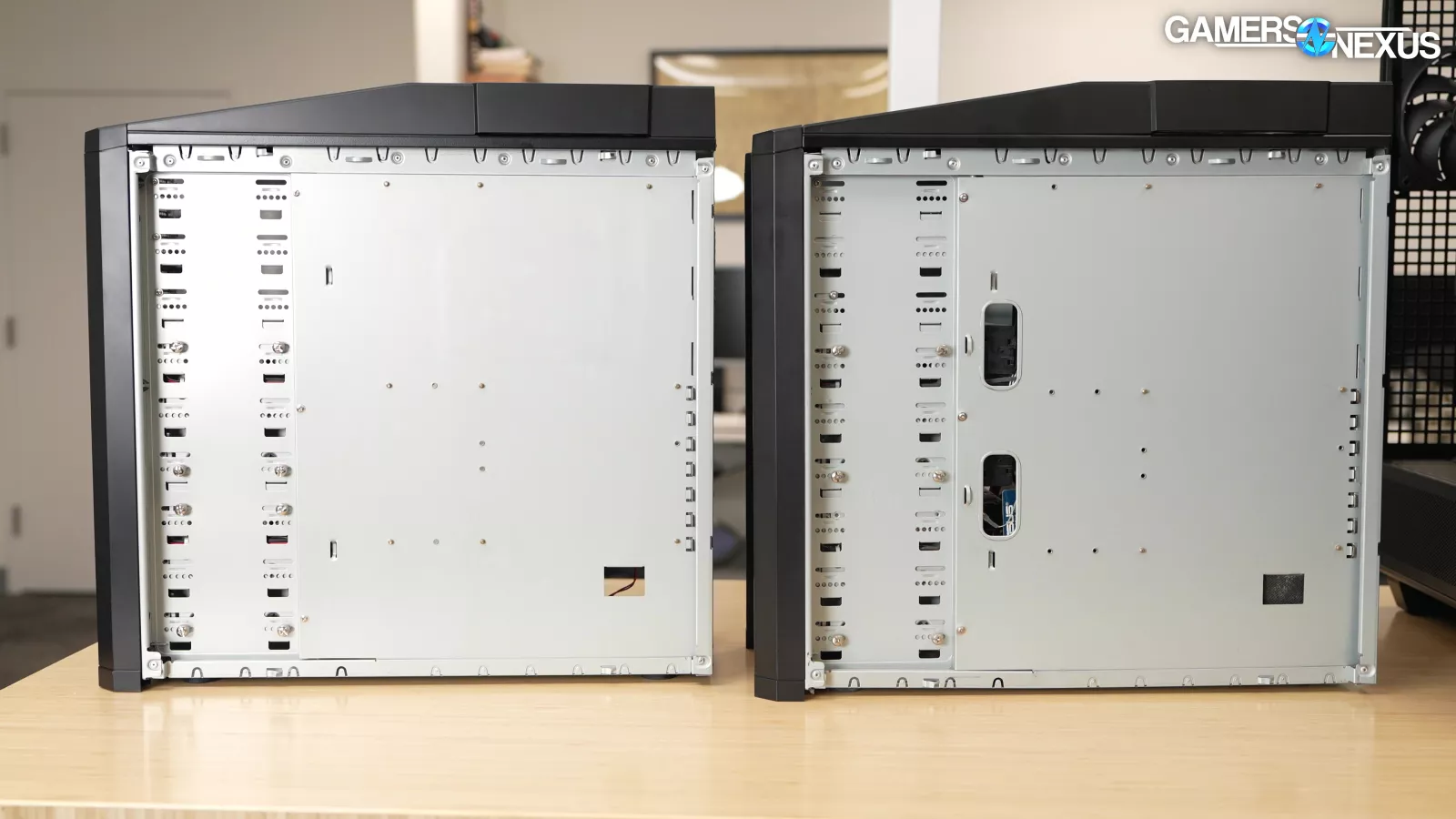
For instance, when we got viewer Tyler’s case in, we noticed some cable management cutouts in the newer revision.
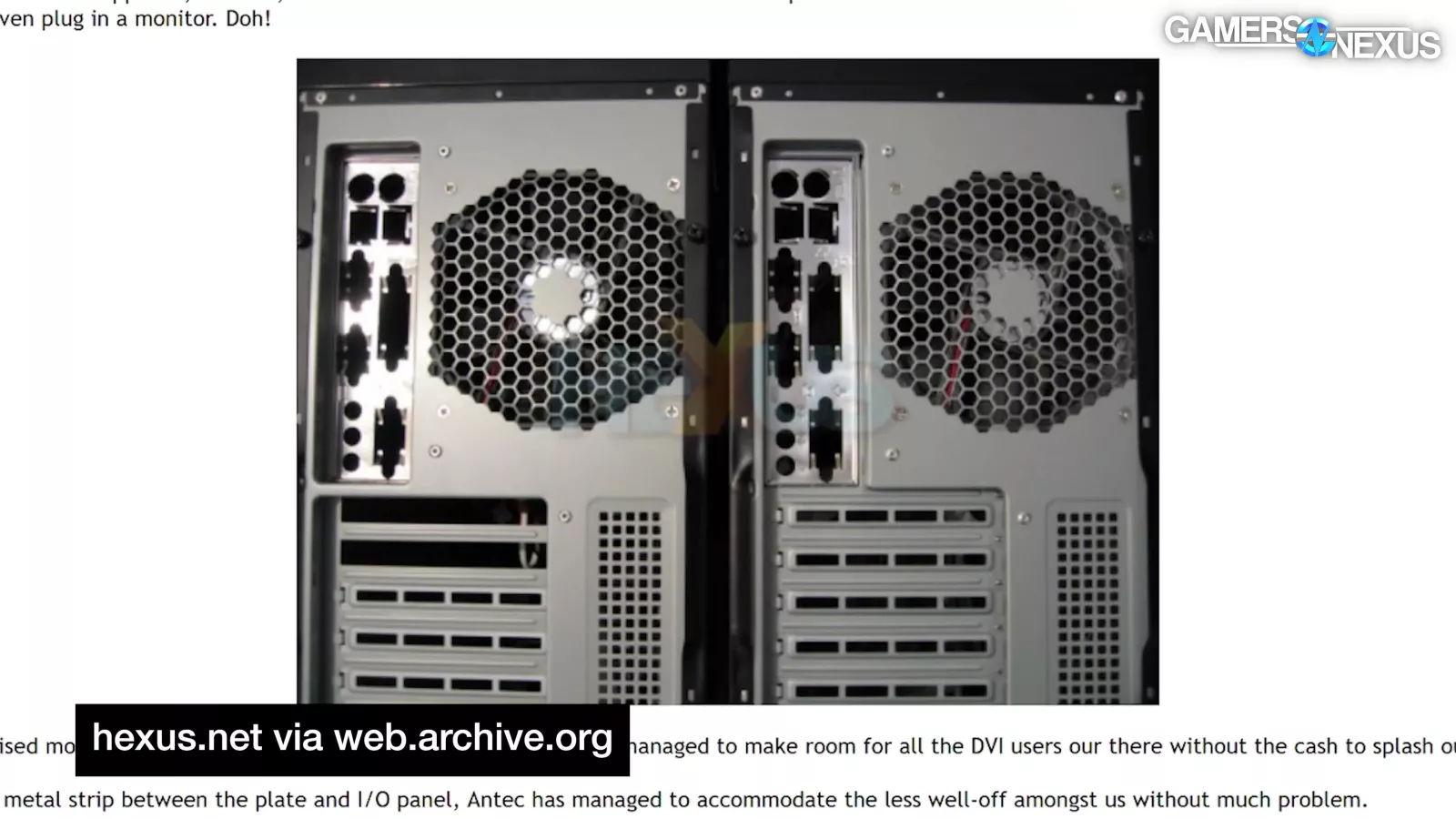
Our 2007 revision also includes rear cutouts for external water cooling, which weren't in the original review units.
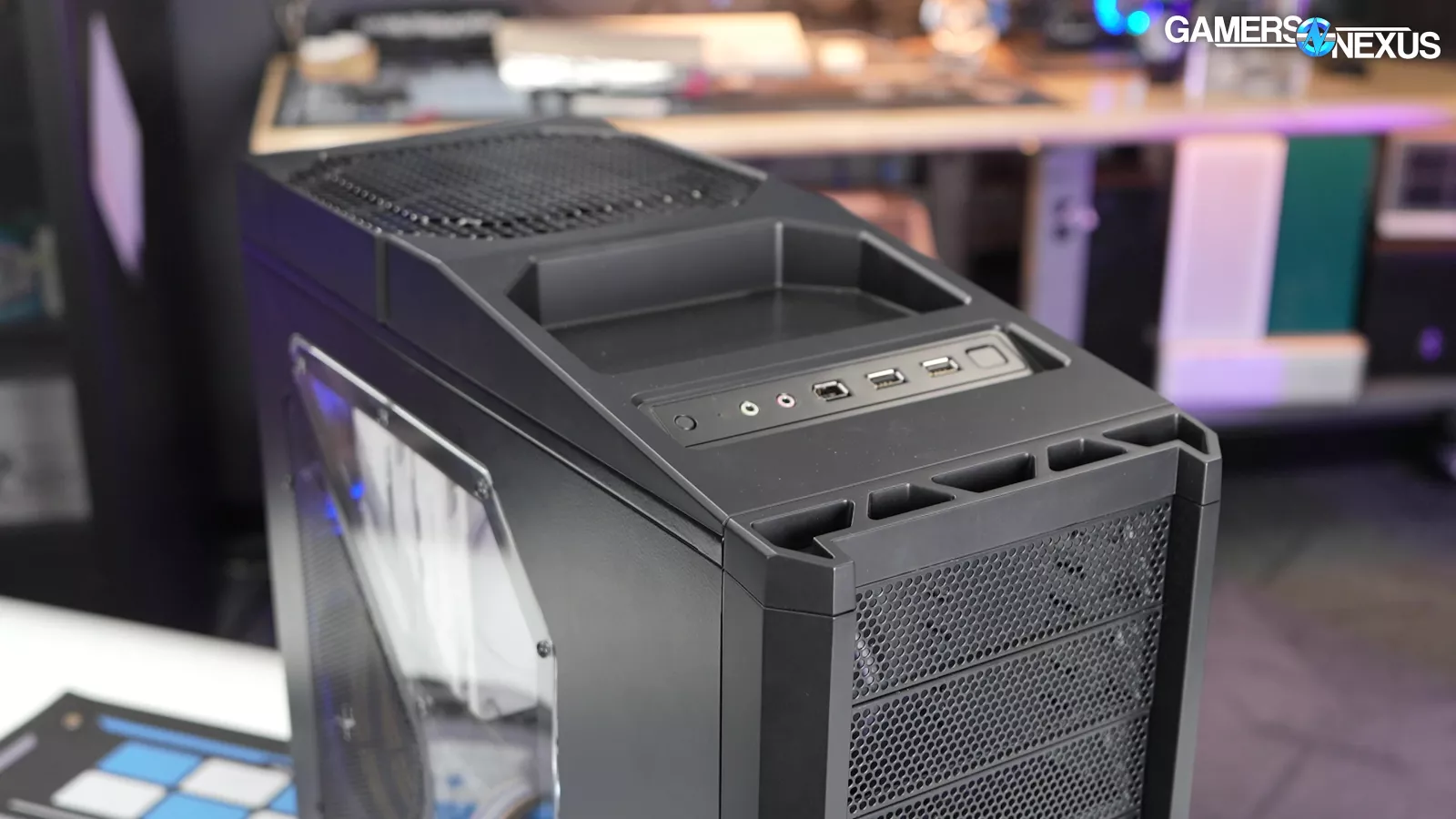
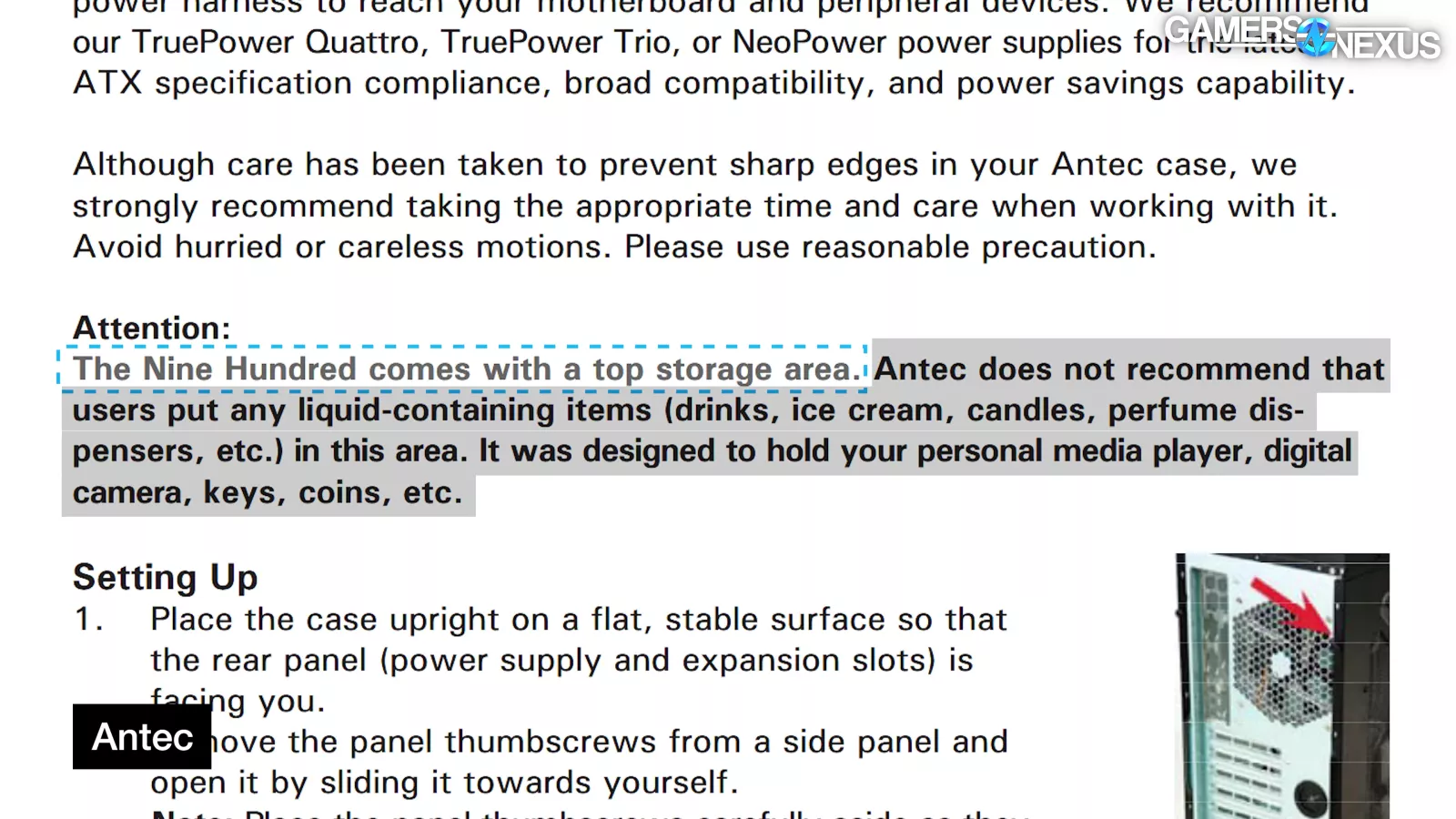
Reviewers of the era liked the top storage area. In the manual, Antec says it "does not recommend that users put any liquid-containing items (drinks, ice cream, candles, perfume dispensers, etc.) in this area. It was designed to hold your personal media player, digital camera, keys, coins, etc."
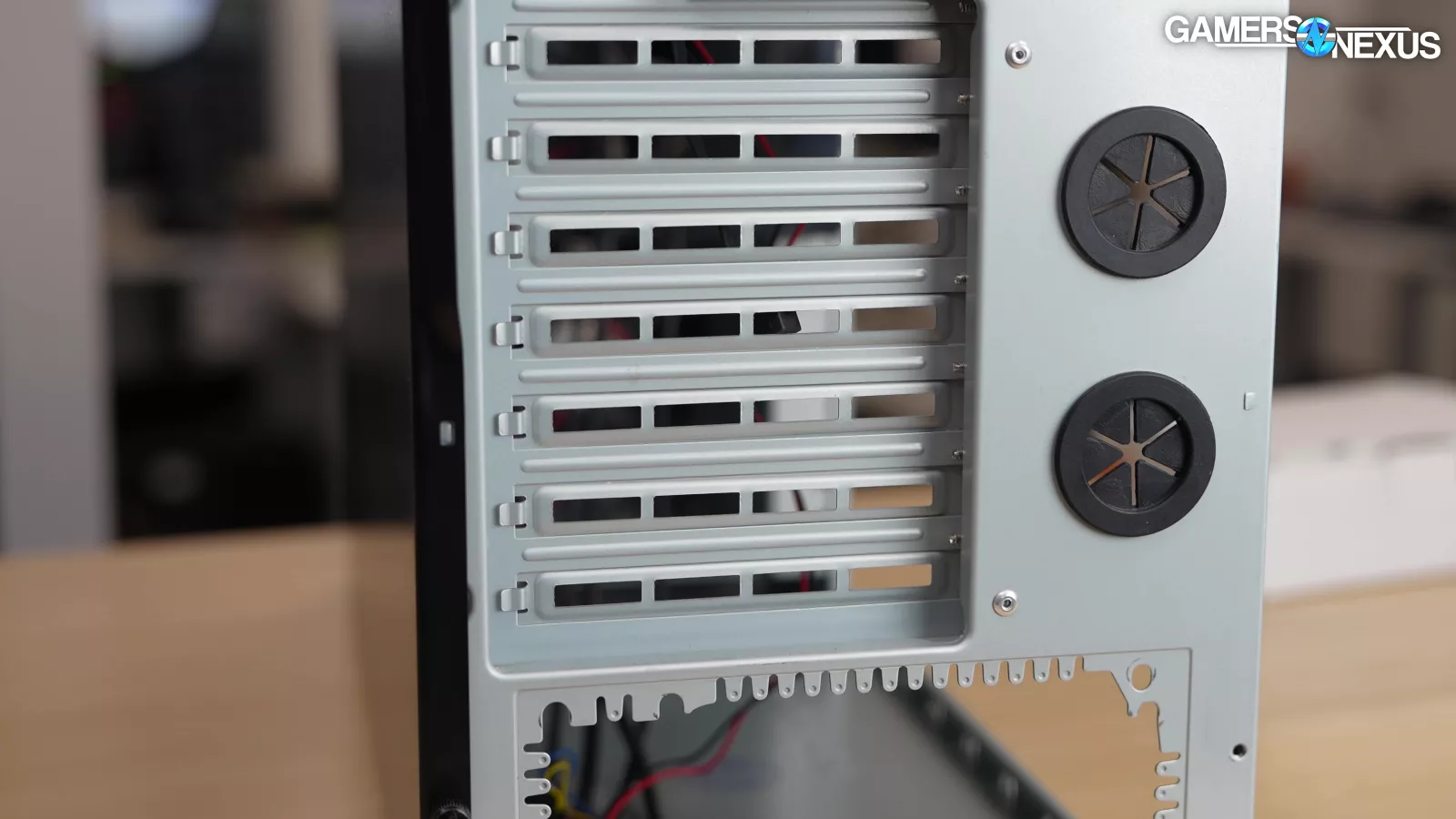
The reusable PCIe slot covers are a nice touch that certainly wasn't a given in 2006, when disposable metal covers were prevalent. The fact that they're ventilated will help with flow into the GPU in negative pressure setups.
Our test system isn't quite what the case designers originally had in mind.
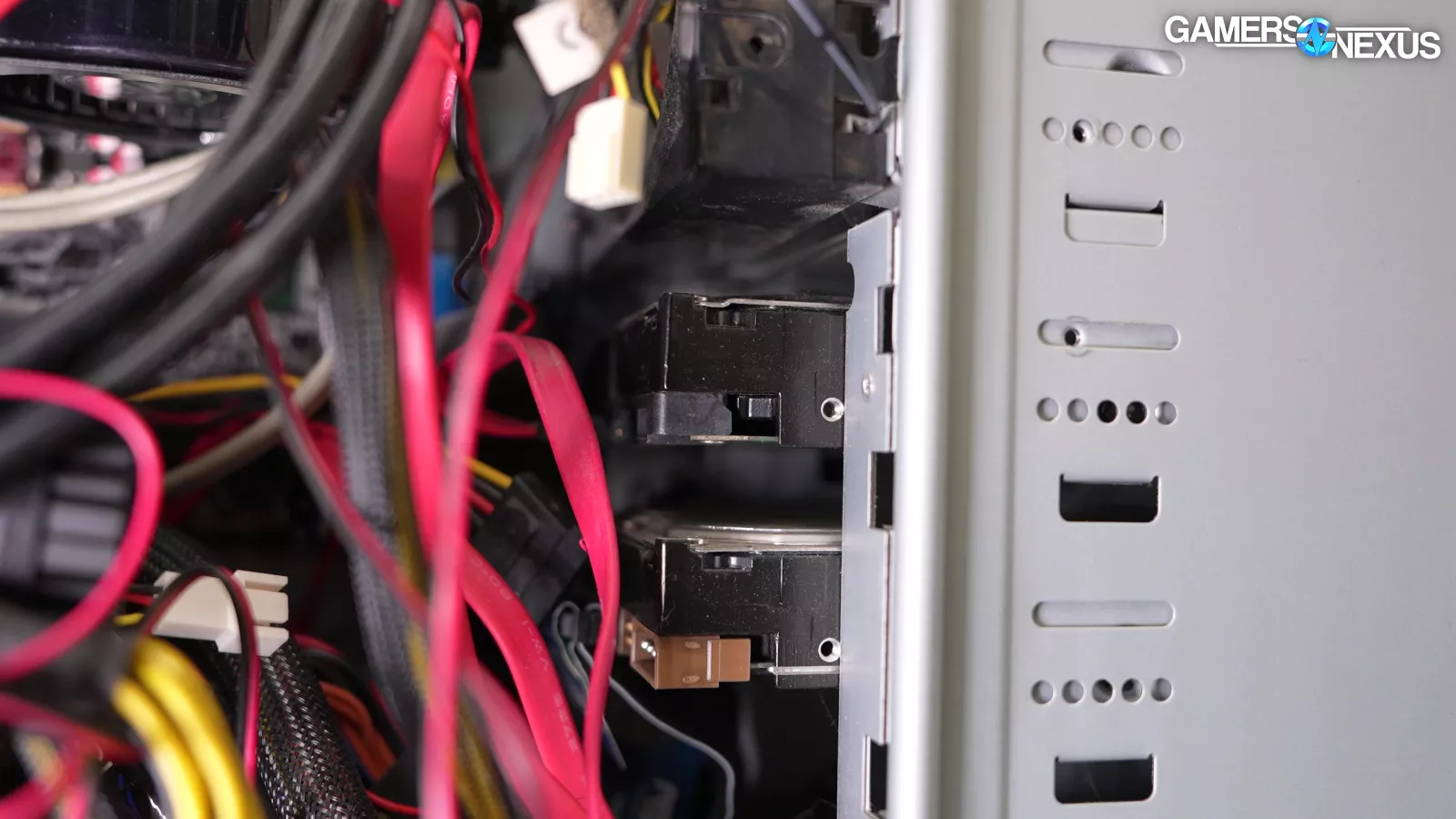
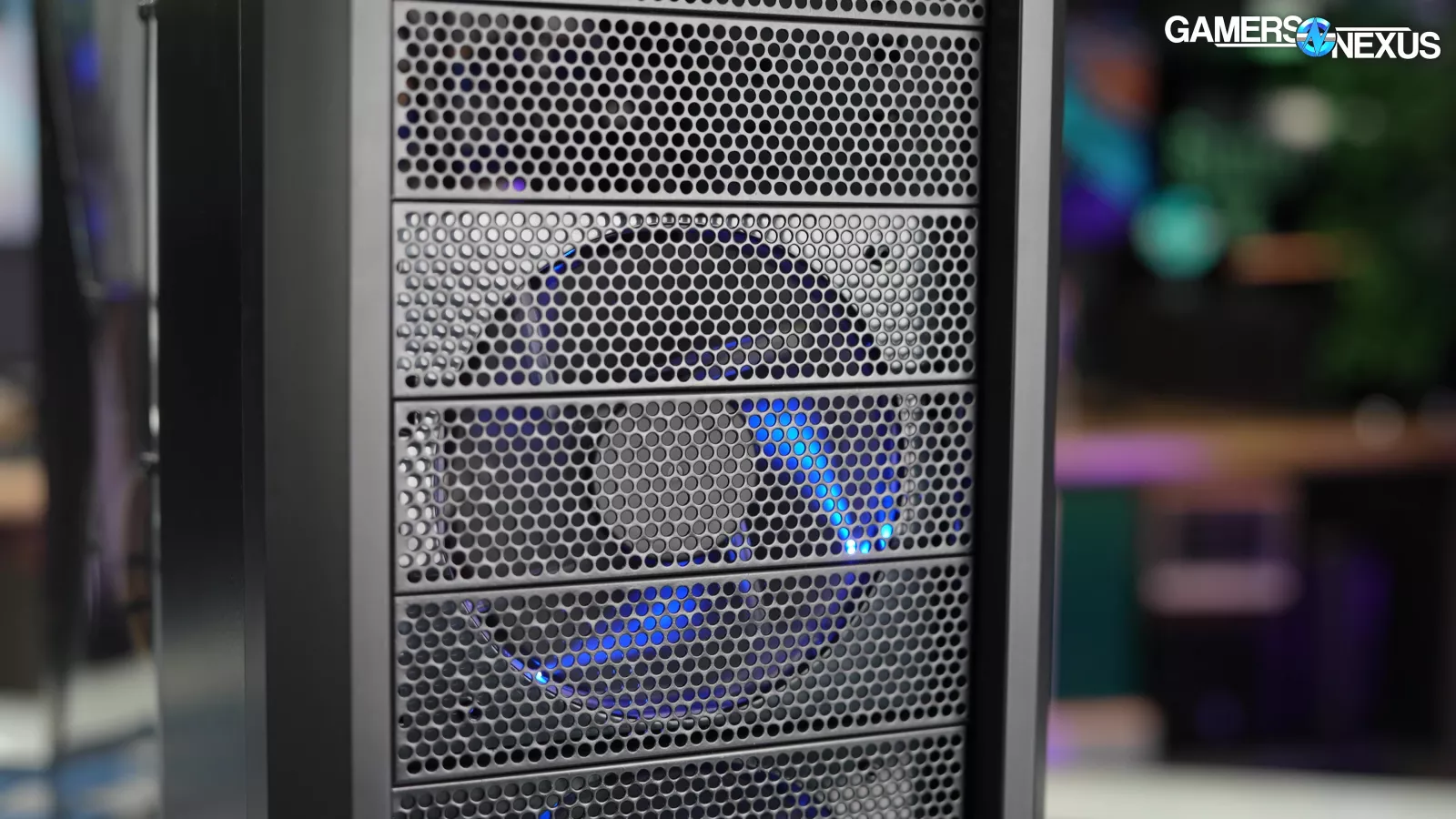
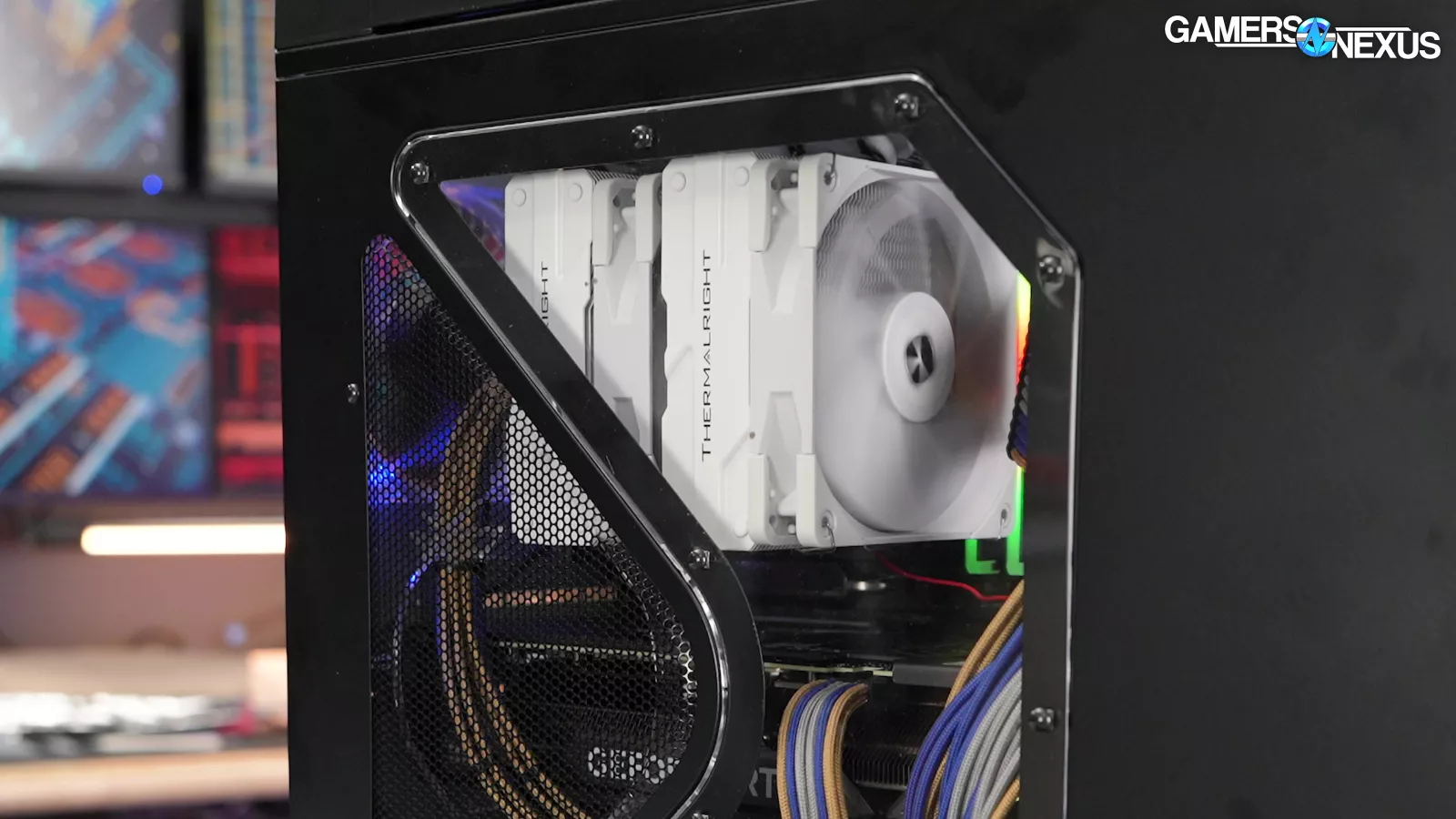
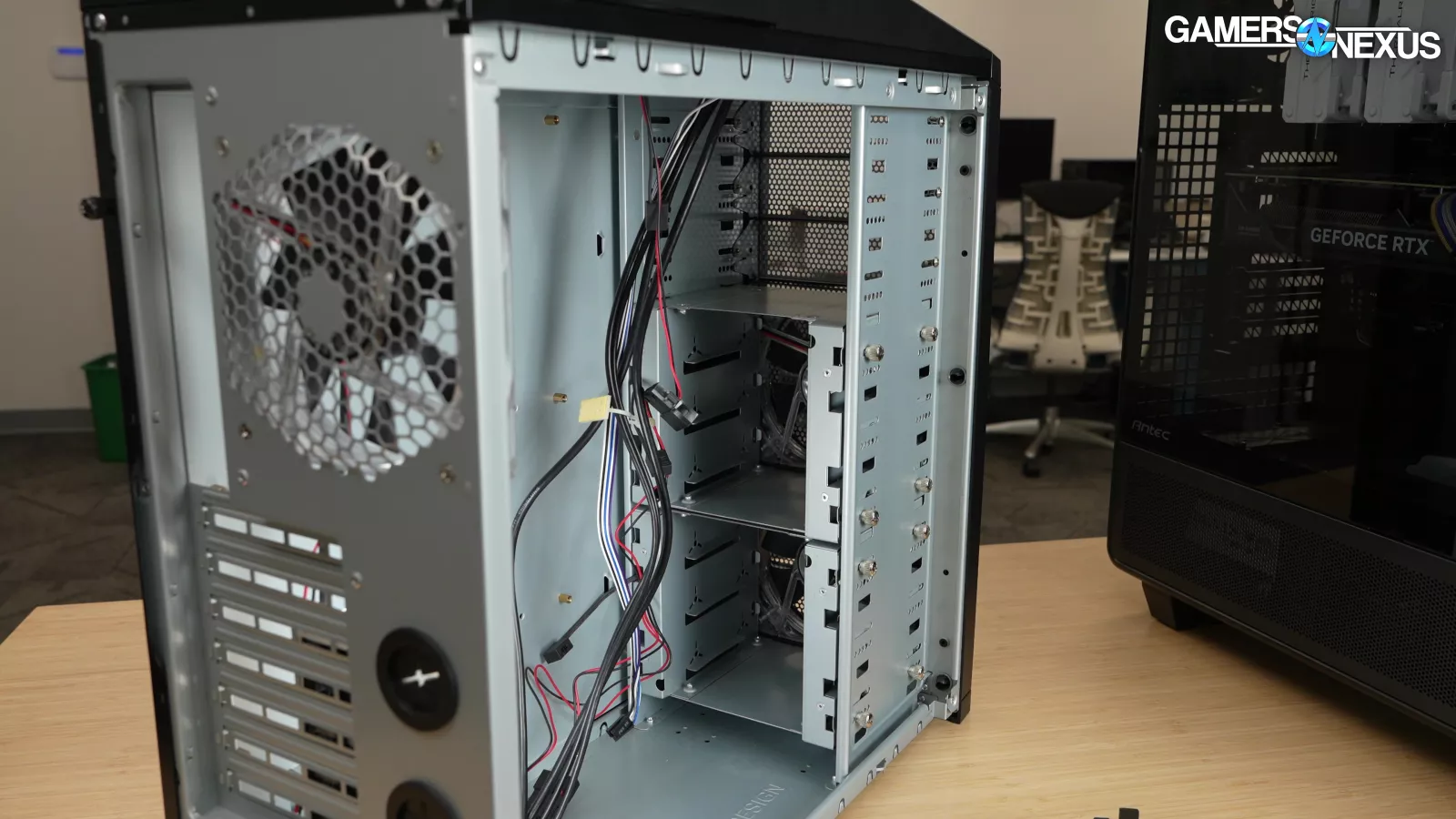
First of all, there aren’t any 2.5" mounts for our SSD, there’s no way to mount the 140mm fans for standardized fan testing, there’s barely any clearance for our CPU tower cooler (but it does fit), and a bunch of 3.5" and 5.25" bays that we have no use for in this test bench -- but these are still useful for some modern builds.
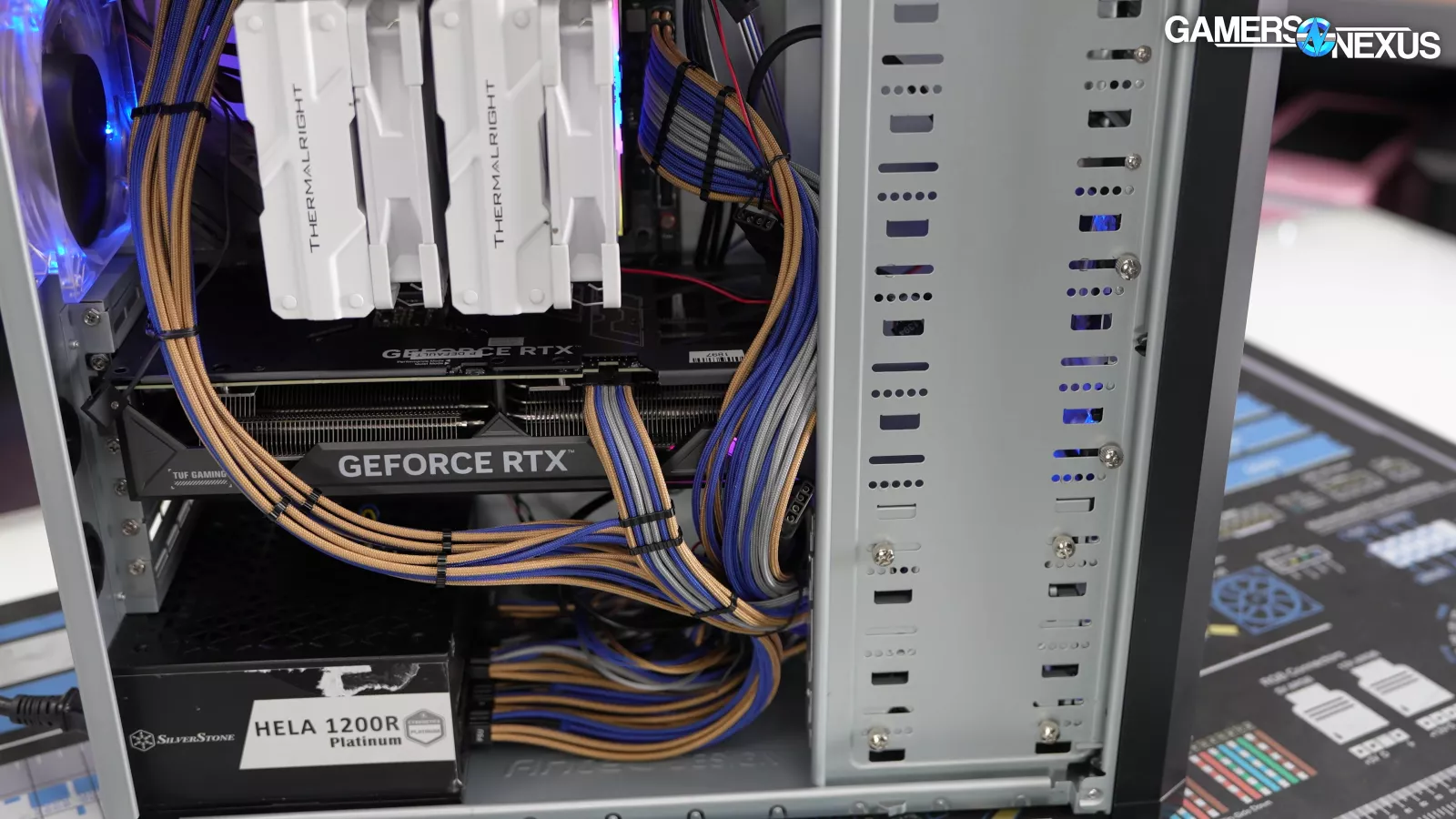
In order to get the GPU in, we had to remove one of the HDD cages.
Thermals will behave wildly differently than they would with period-appropriate hardware, so we don't expect to replicate anyone's old results. It’ll be fun to see on the charts, though.
The New Antec 900
On to the new 900.
When we asked about the old Nine Hundred, Antec told us politely that they would "like to focus more on the new 900, as its application is quite different from the original version."
That's a pity, because we don't think this new 900 will go down in history like its predecessor.
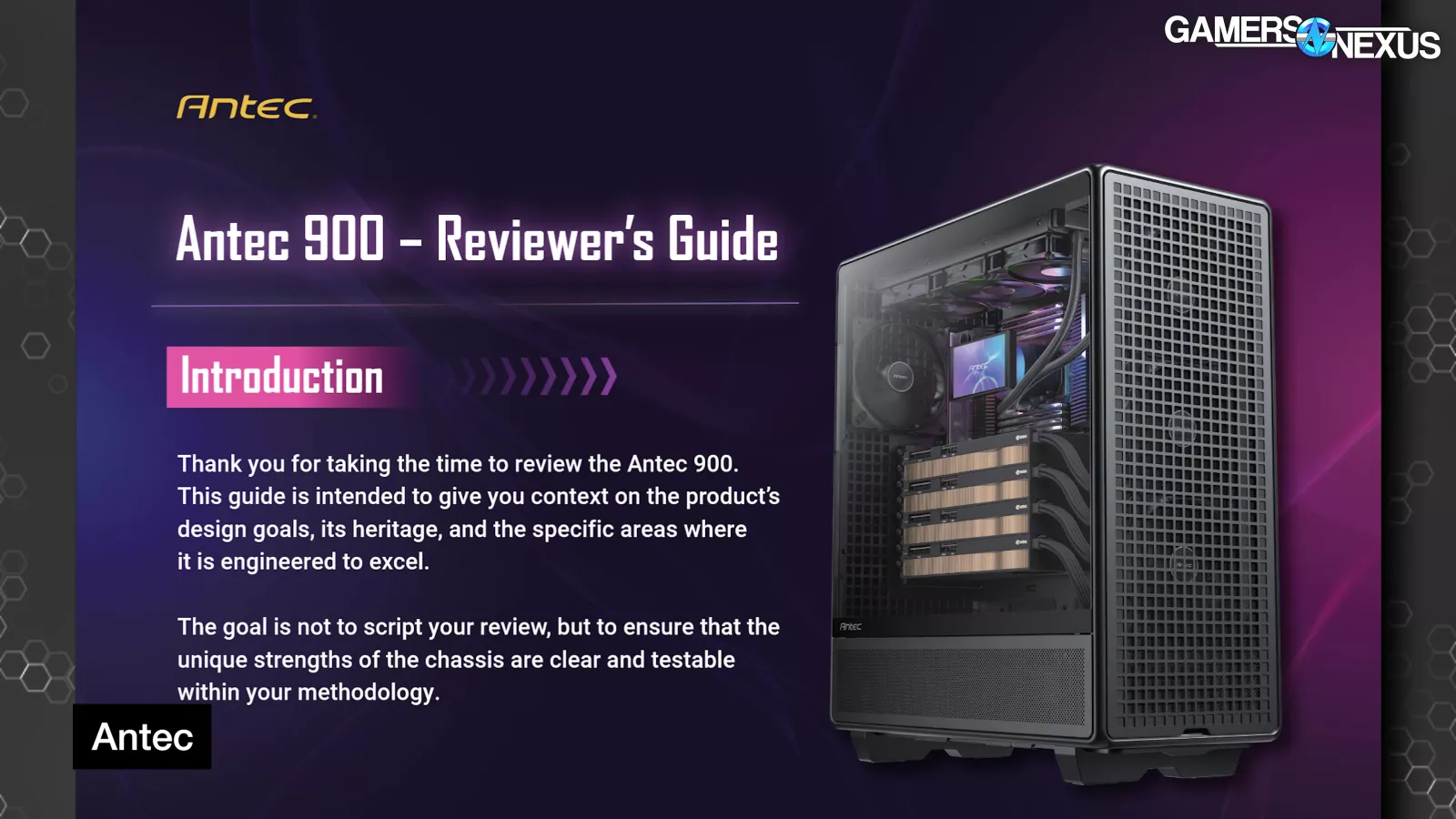

Nearly every page of Antec's product information alludes to AI.
"The Antec 900 is a full-tower chassis designed for modern compute workloads: Edge AI, workstation, engineering, content creation, and high-end gaming."

"The 9 total drive bays are a deliberate nod to the original Nine Hundred, now reinterpreted for datasets, scratch storage, and project libraries."
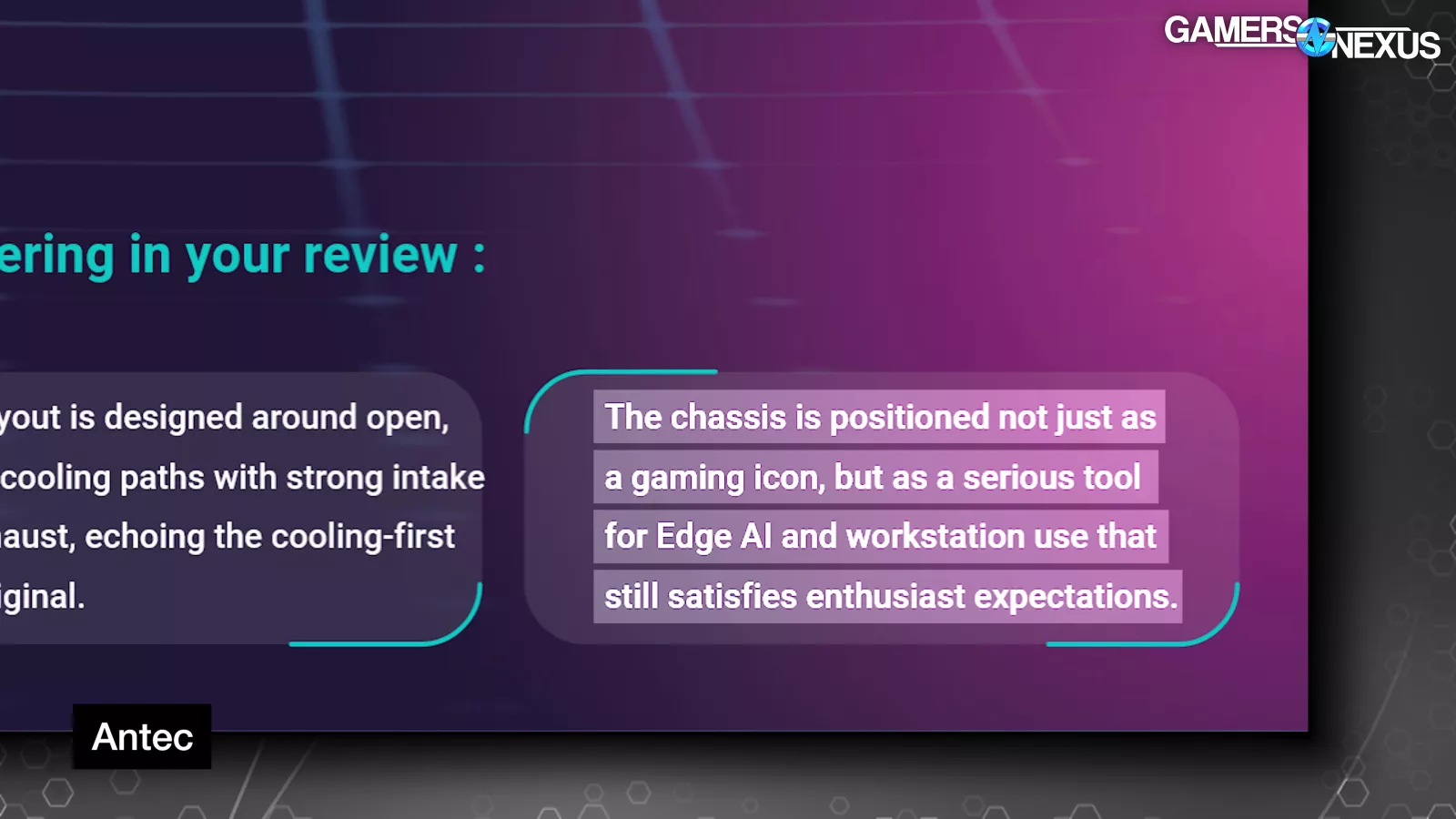
"The chassis is positioned not just as a gaming icon, but as a serious tool for Edge AI and workstation use that still satisfies enthusiast expectations."
"Edge AI & Workstation-Centric: Support for SSI-EEB, Threadripper, and multi-GPU accelerator layouts for real workloads, not only consumer gaming."
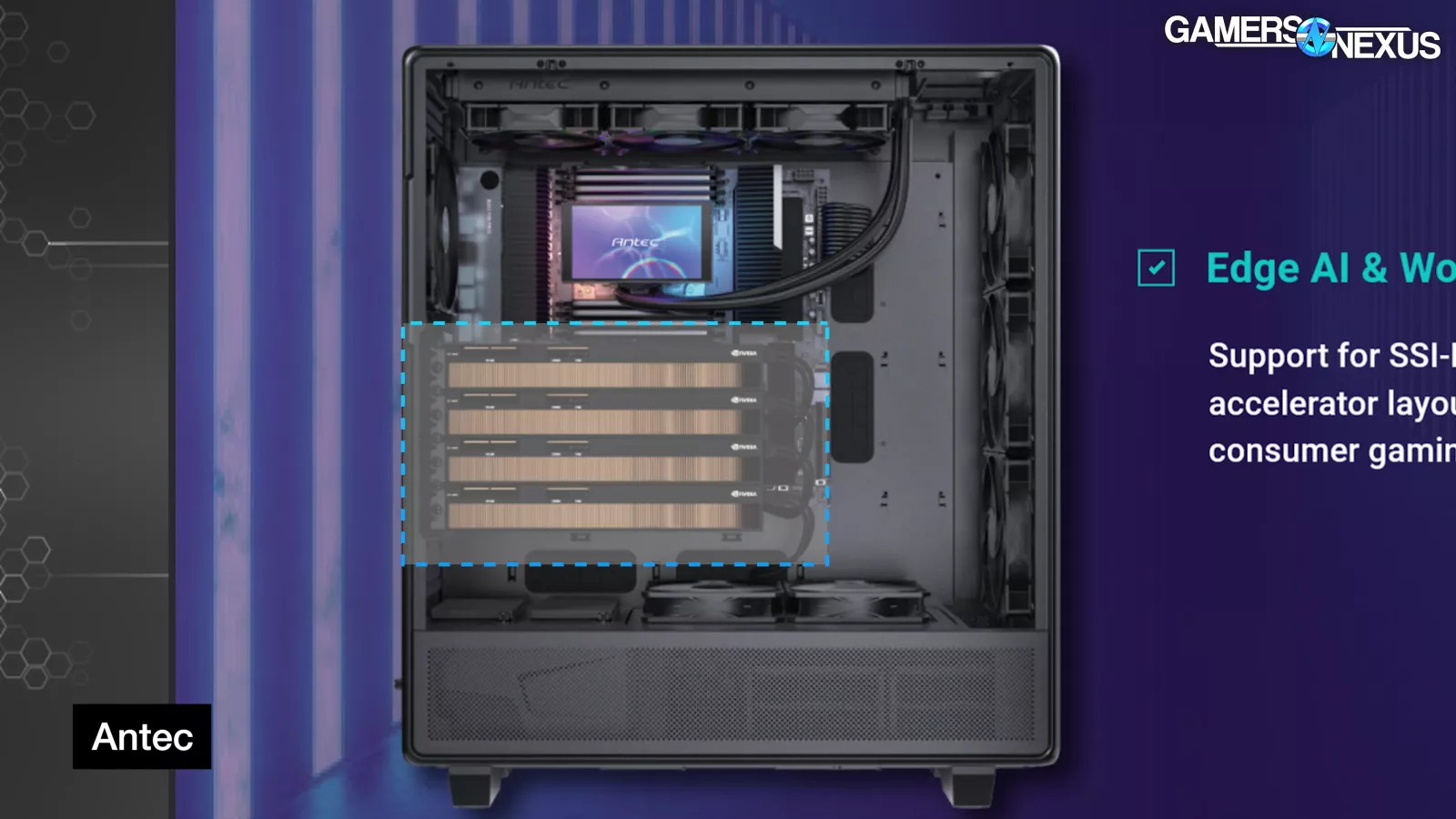
Antec then shows its follow-up to the gaming icon Nine Hundred as being packed with 4 GPUs, but seems to forget that 1) multi-GPU was also a thing when the original Nine Hundred came out in the SLI and CrossFire days and 2) the marketing copy we just went through covers workstation, engineering, AI, and edge AI applications. There are very few gaming references. This feels like a huge missed opportunity to go for nostalgia and just to pay tribute to the old case.
This new case isn’t anything like the old one.
It’s sad to see that Antec has seemingly completely forgotten the Nine Hundred’s purpose. It was built for consumers and gaming. We get that they want to market at the shiny new thing, but if doing that, there’s no reason to reprise a name synonymous with gaming PCs and then drag it through the AI mud like this.
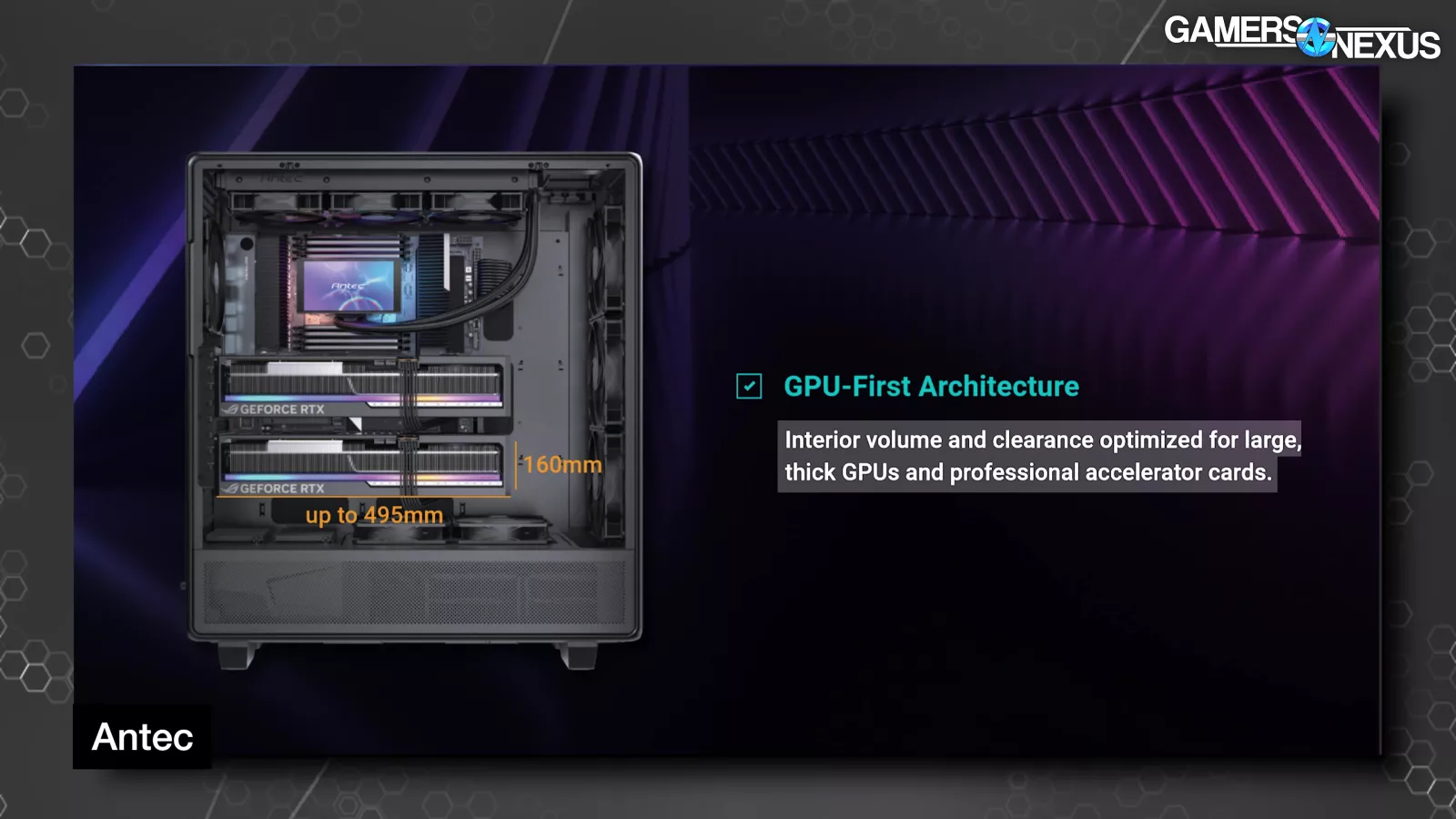
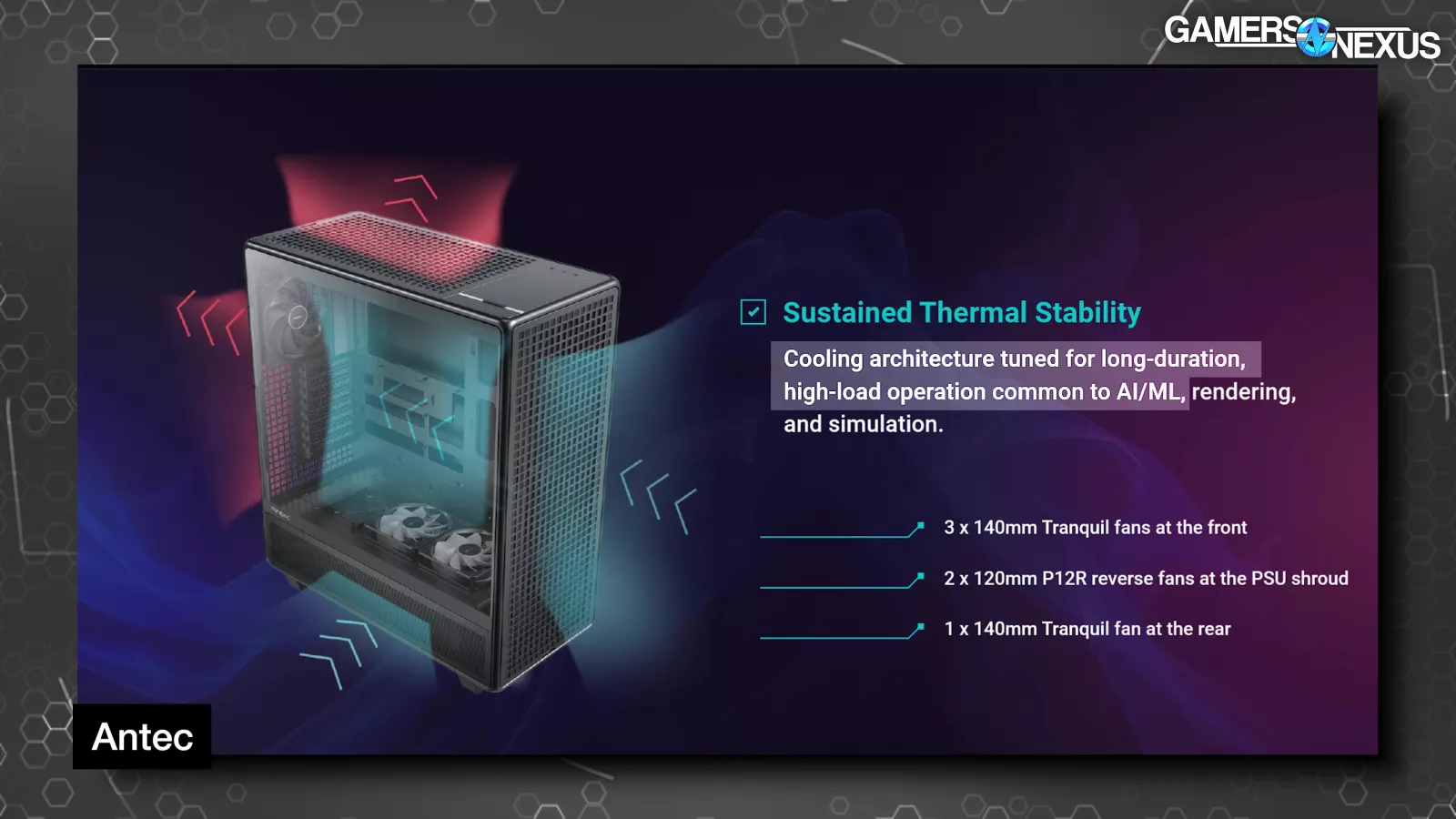
"Interior volume and clearance optimized for large, thick GPUs and professional accelerator cards,” Antec says. "Cooling architecture tuned for long-duration, high-load operation common to AI/ML, rendering, and simulation."
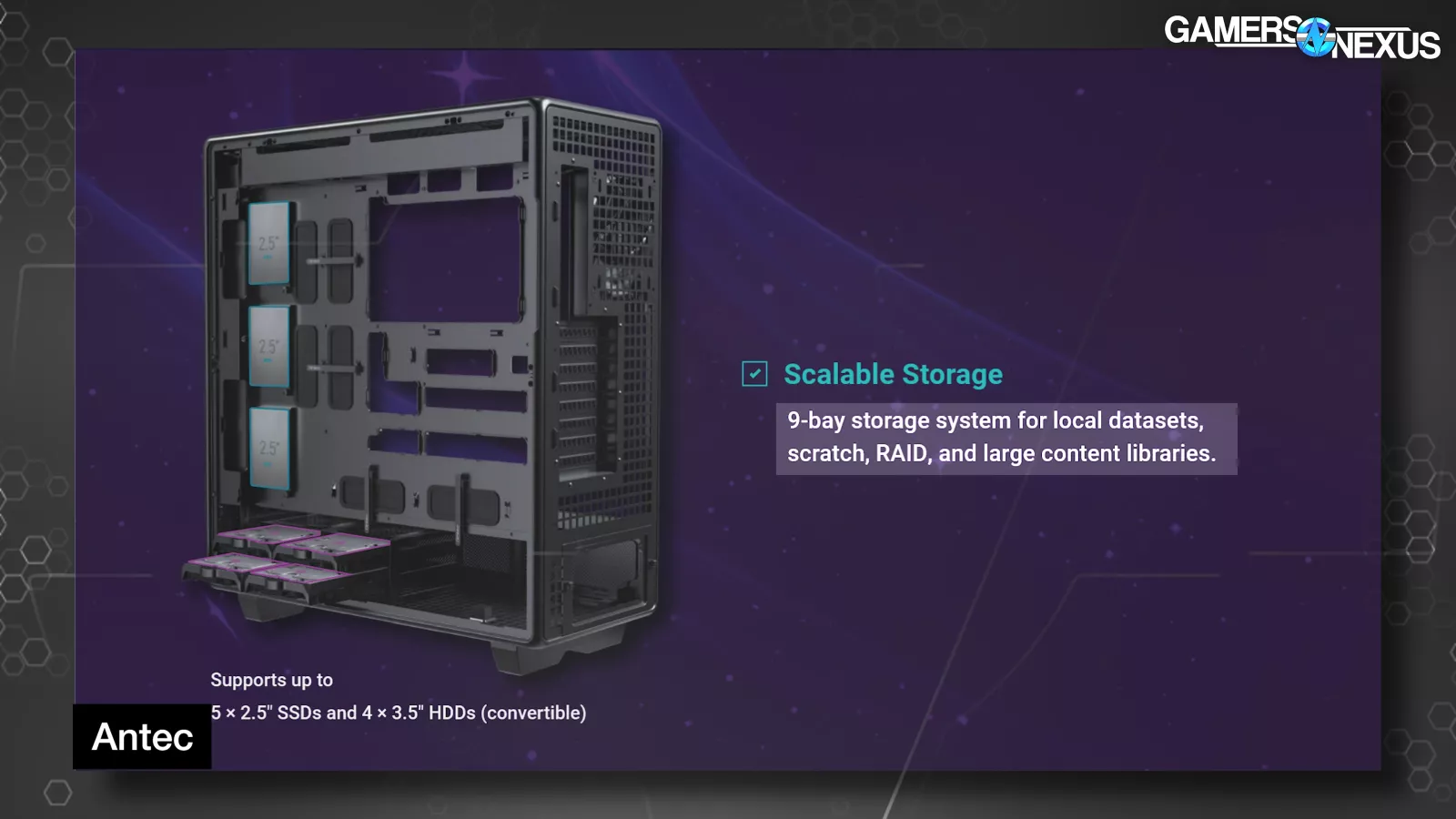
Yet more AI marketing on the next page: "9-bay storage system for local datasets, scratch, RAID, and large content libraries."
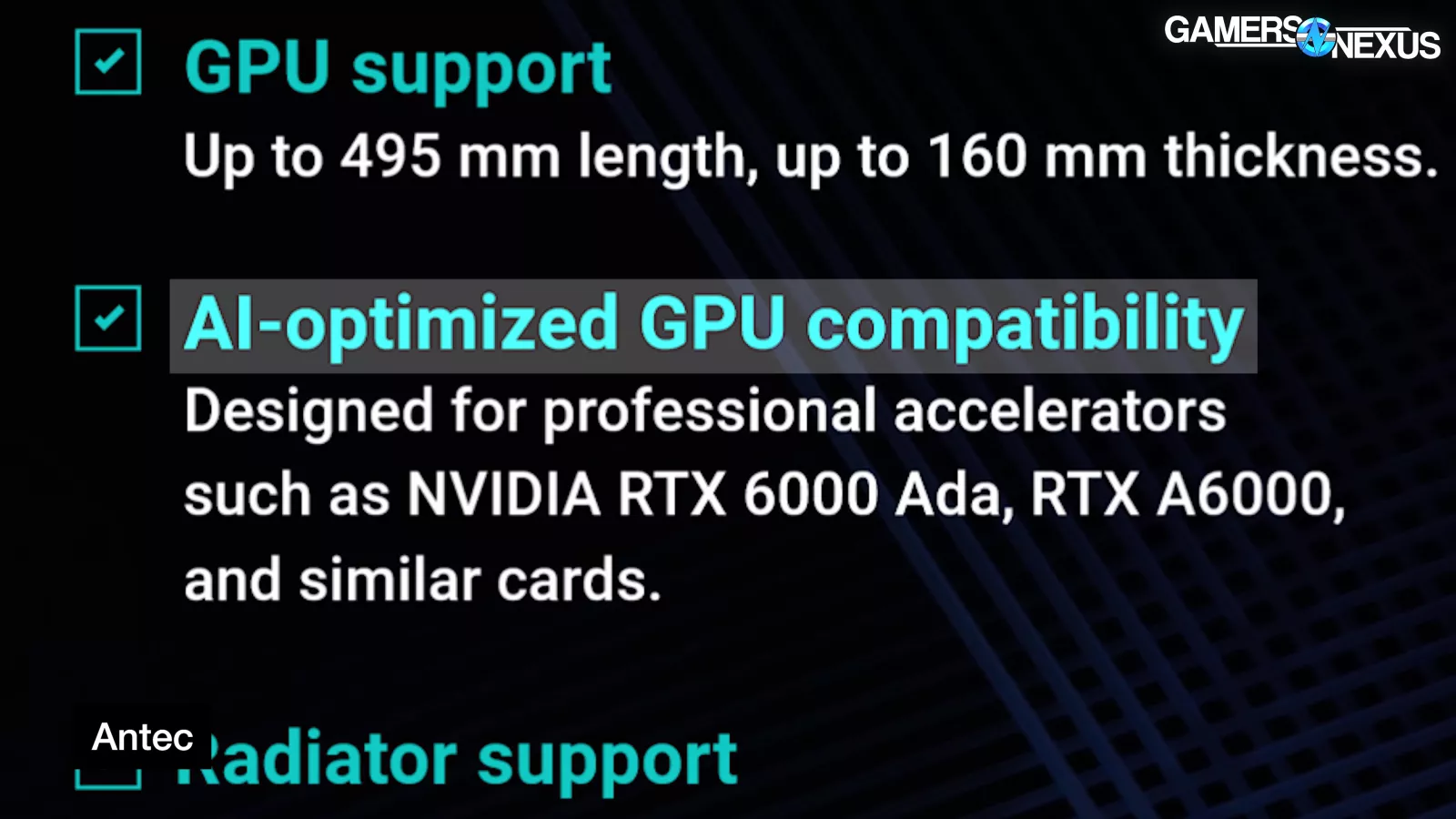
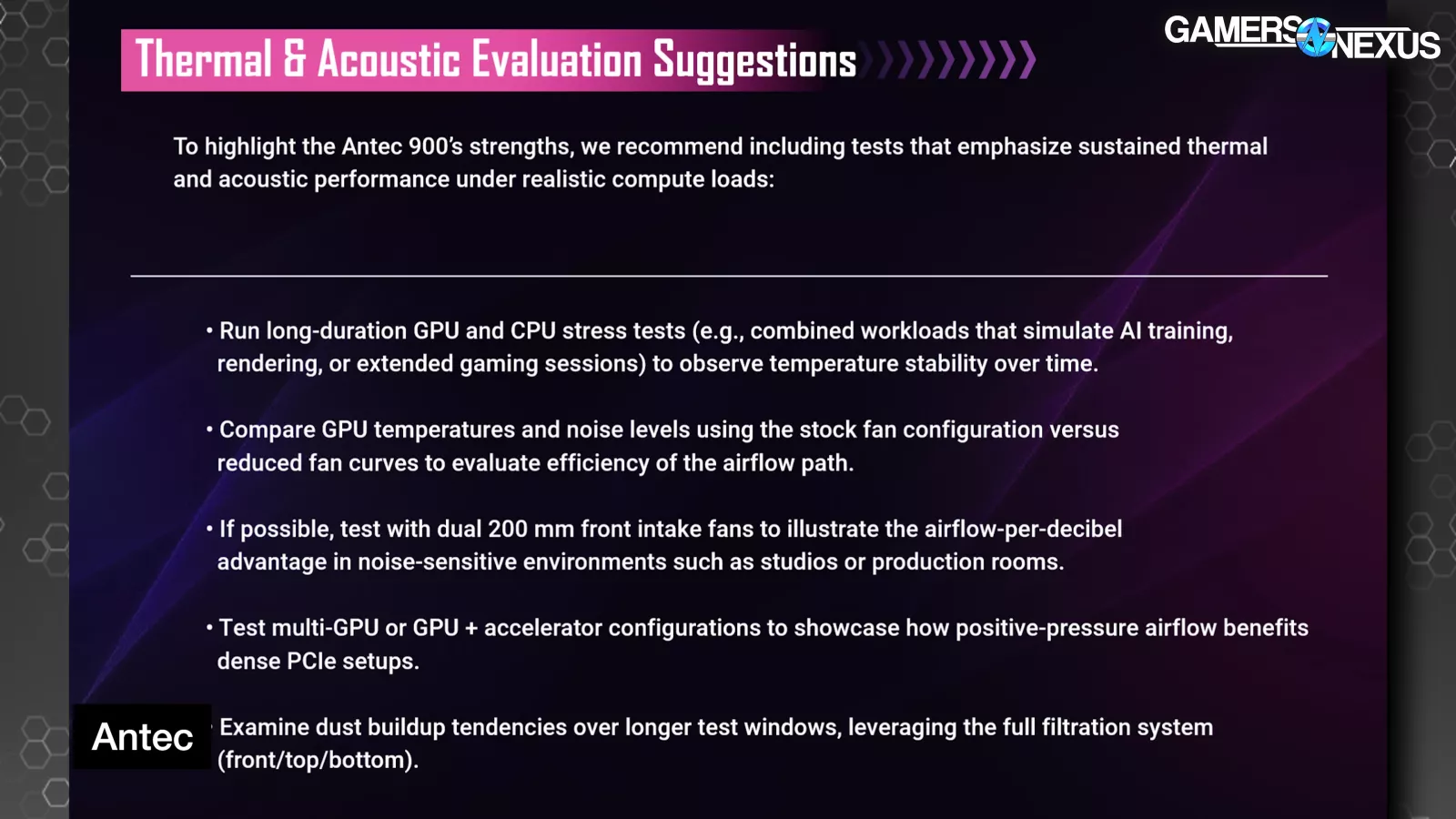
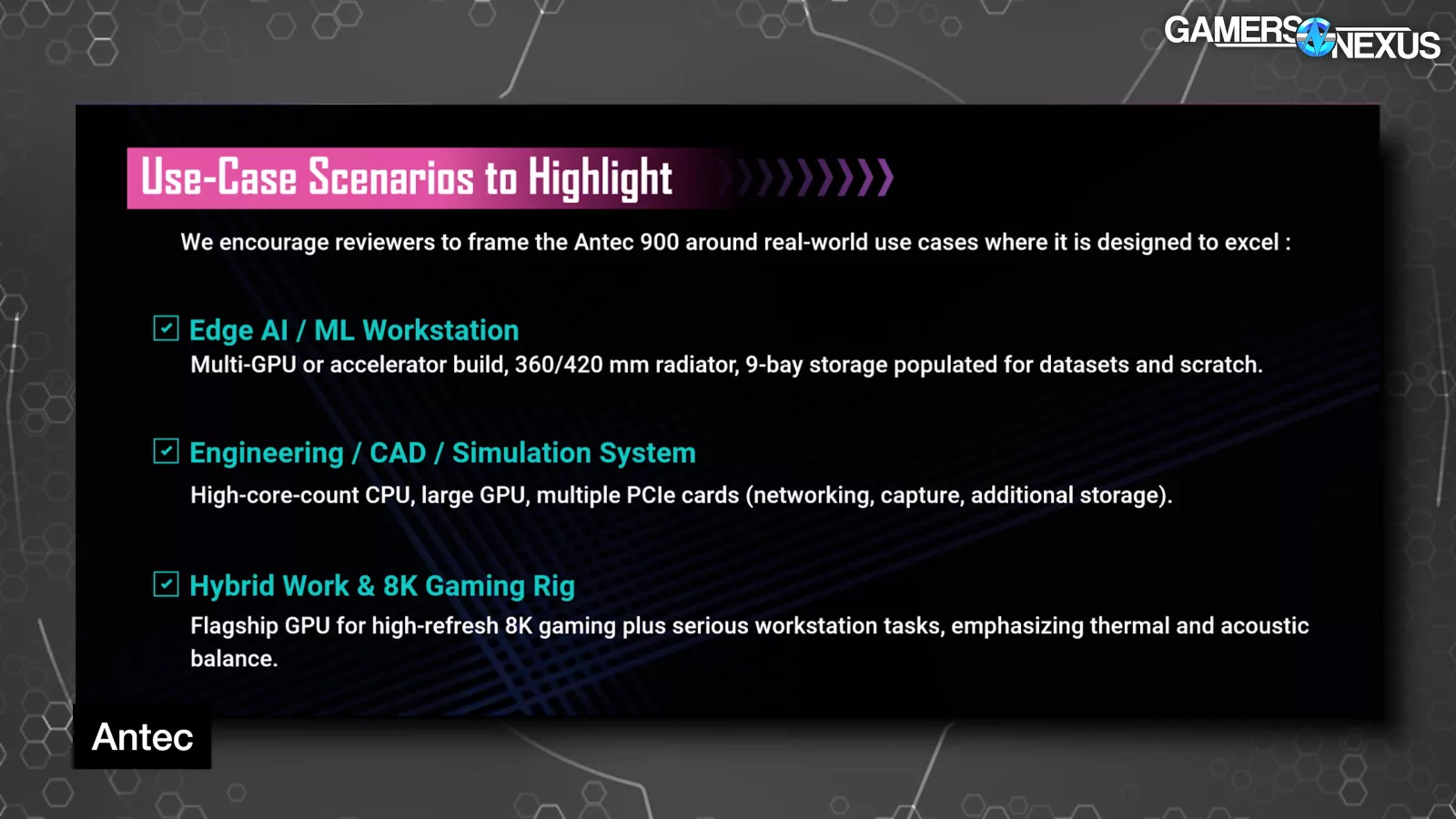
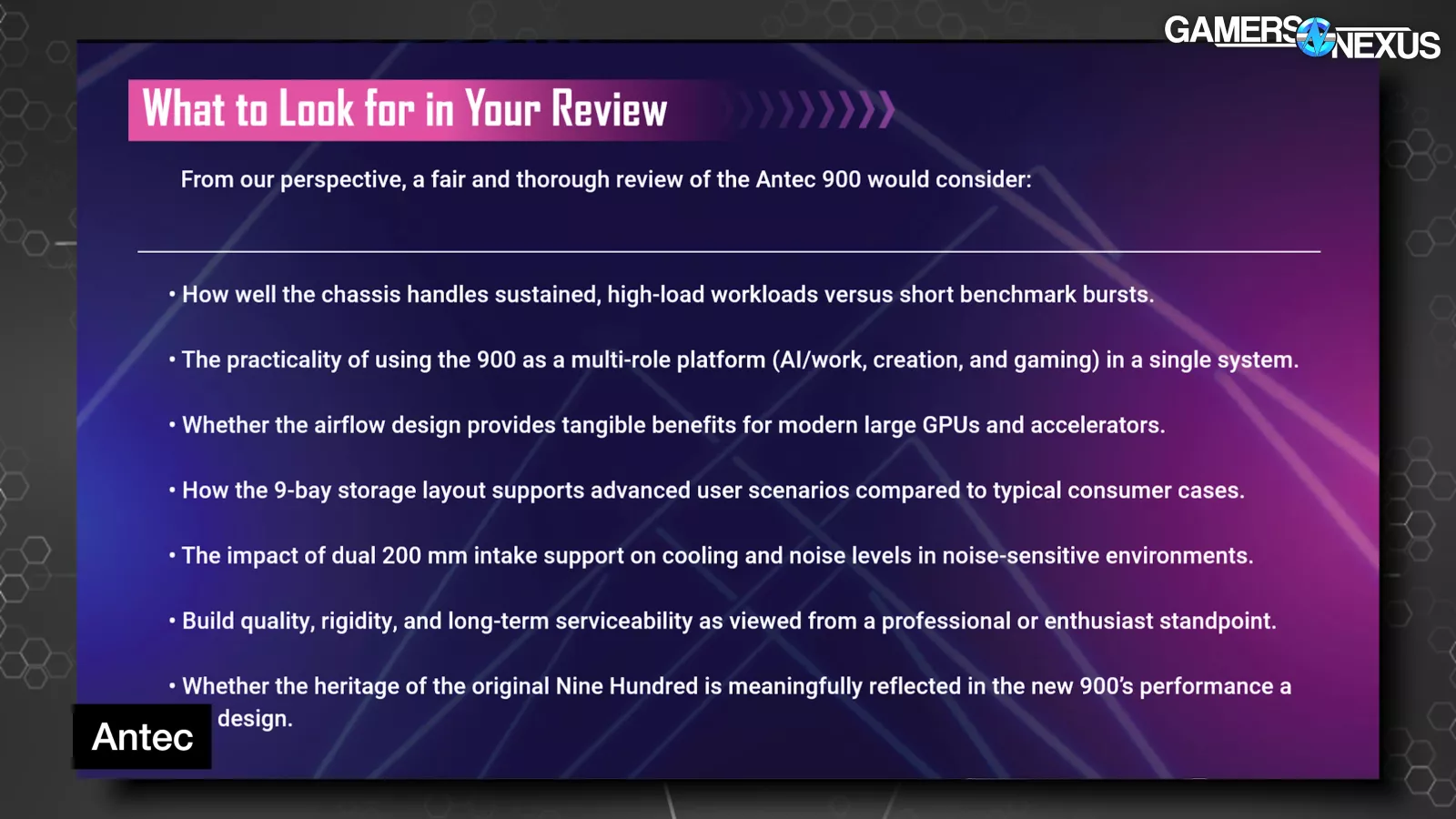


Then there’s the “AI-optimized” GPU compatibility (whatever that means), the design for “professional accelerators,” Antec’s weird overstep of testing recommendations for reviewers (who can do their own job without manufacturer dictation like this), including “combined workloads that simulate AI training.” This document goes on-and-on, speaking of Edge AI/ML workstation use, accelerator builds, more references of large datasets, an overstepping of boundaries in dictating reviewers what to look for in reviews, such as the 900 being used for AI with a handwave reference to gaming, and finally, a closing remark that says: “The Antec 900 is our statement chassis for the next wave of performance computing--blending the legacy of the Classic Nine Hundred with modern requirements for Edge AI, workstation compute, and 8K gaming.”
Review documentation is normal and serves as basically a more detailed manual, but the language here matters. Manufacturers are normally more careful to not overstep the line of “here’s what we’re trying to achieve” and “here’s what you should say.”

Antec, we think, is overstepping that line with its language. Statements like “what to look for in your review” is an egregious overstep of the relationship and unacceptable. This would best be reframed as “what we’re trying to achieve.”
Then let the reviewer decide if reality matches that claim. That’s just reviewing marketing versus reality, which is part of our job, as opposed to following a literal guide to a review. Review guides normally cover things like common mistakes, unique issues (like core parking for AMD) and how to avoid them, or market position. This is just too much.
Anyway, we have a case to review.
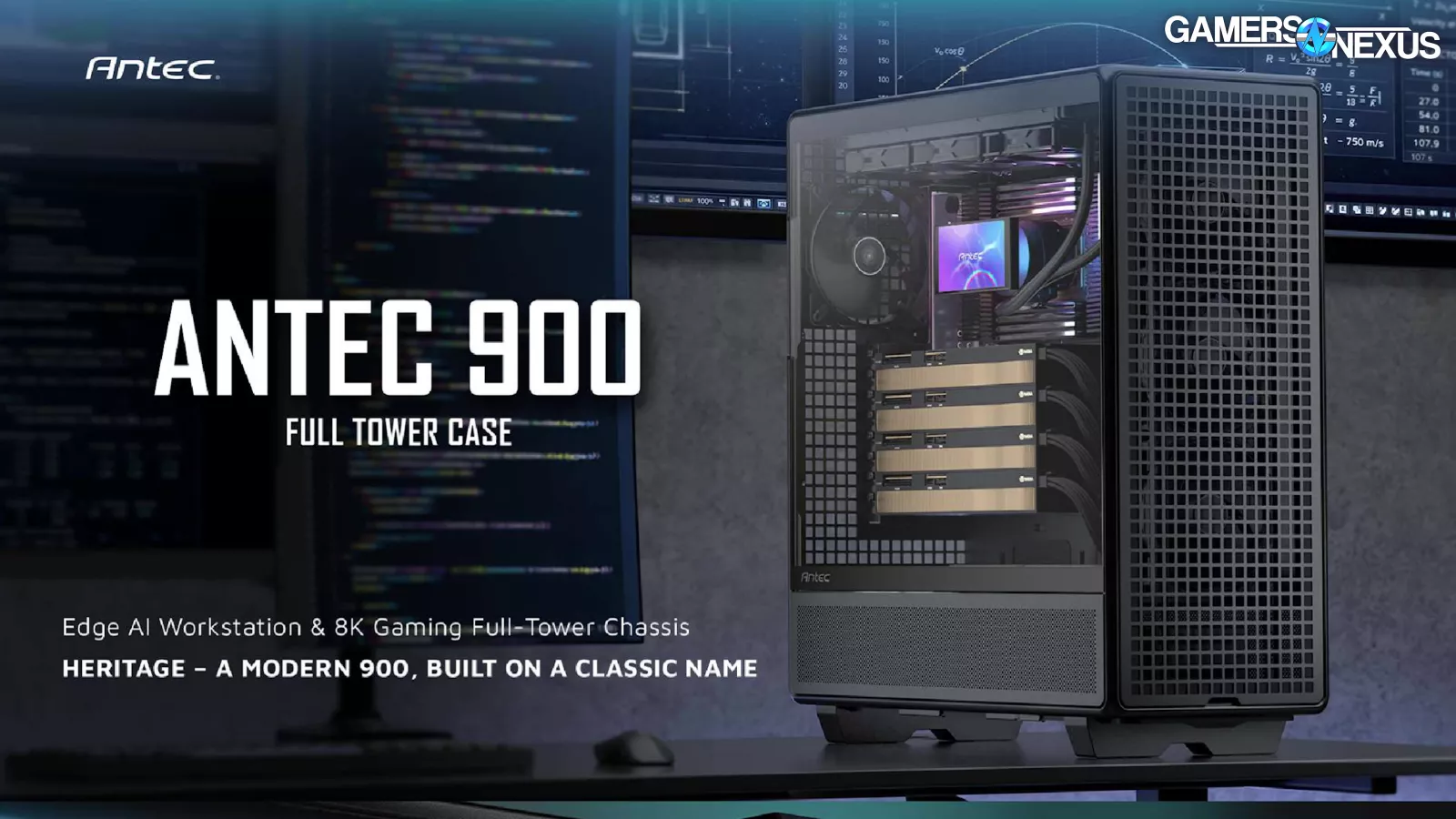

One of Antec’s claims in its product brief calls the 900 a "Full-Tower Chassis," which seems to mean that it can fit a really big motherboard with a ton of GPUs.
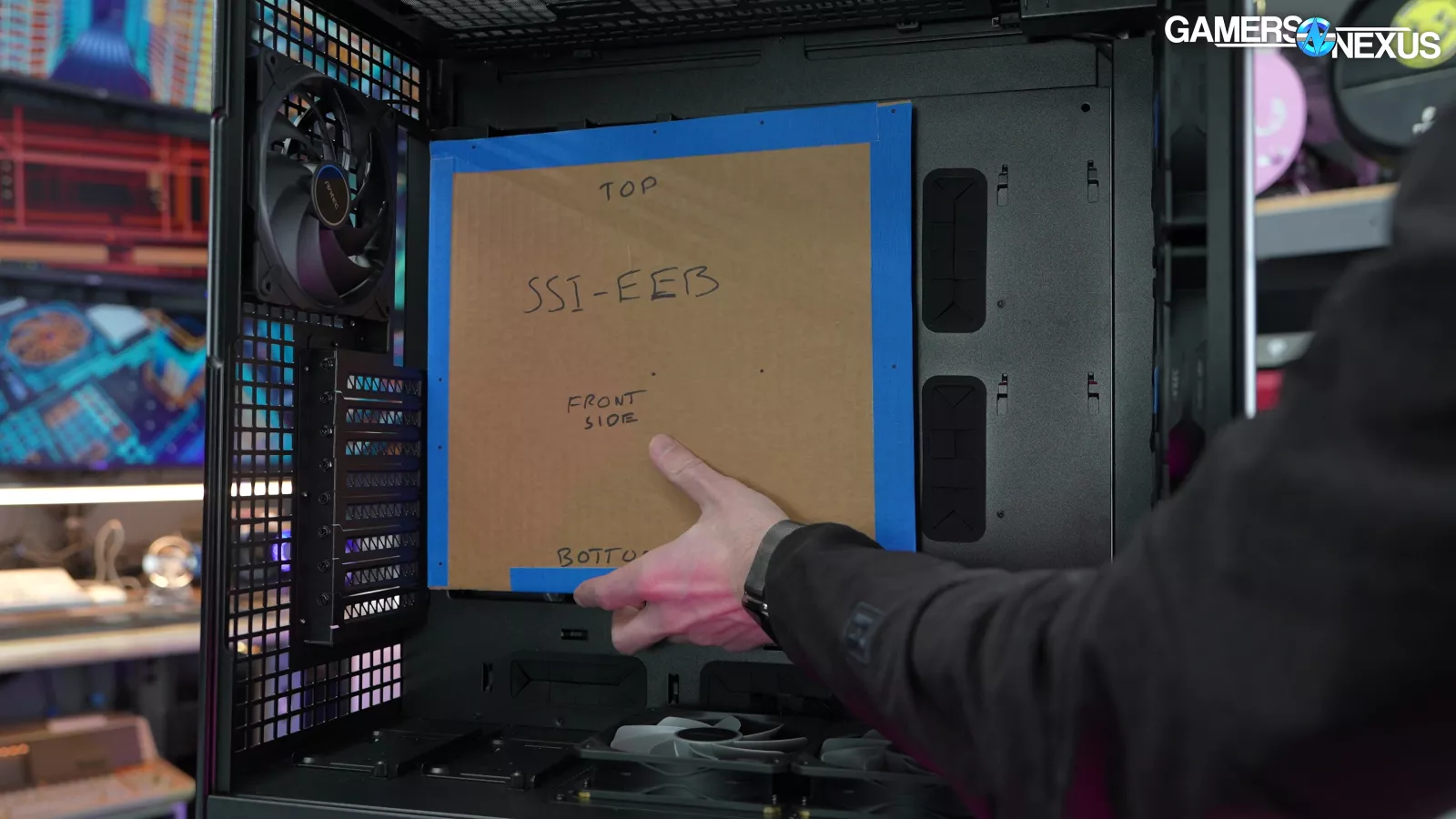
The case's size makes it easily compatible with full SSI-EEB motherboards and pre-installed standoffs make that easy.
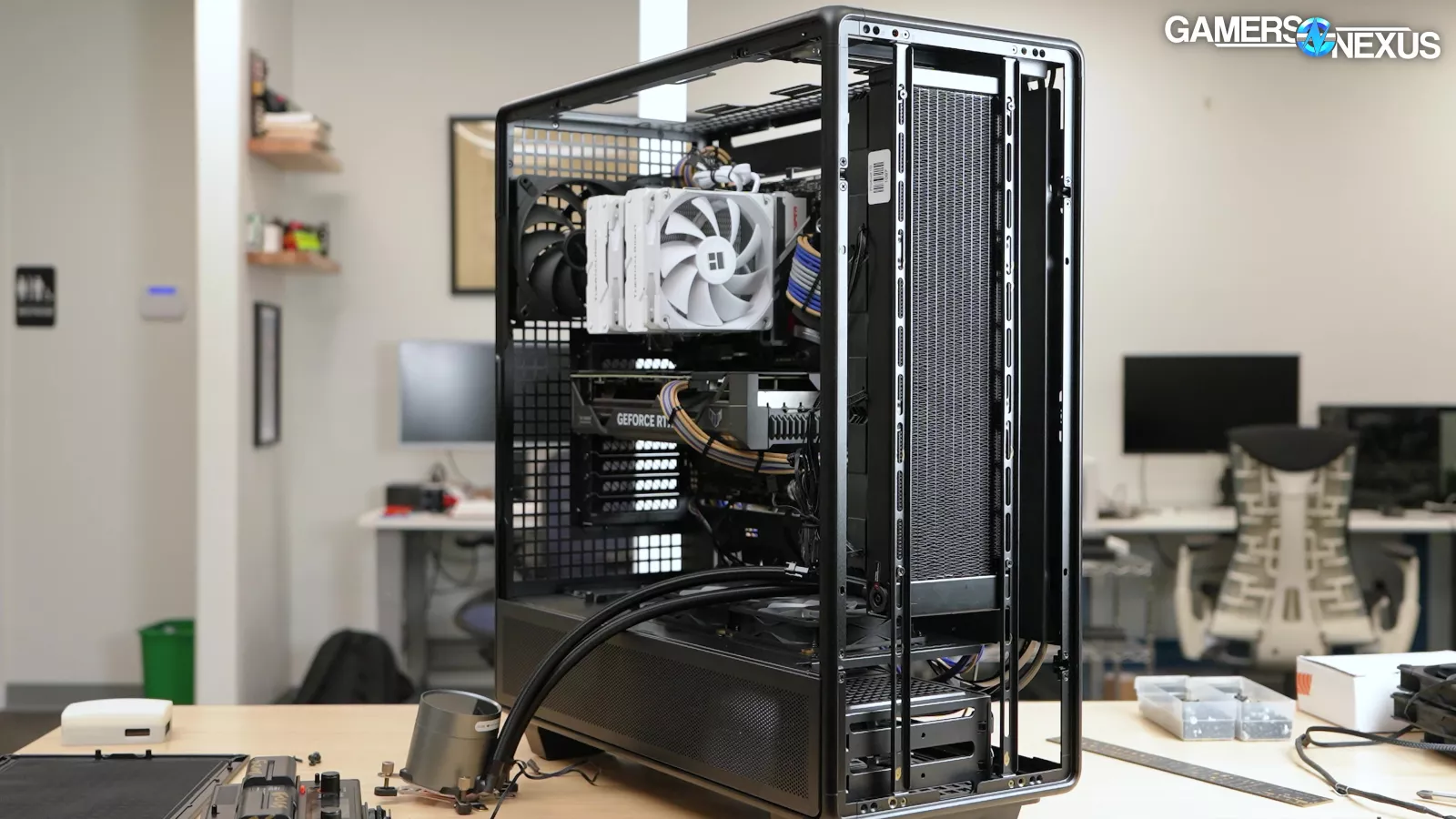
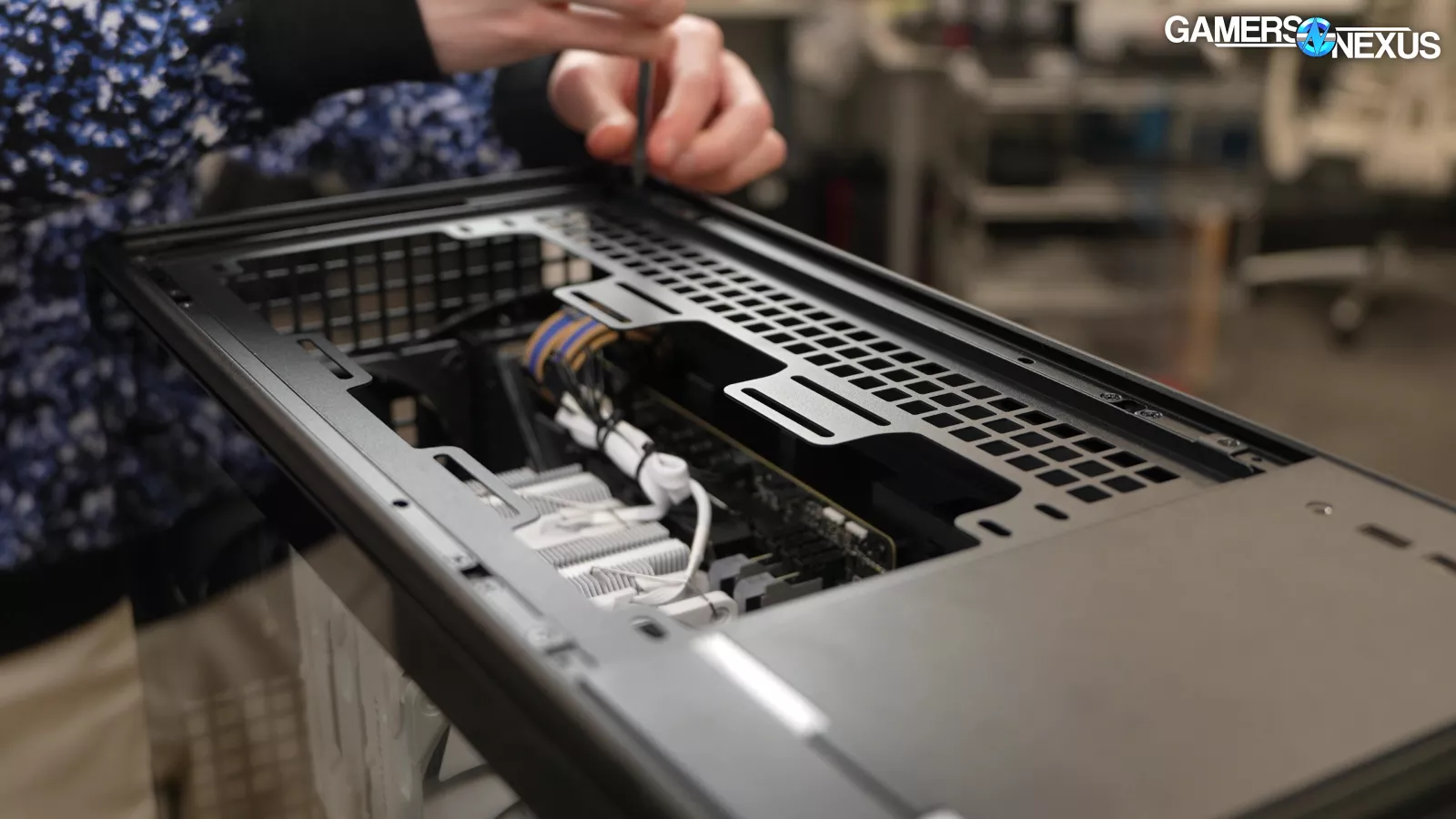
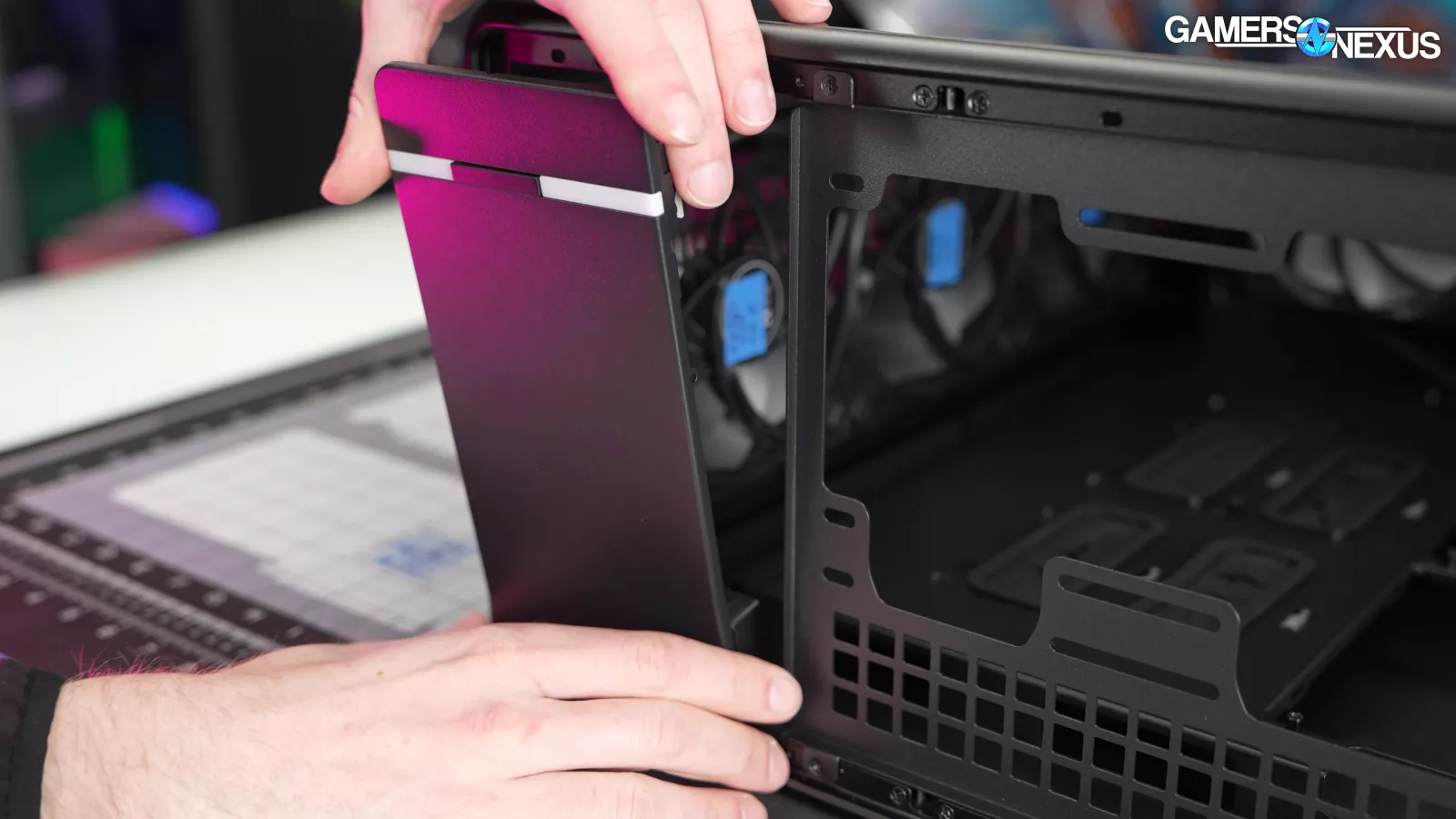
Even the largest motherboards will leave plenty of clearance at the top, front, and bottom edges for fans and radiators. The top of the case can also be fully removed along with the I/O for even more elbow room, which is a feature we’ve liked on past cases.
If we had to pick the features of the old Nine Hundred that would be relevant in a modern design, they would be high airflow with open mesh, the distinctive humpback silhouette, sharp angled decorations, and creative fan mounting locations with a stock 200mm included.
Other than airflow, these are not the features that Antec picked.
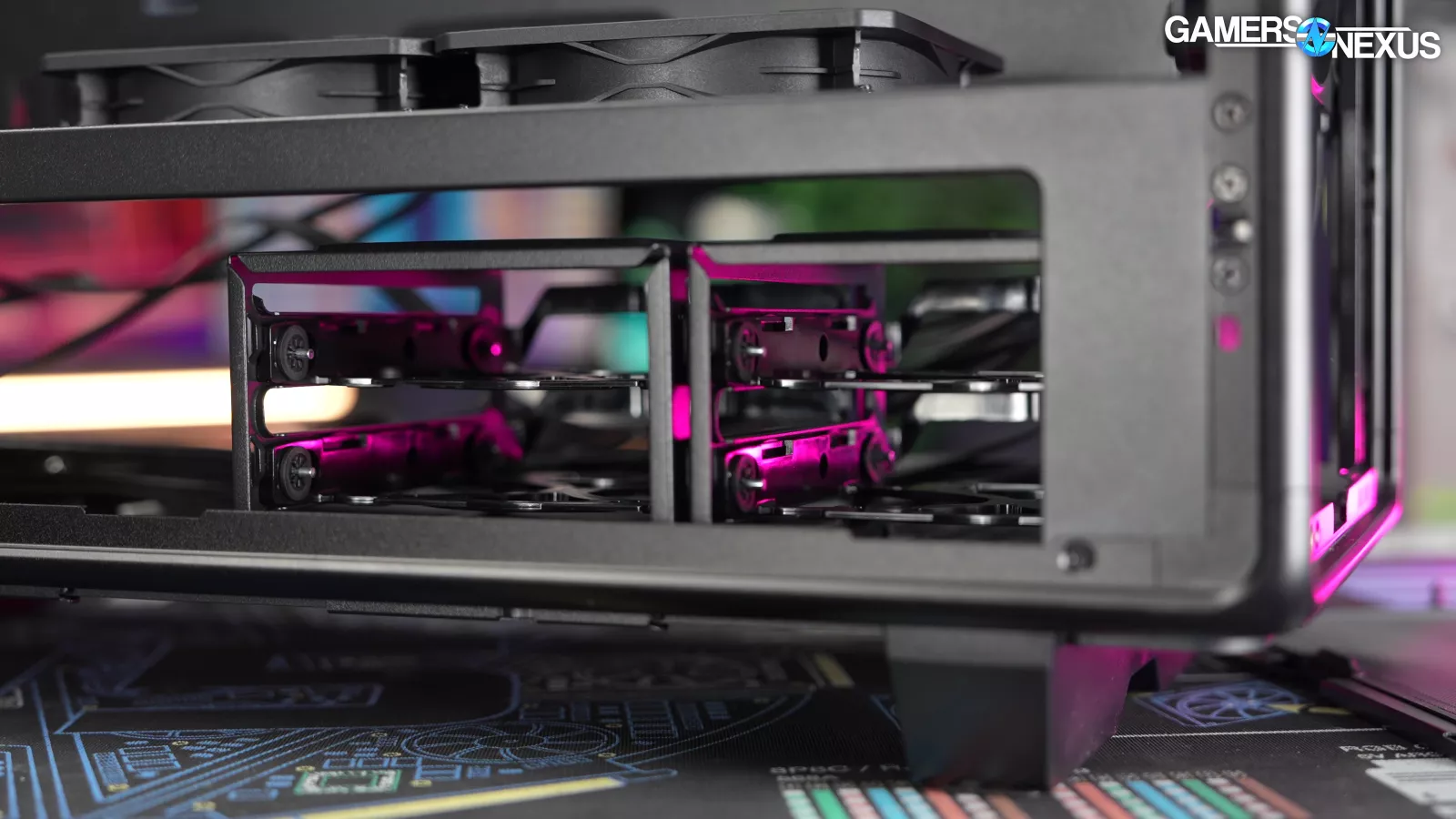
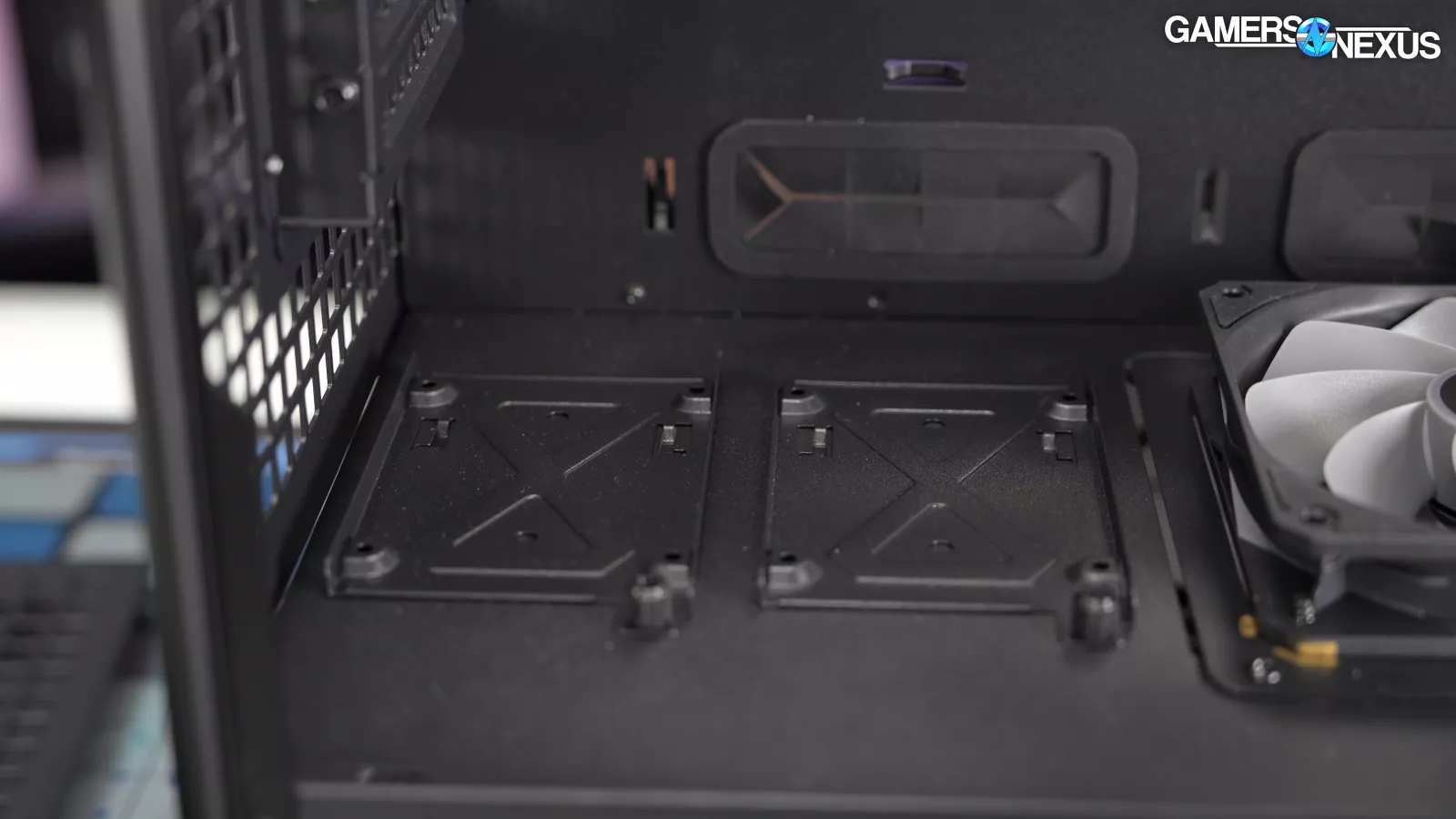
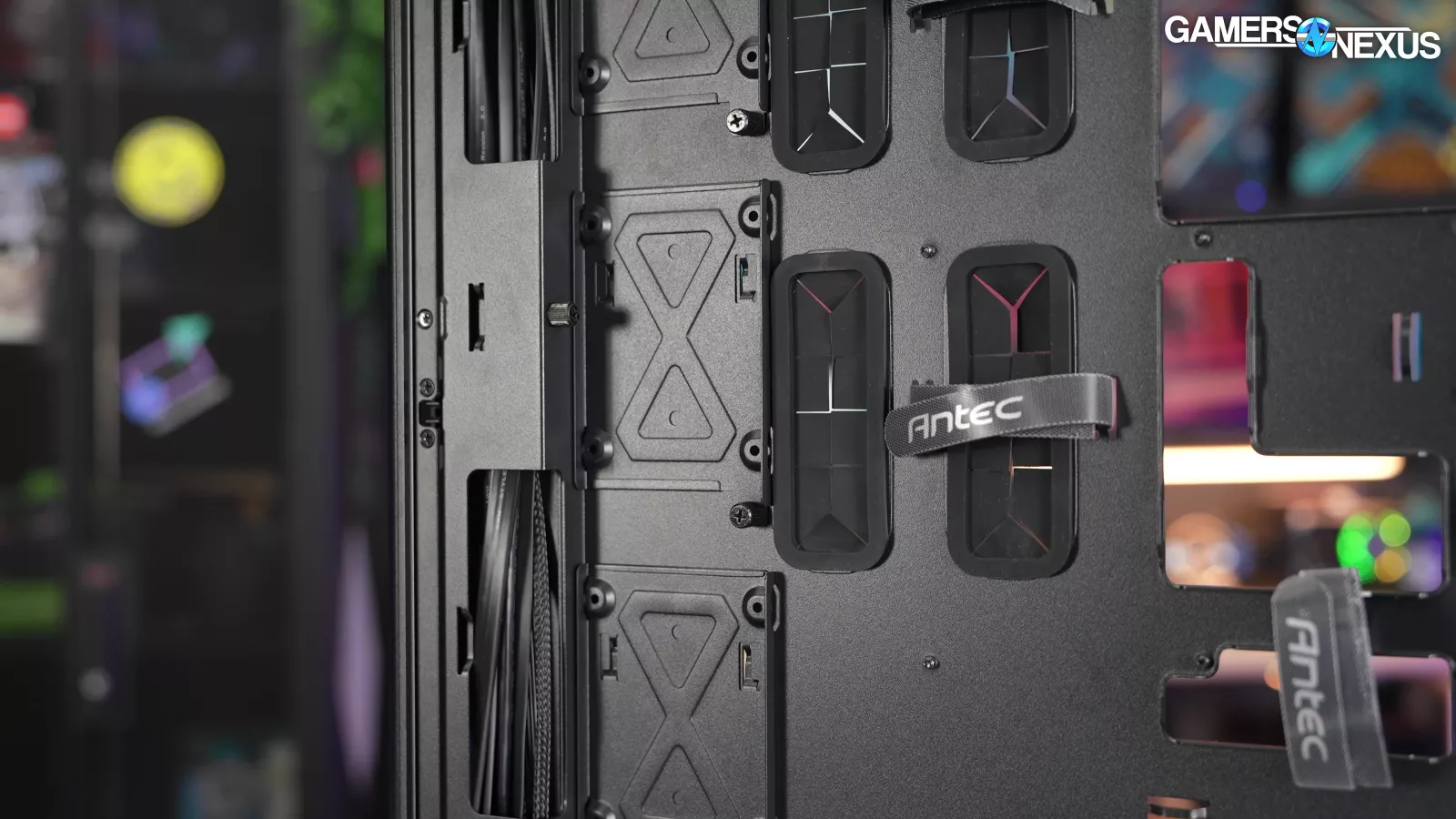
Drives are widely supported, though: There are four 3.5"/2.5" bays under the shroud, two 2.5" mounts on top, and another three 2.5" mounts behind the motherboard tray.
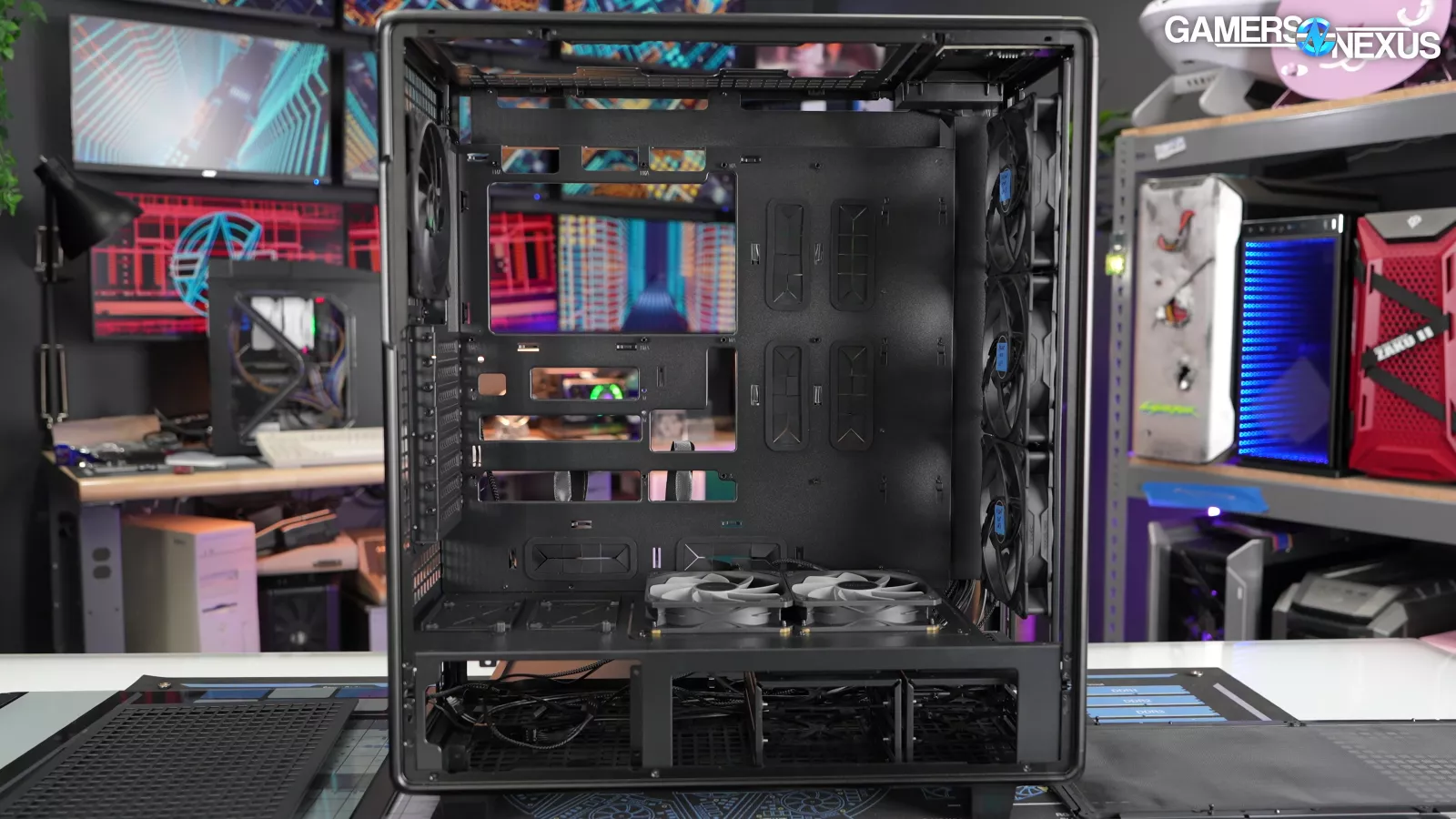
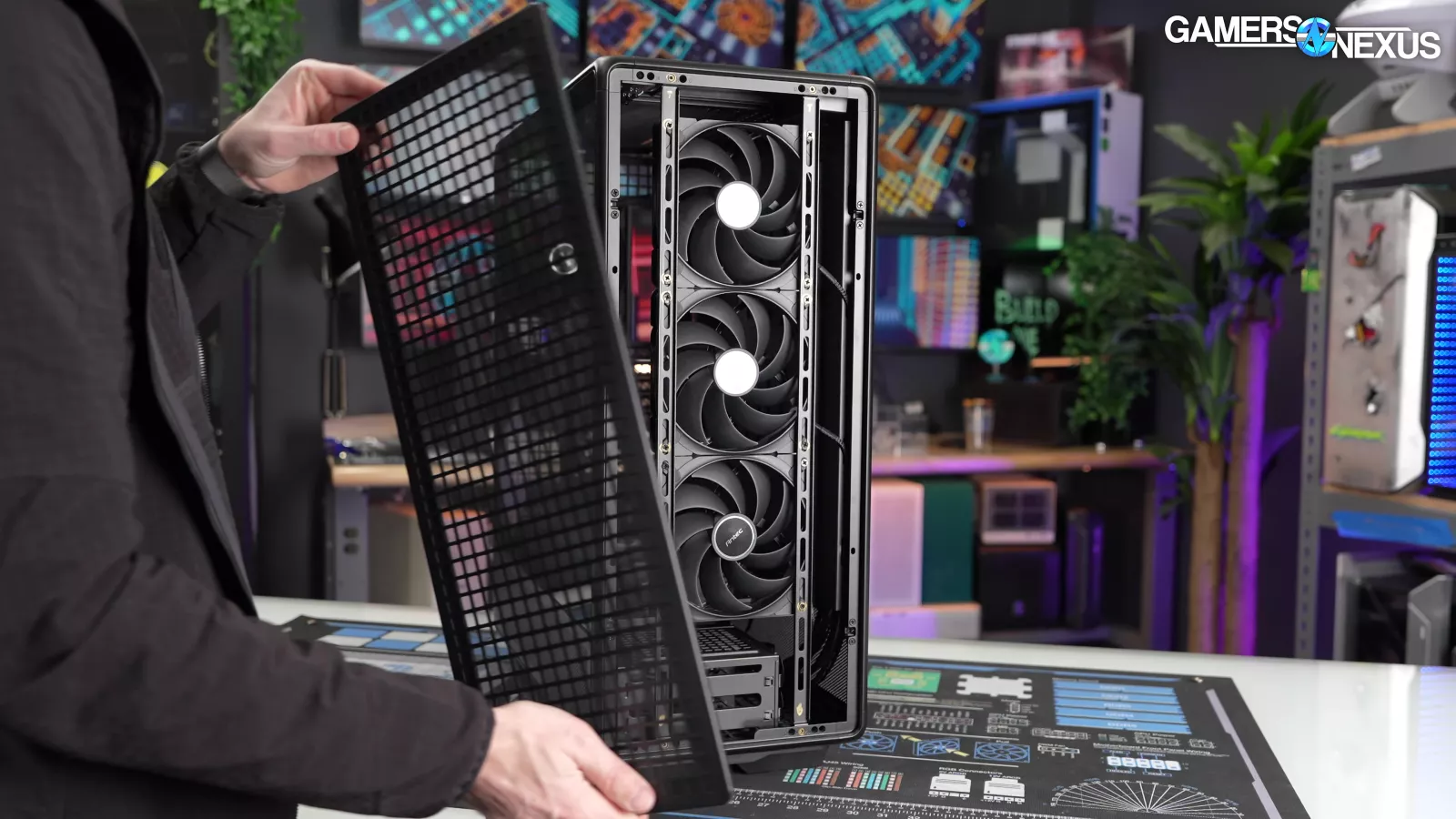
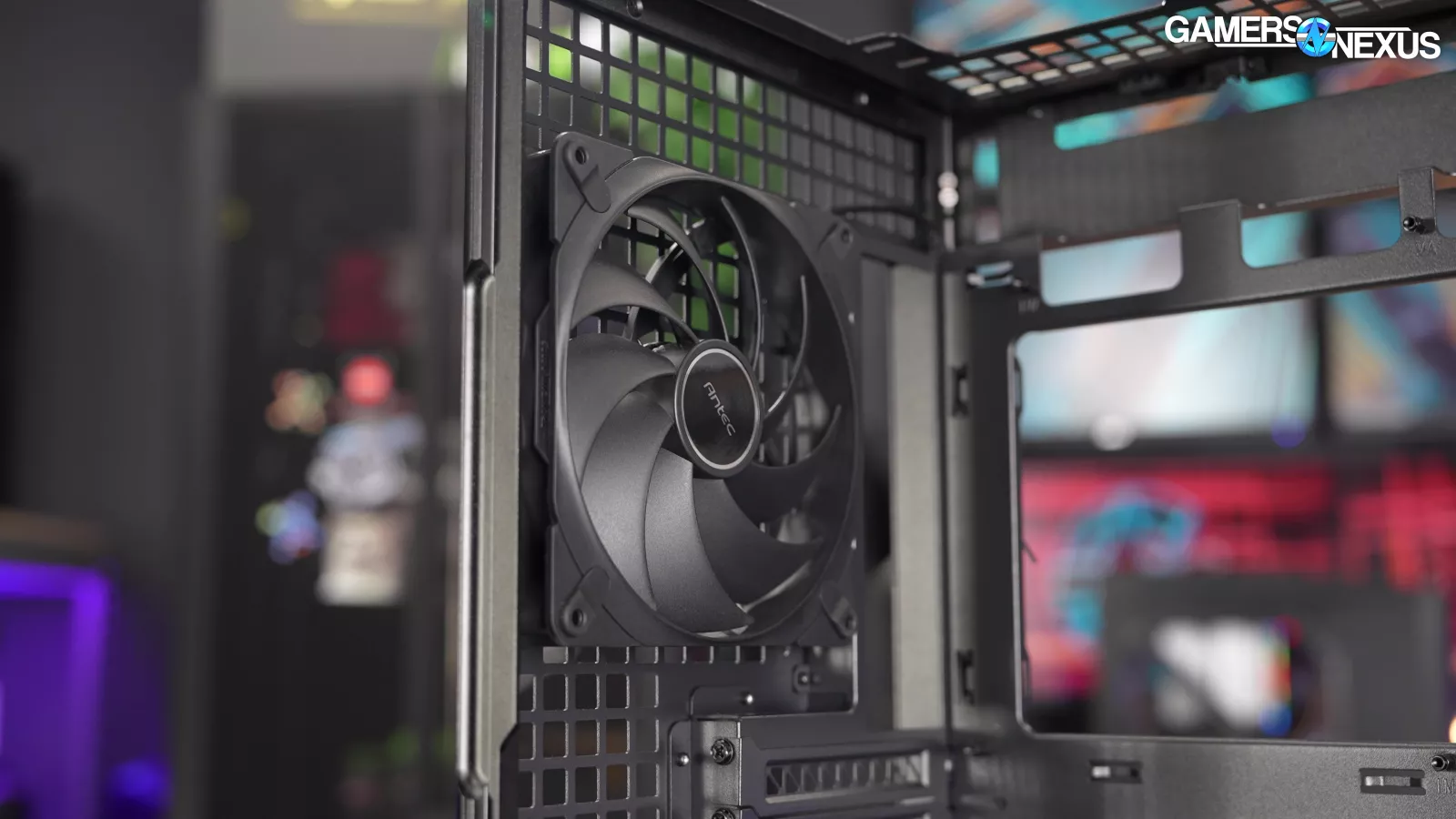
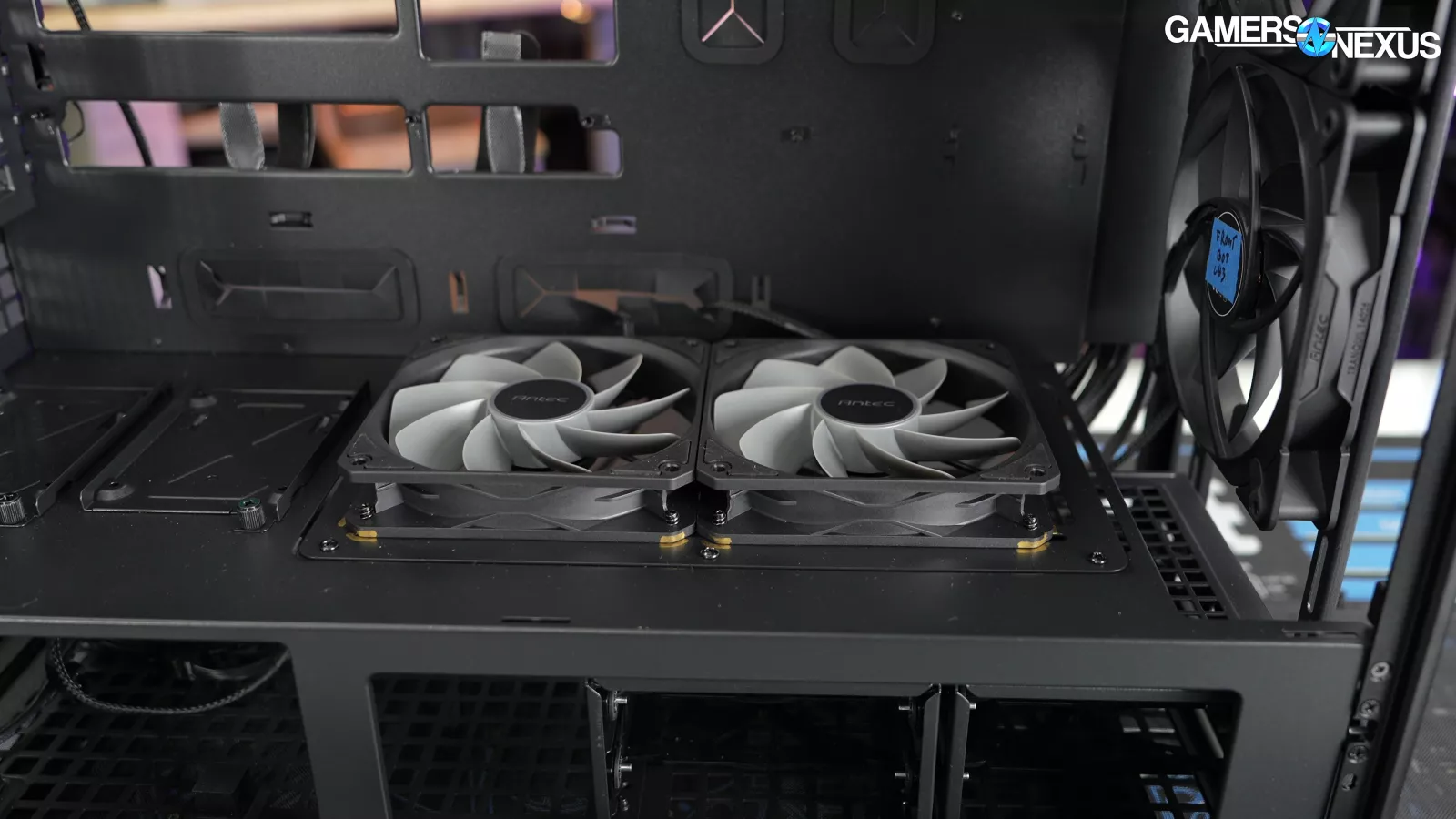
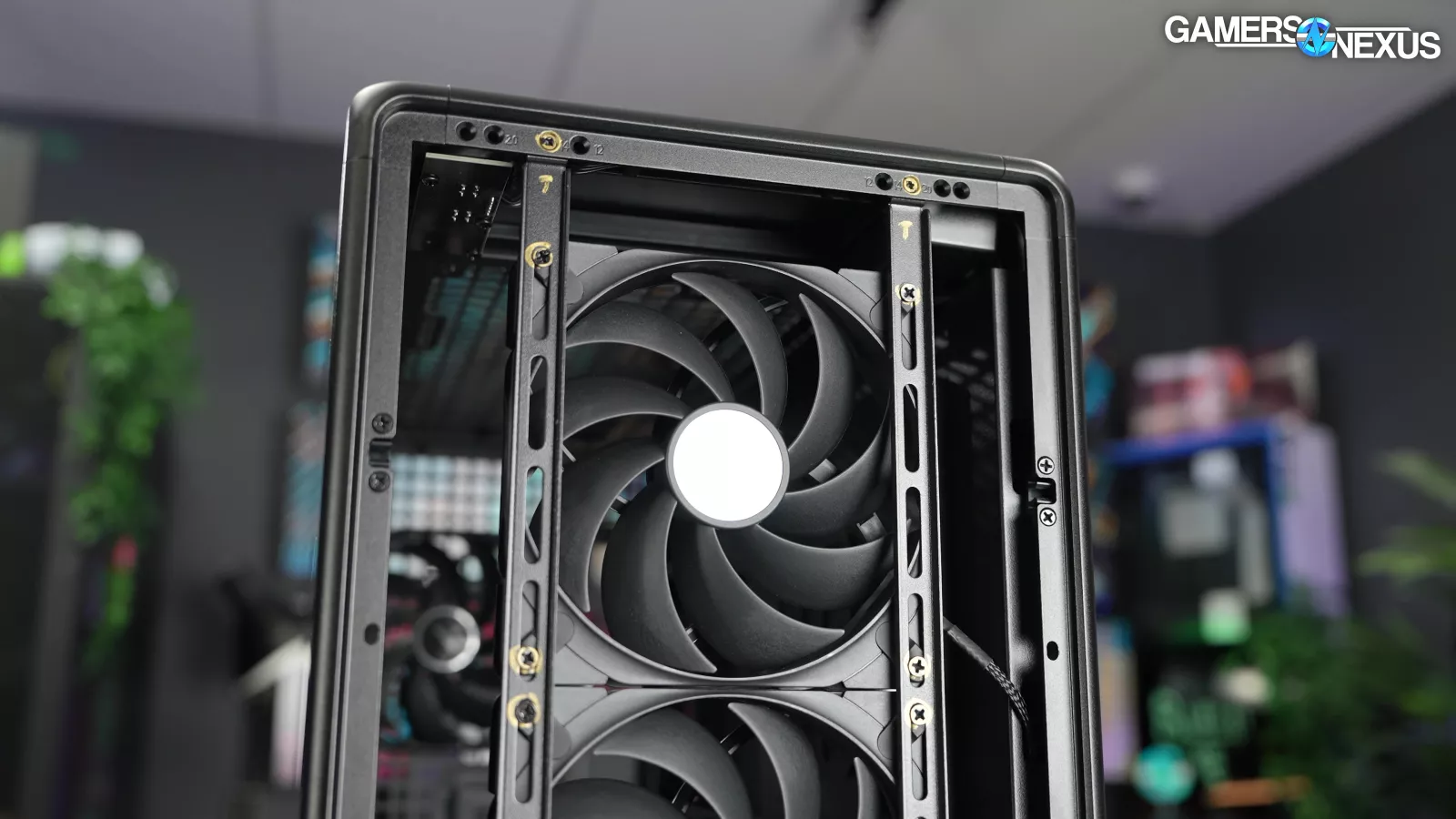
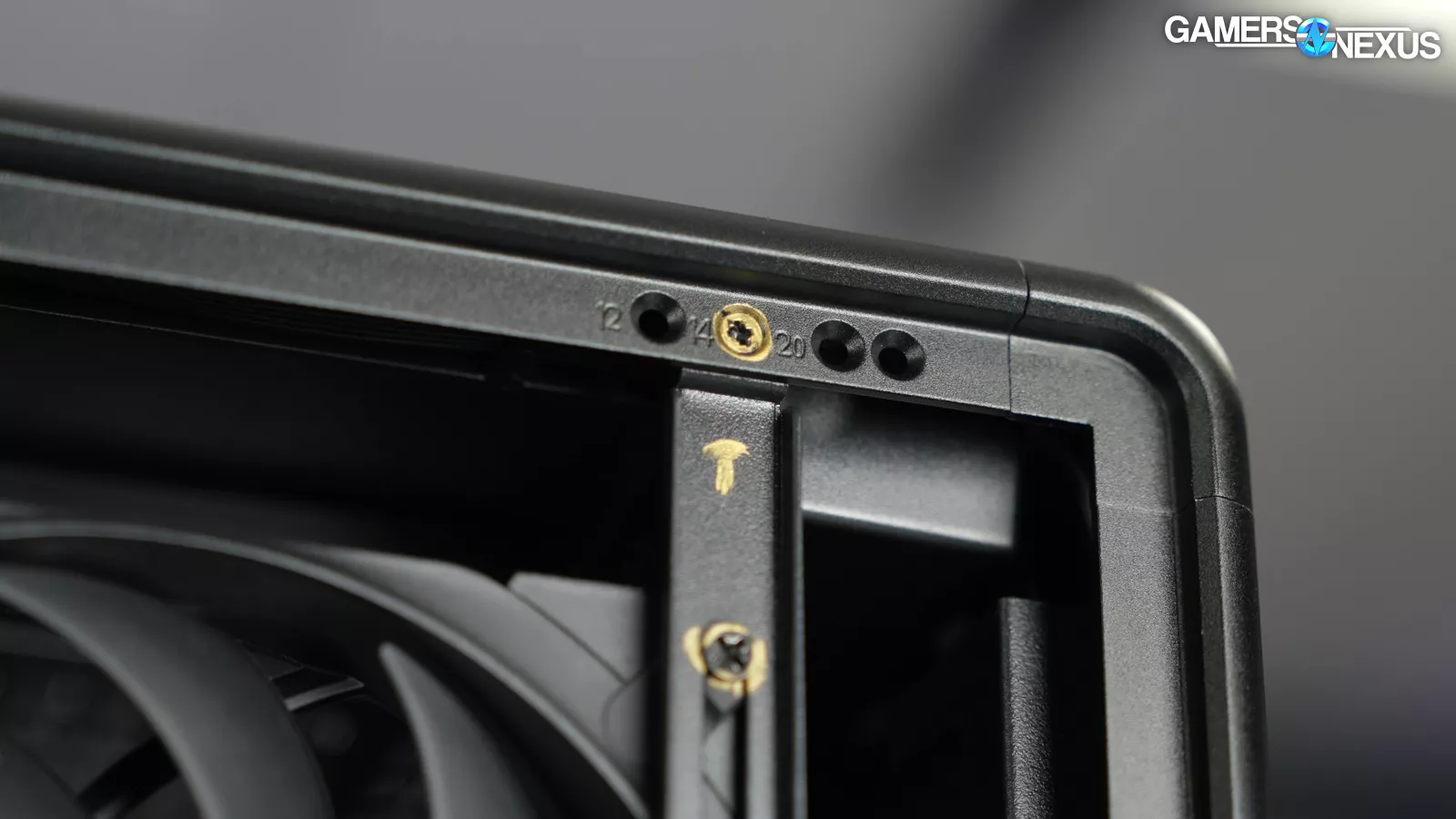
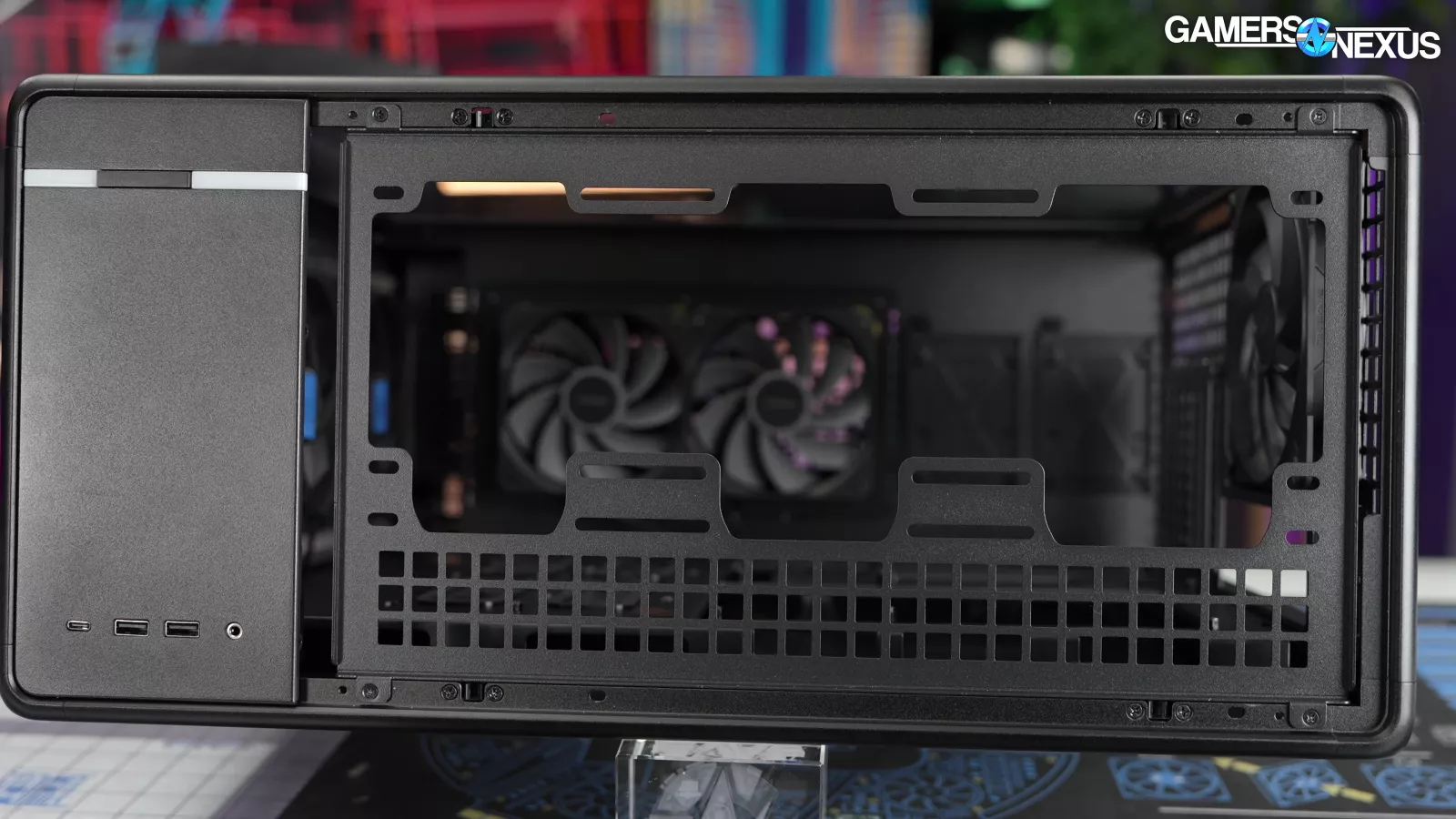
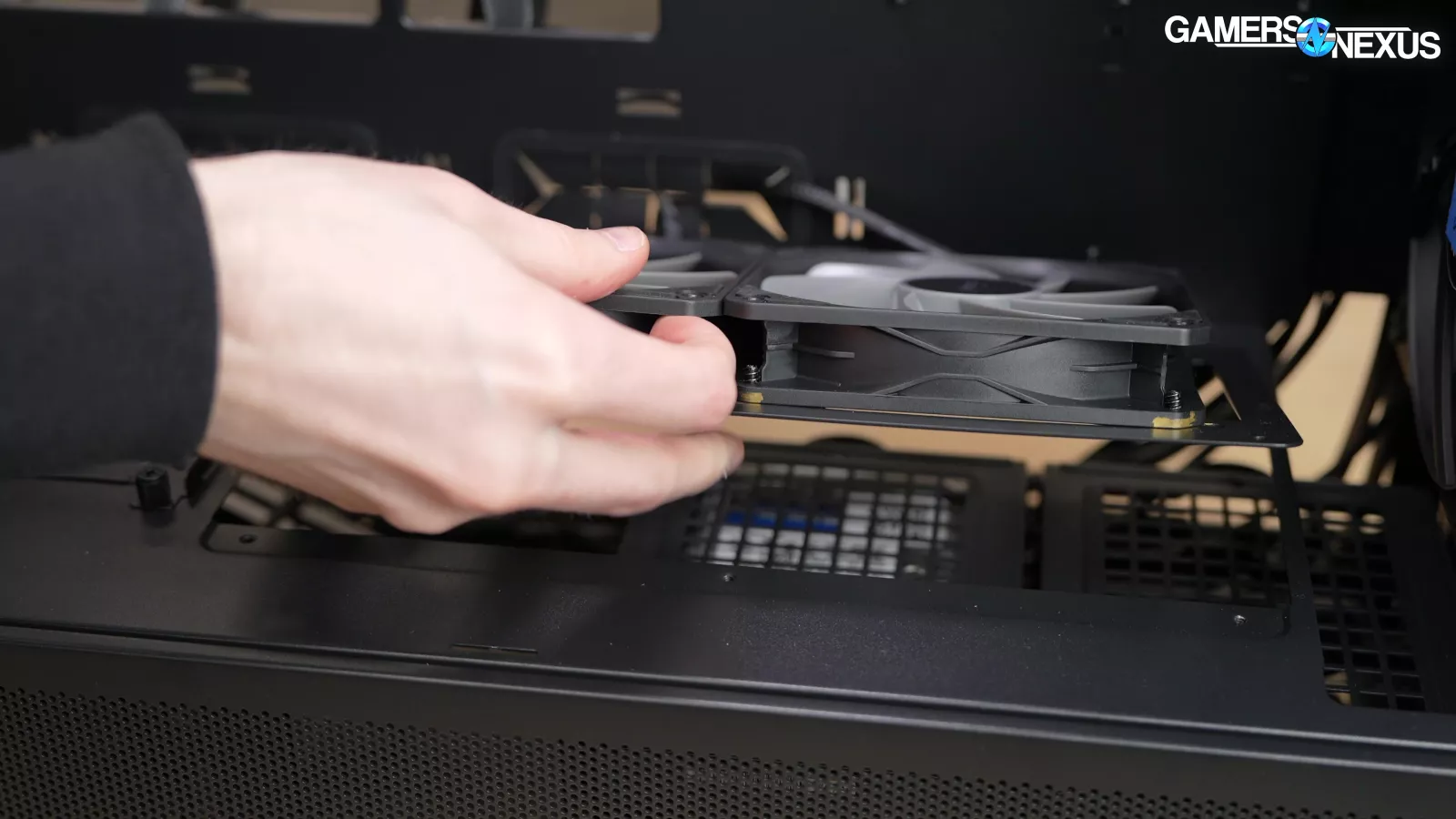
The new 900's stock layout is identical to the Flux Pro with 3x 140mm front intake, 1x 140mm rear exhaust, and 2x reverse-blade 120mm shroud-top intake. The front fans mount to two adjustable rails that can be spaced up to 200mm, top fans to a removable 140mm/120mm tray, and the shroud-top fans to another removable tray that only fits 120mm.
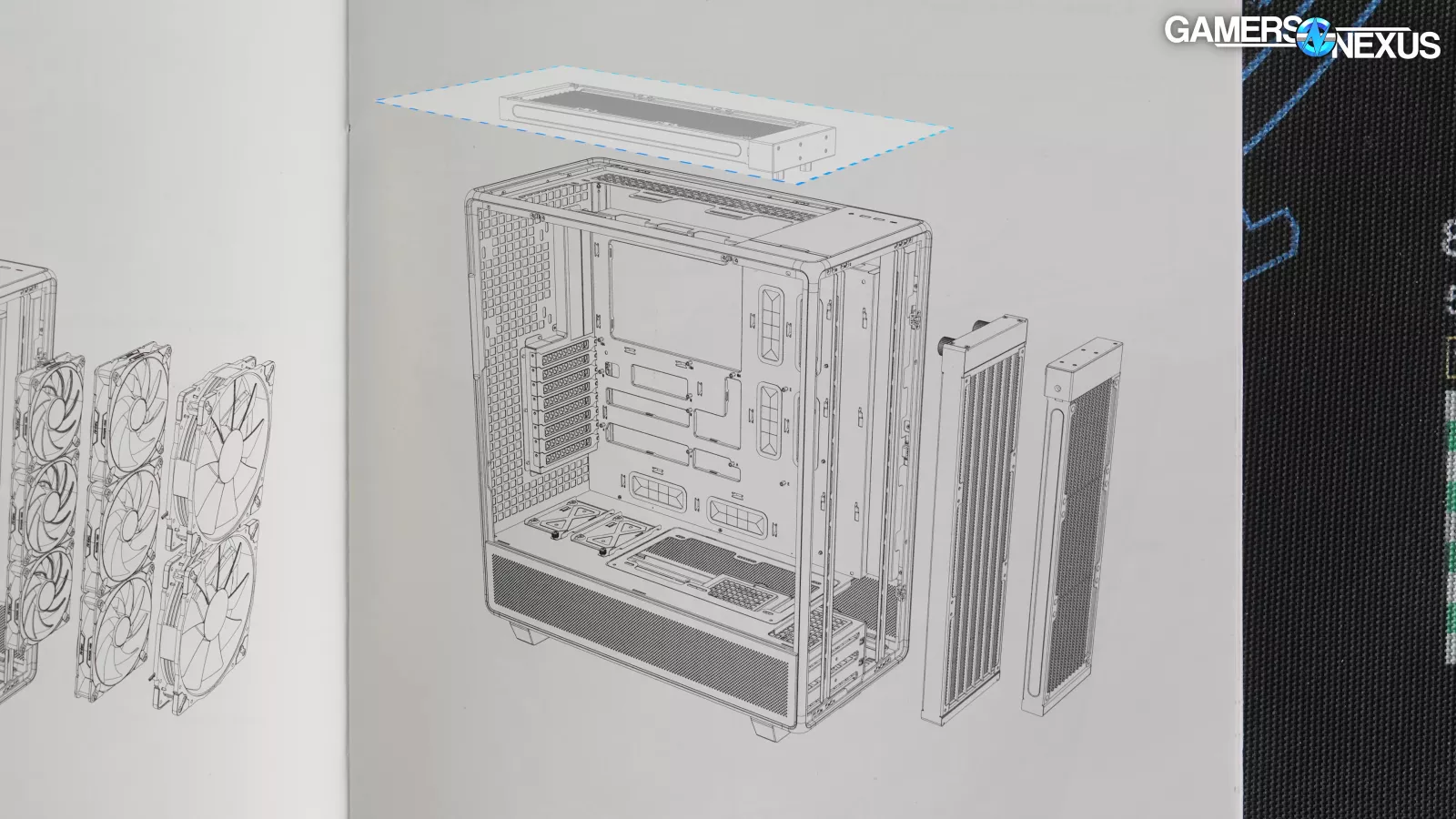
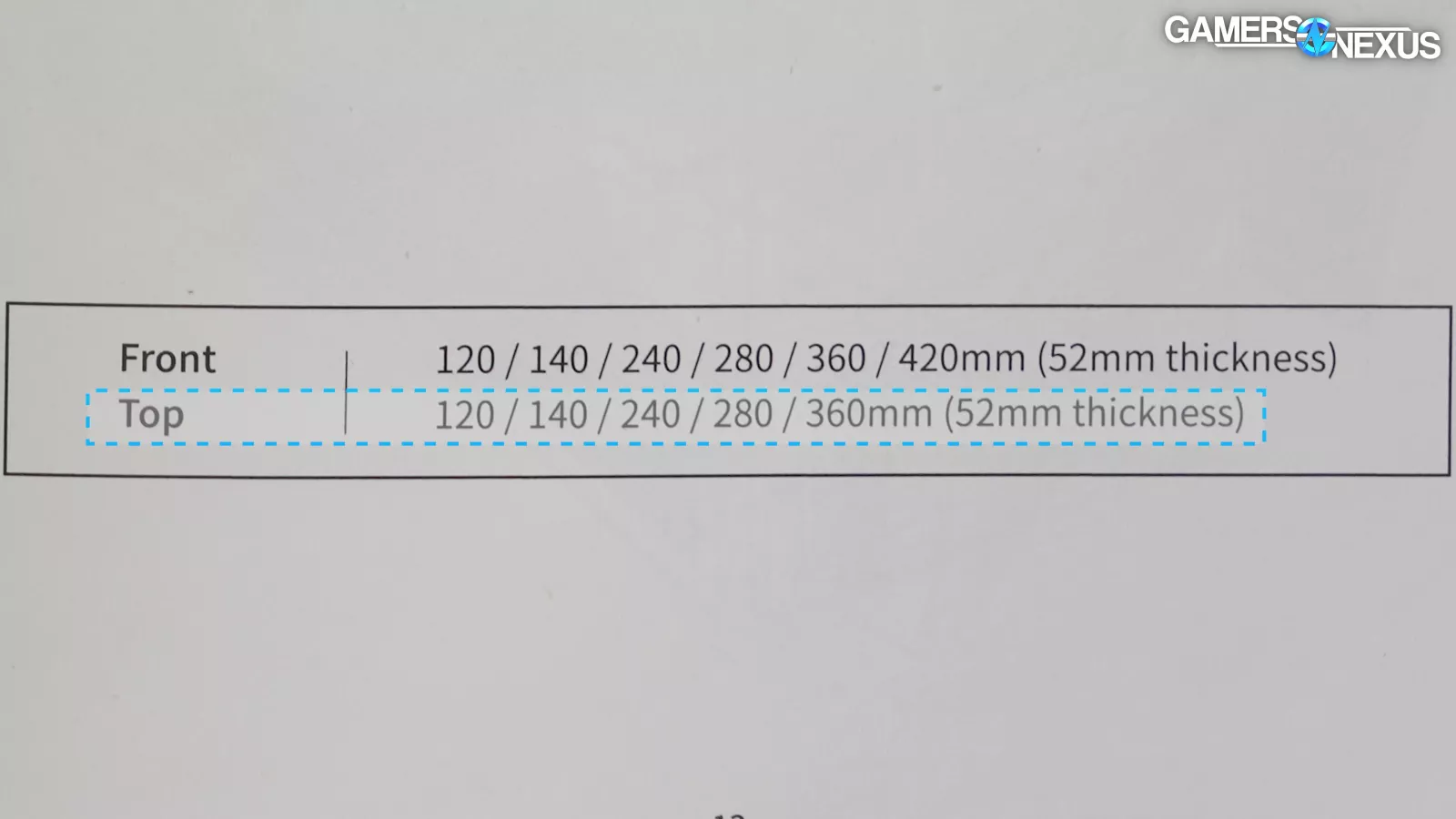
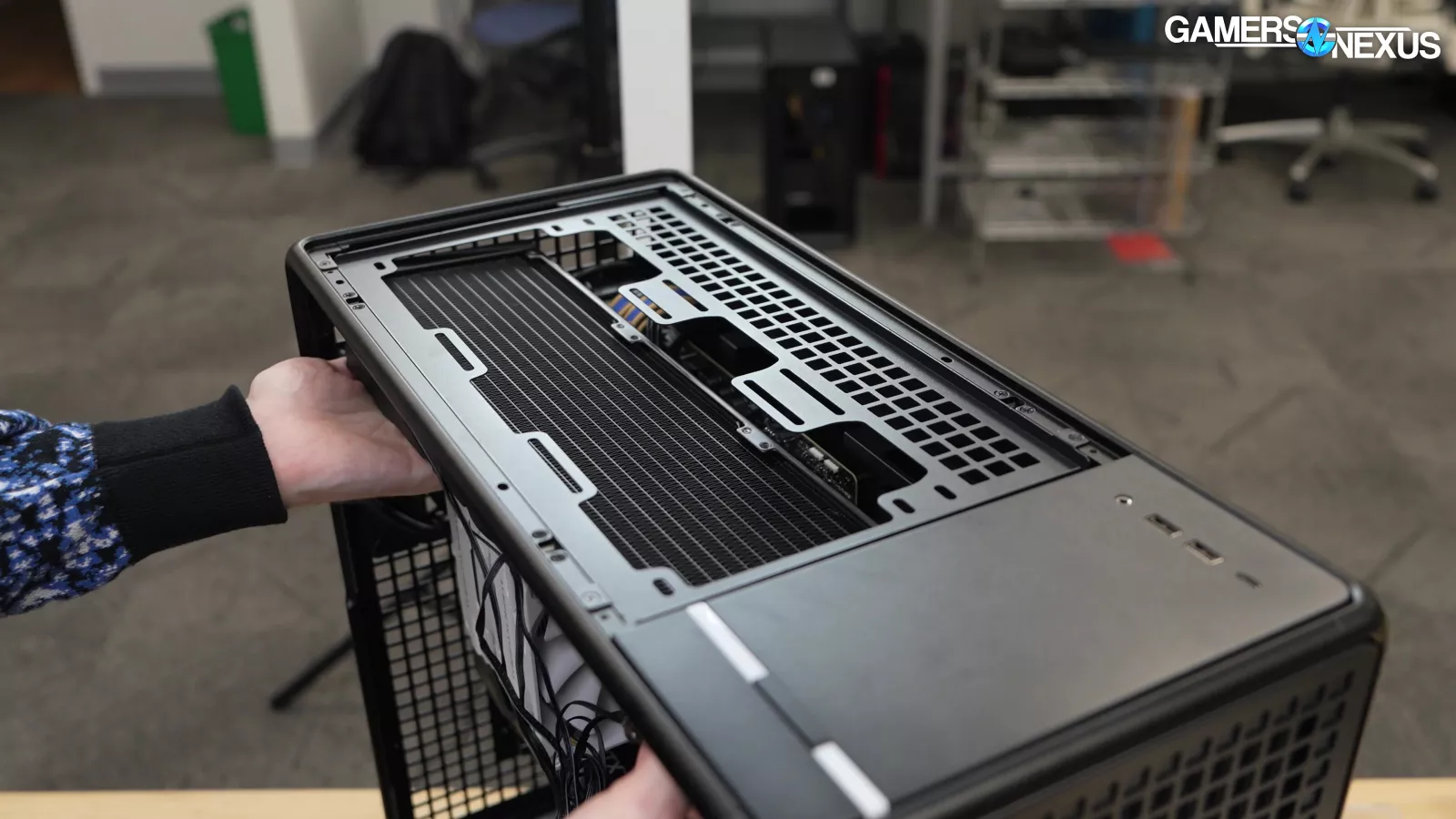
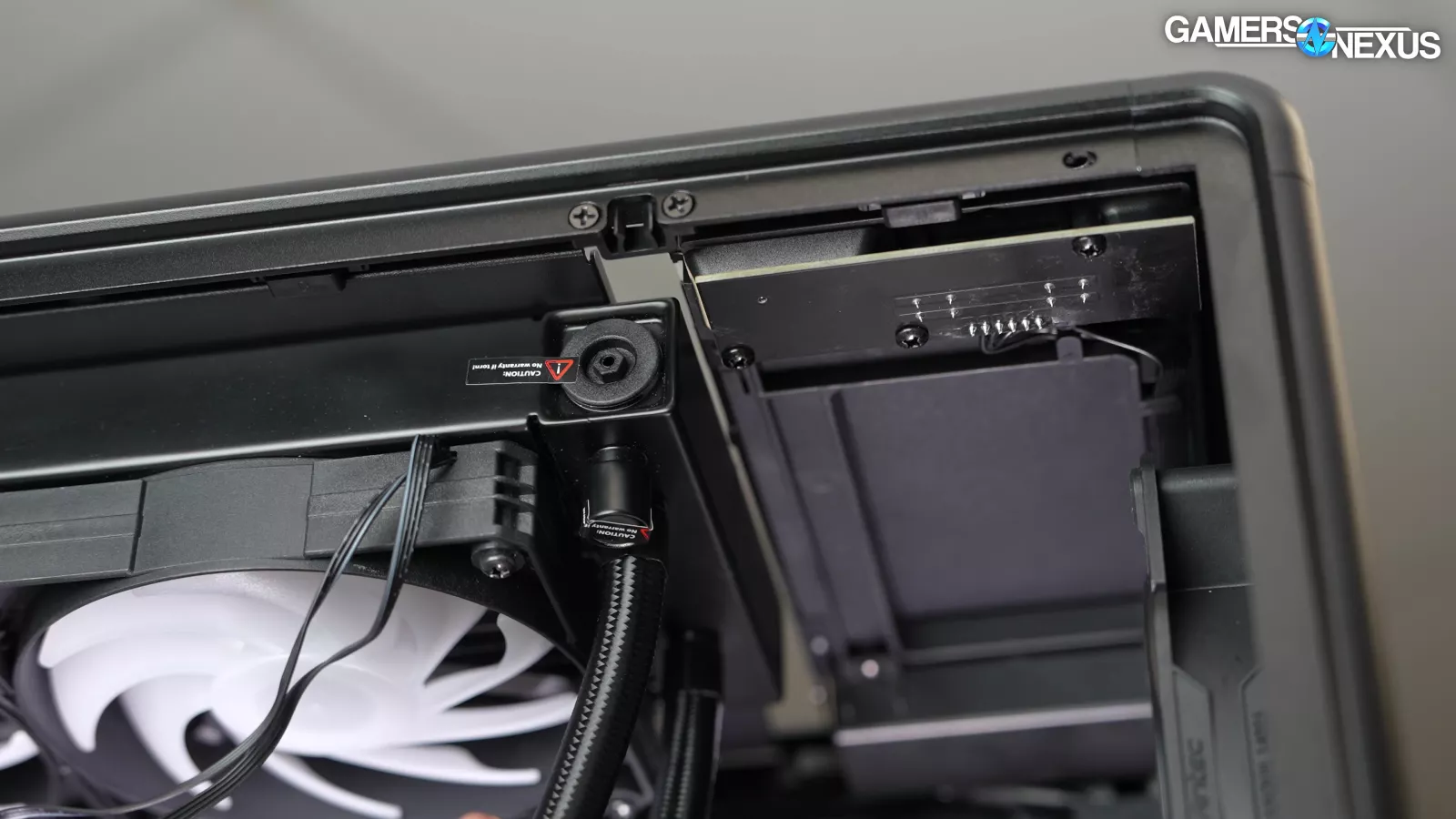
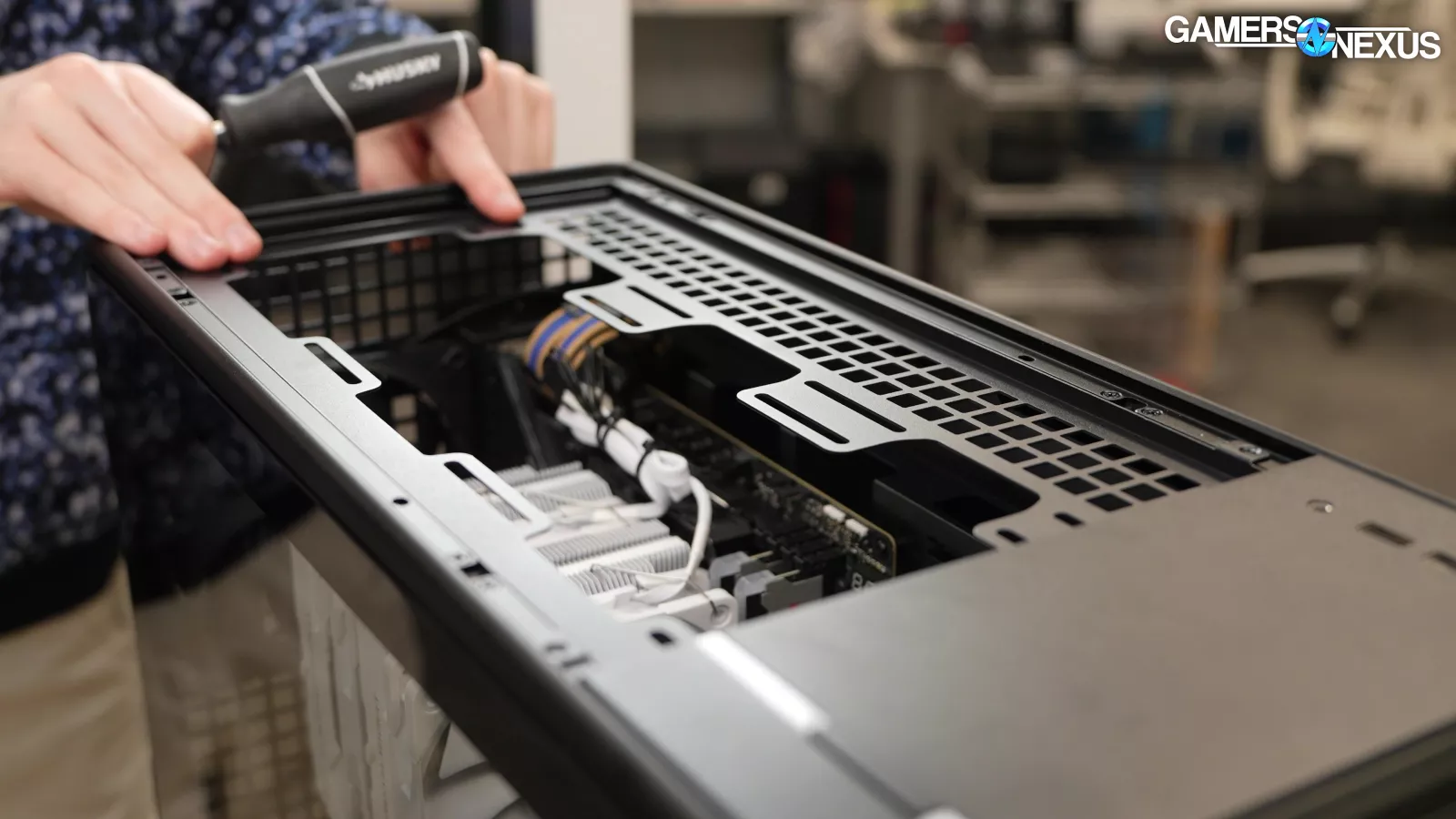
The top mount fits radiators up to 360mm, but it's a weirdly tight fit due to the oversized front I/O plate. The mount can be shifted forward exactly 1cm, which could help with some hyper-specific clearance issues.
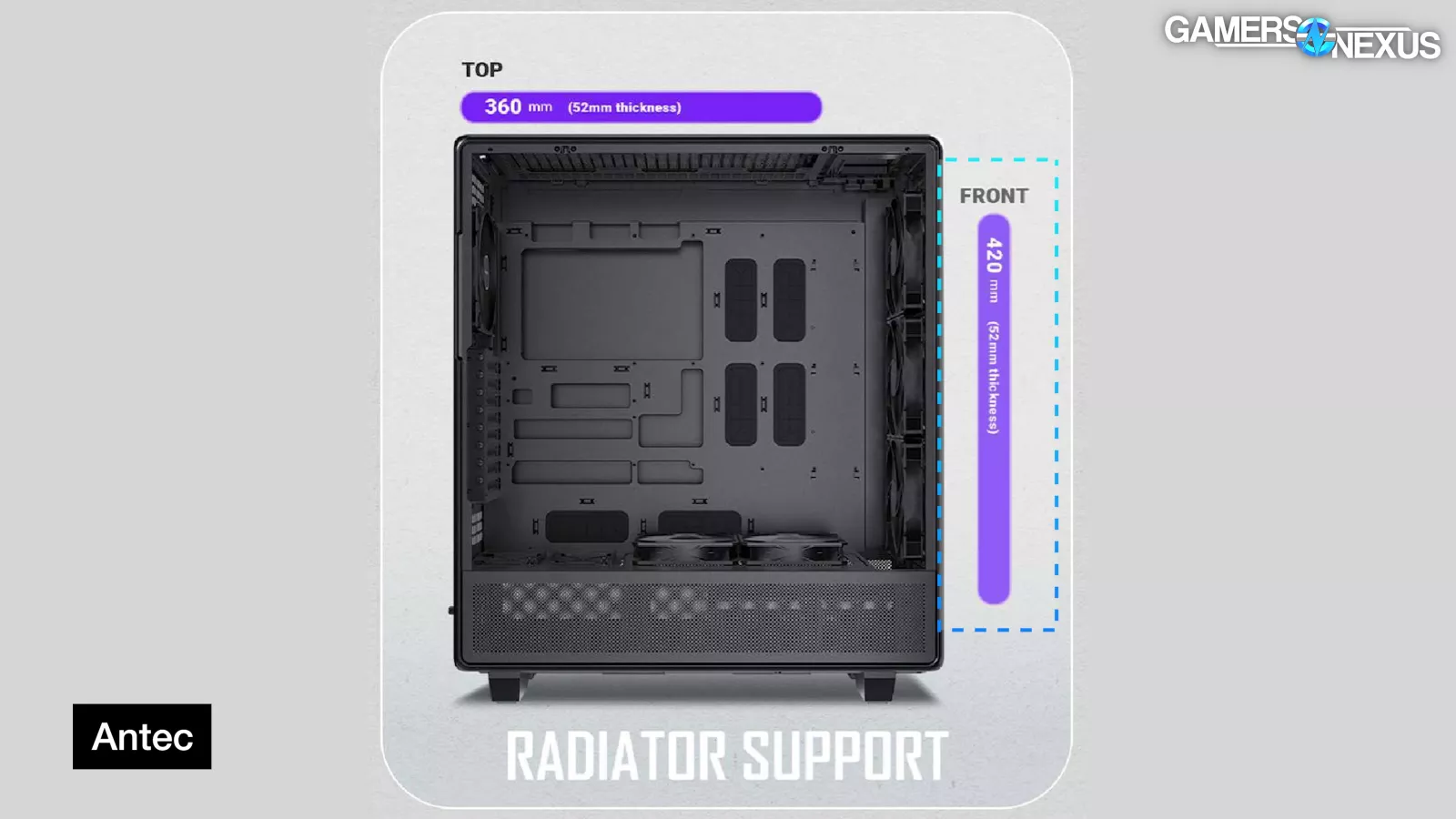
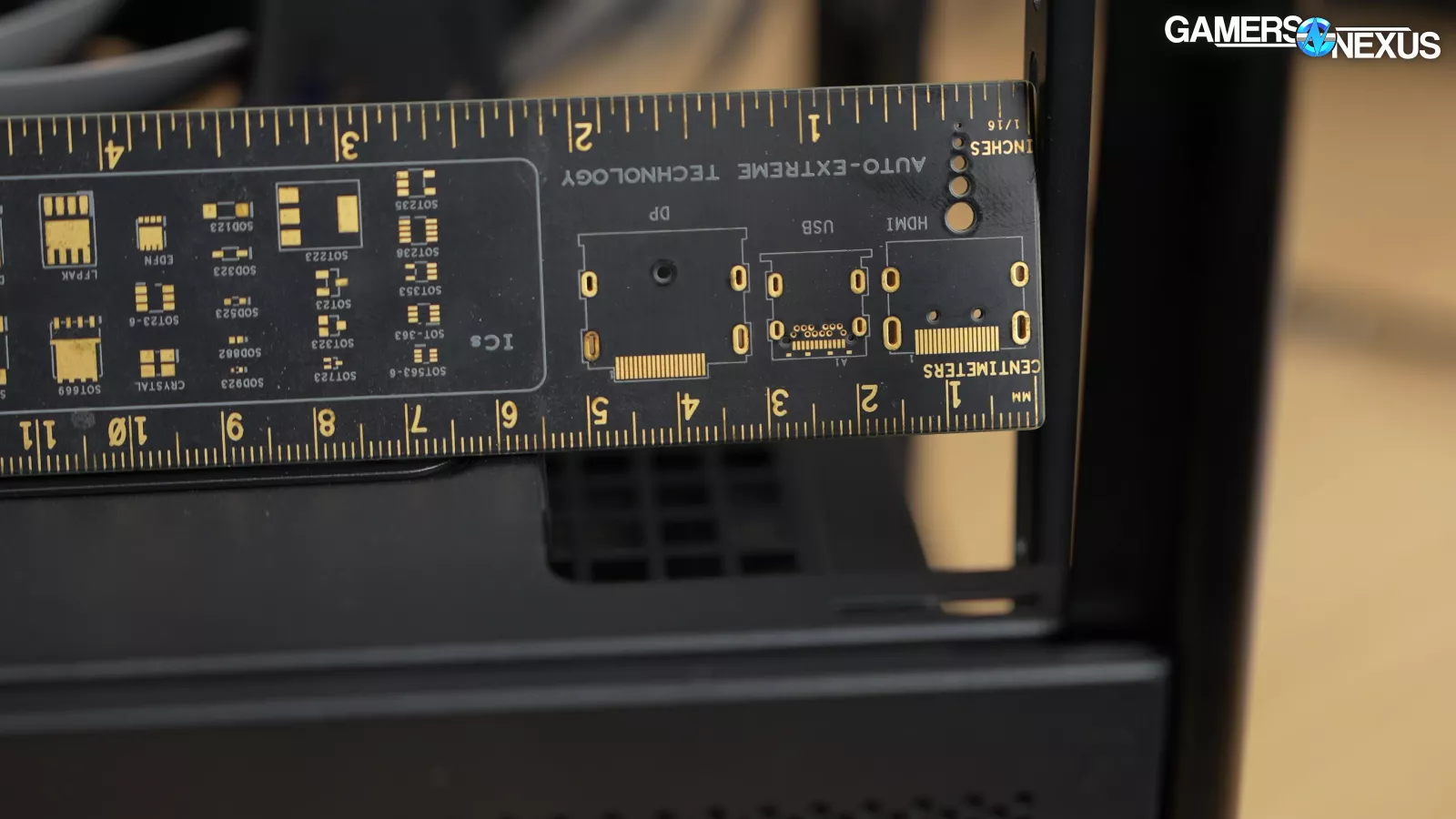
Per Antec, the shroud cutout allows for a maximum rad+fan thickness of 52mm, but we measured closer to 55.
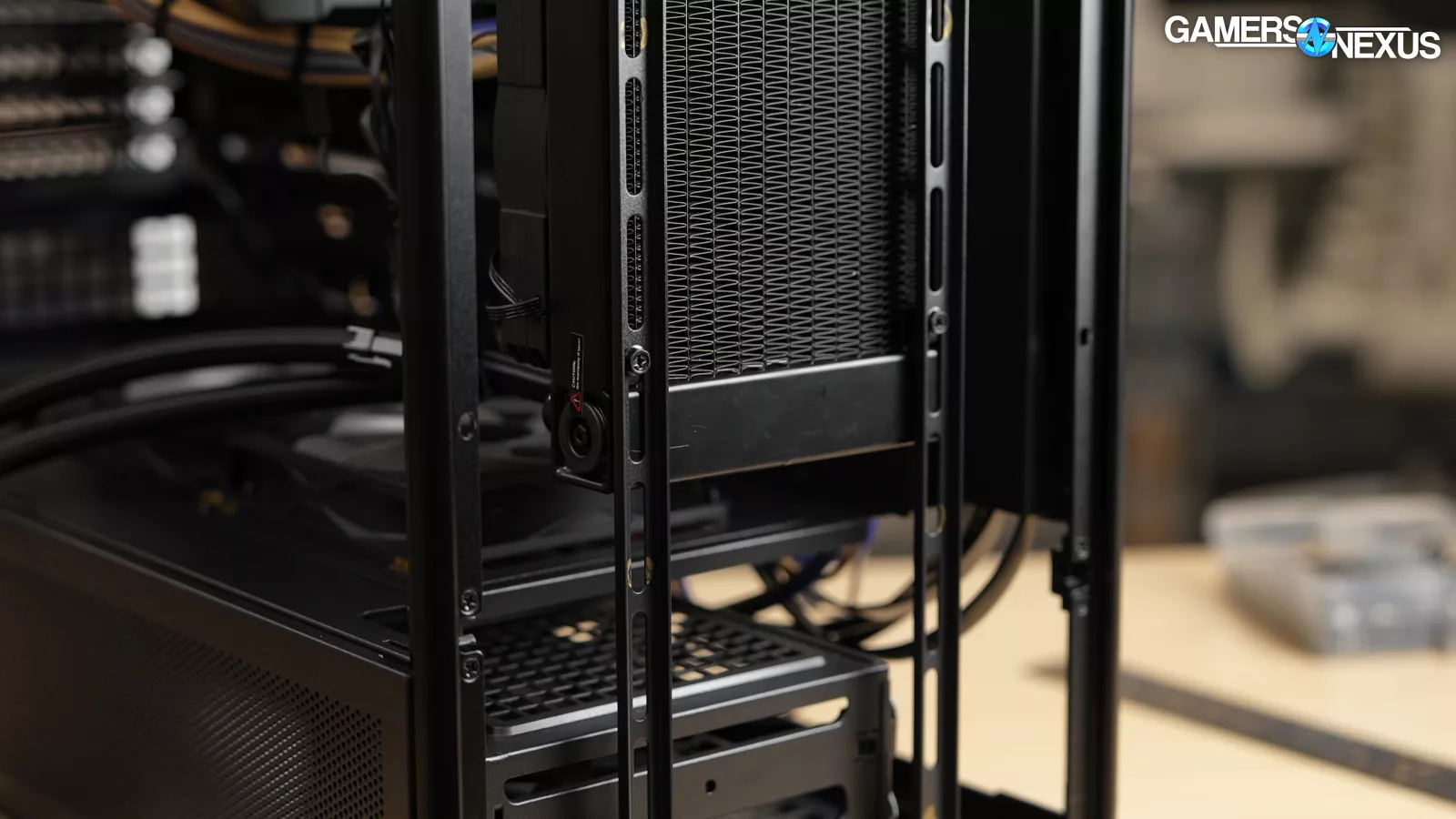
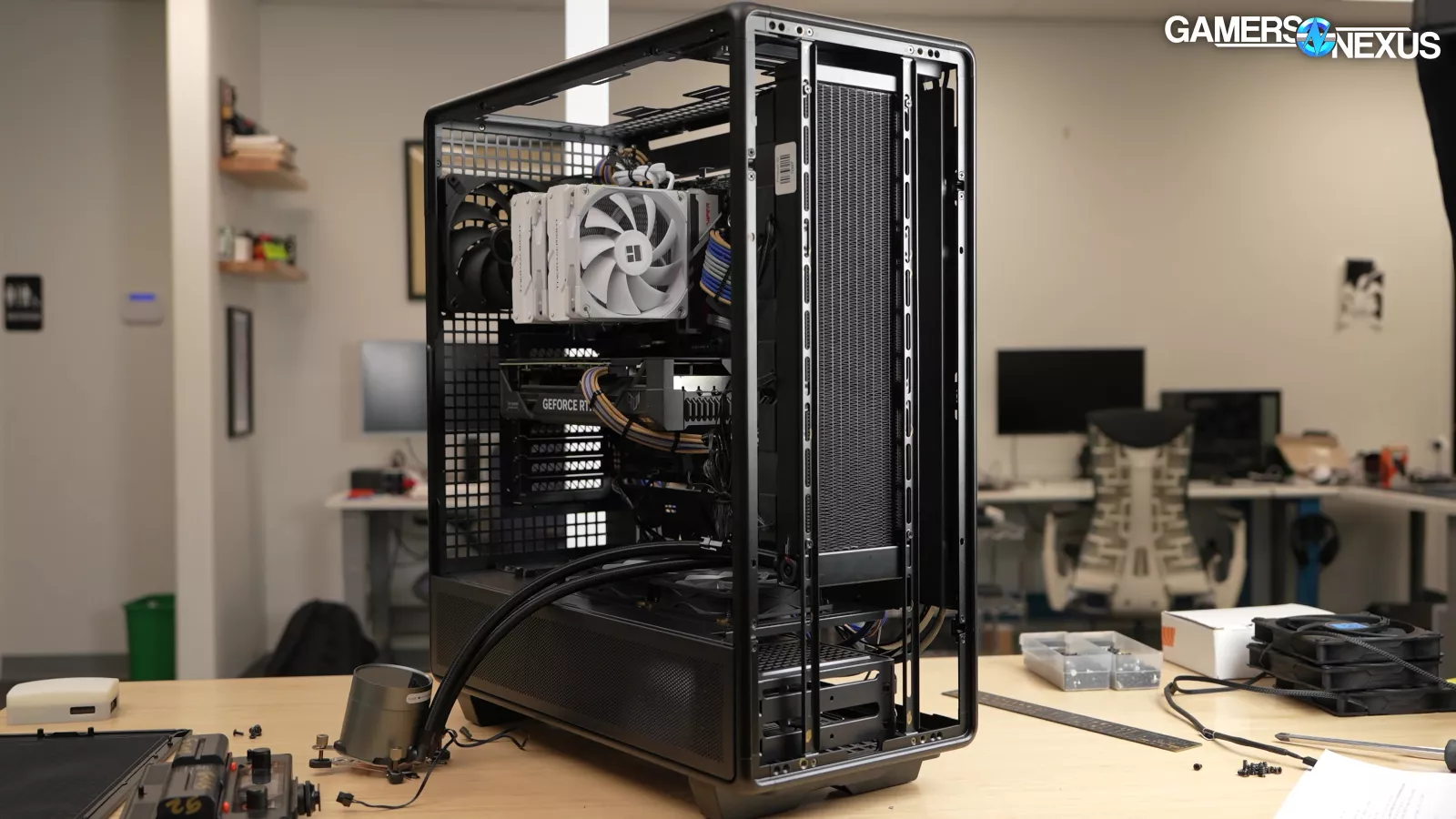
360mm radiators can sit fully above the level of the shroud.
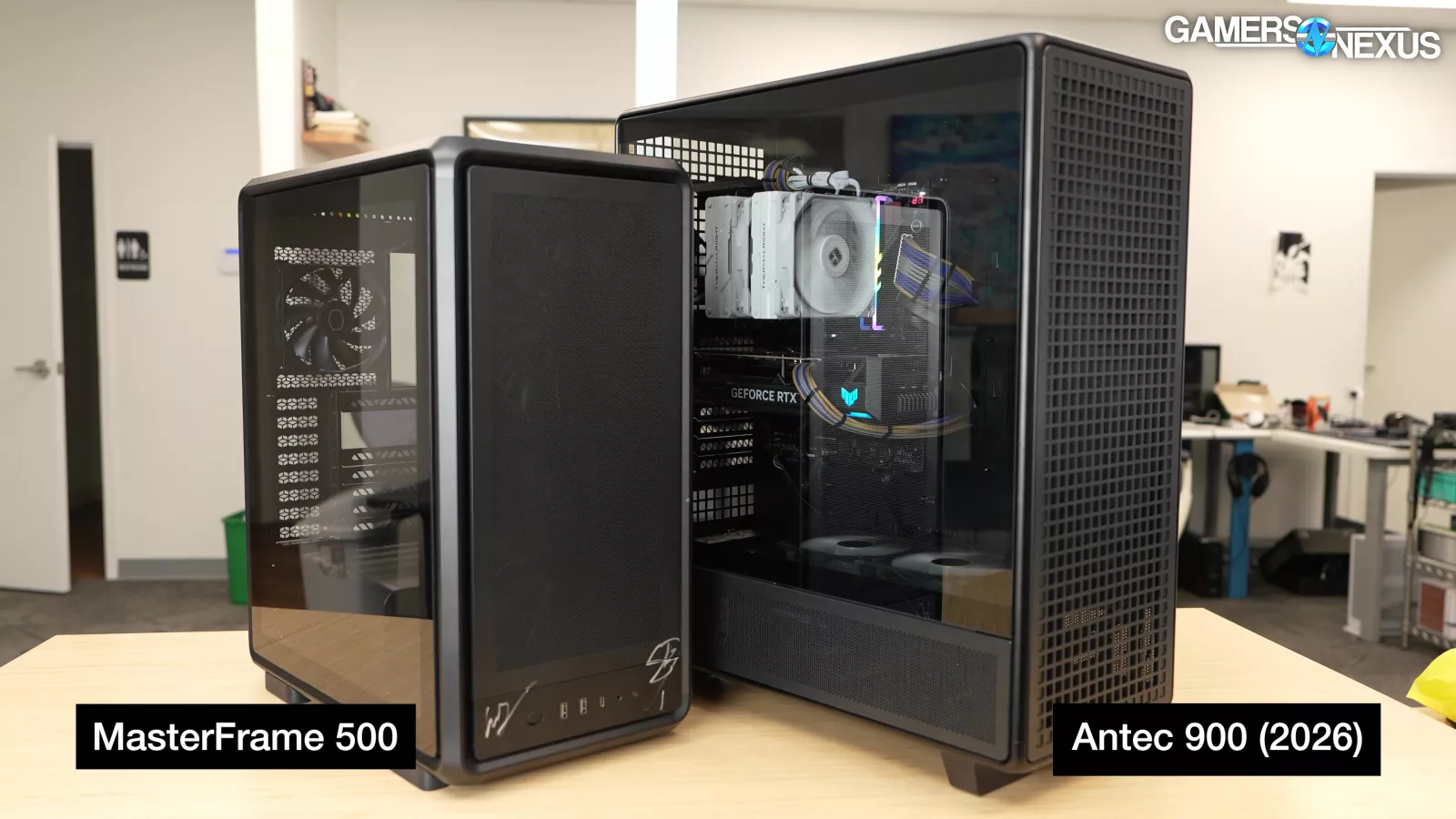
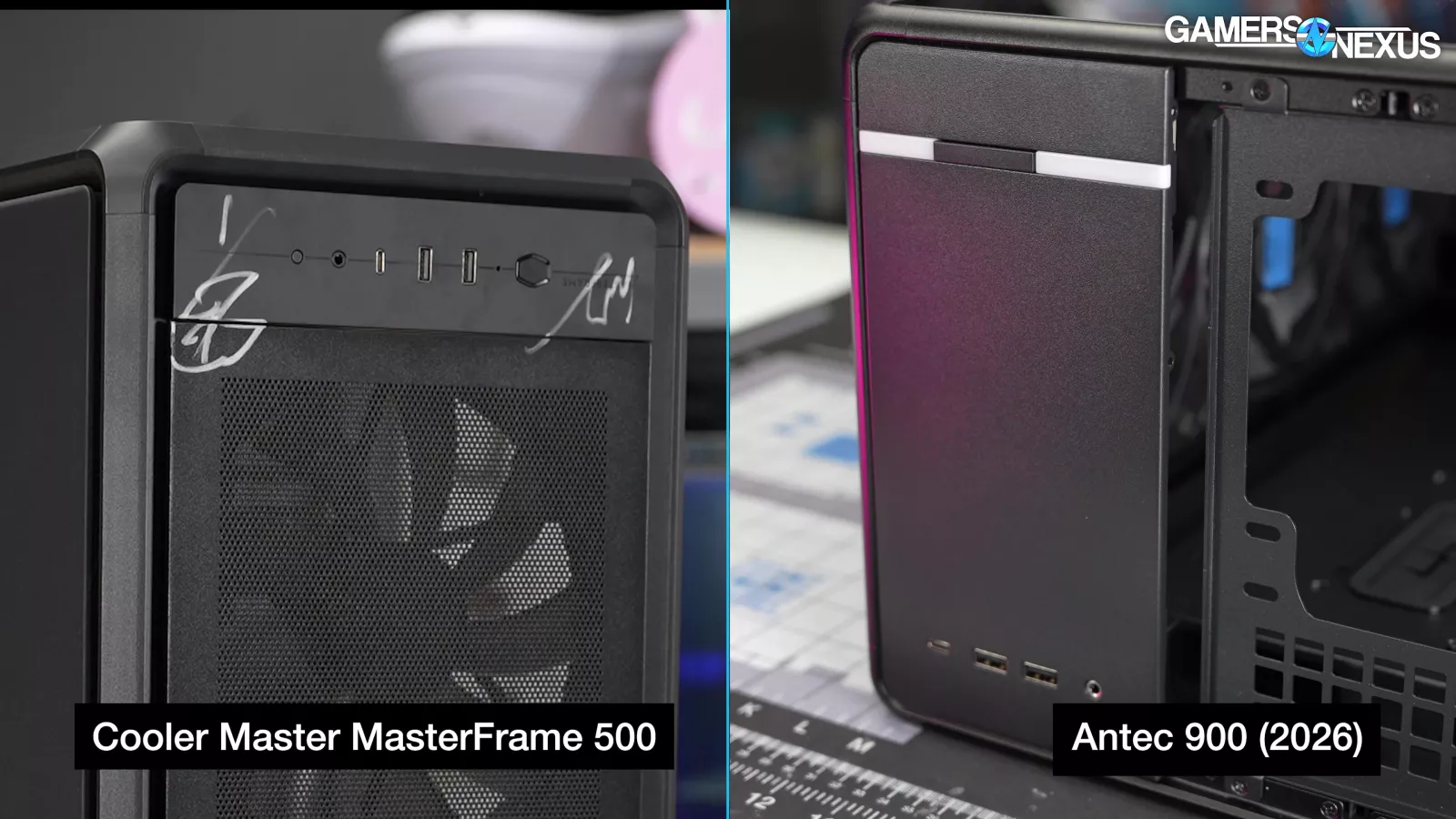
The new 900 reminds us of Cooler Master's MasterFrame 500 (read our review) more than anything else. They have the same aluminum skeleton of corners and beams, the same round-edged panels, and even a similar front I/O setup (depending on how the MF500 is configured). Unlike the 900, the MF500 does include 200mm fans.
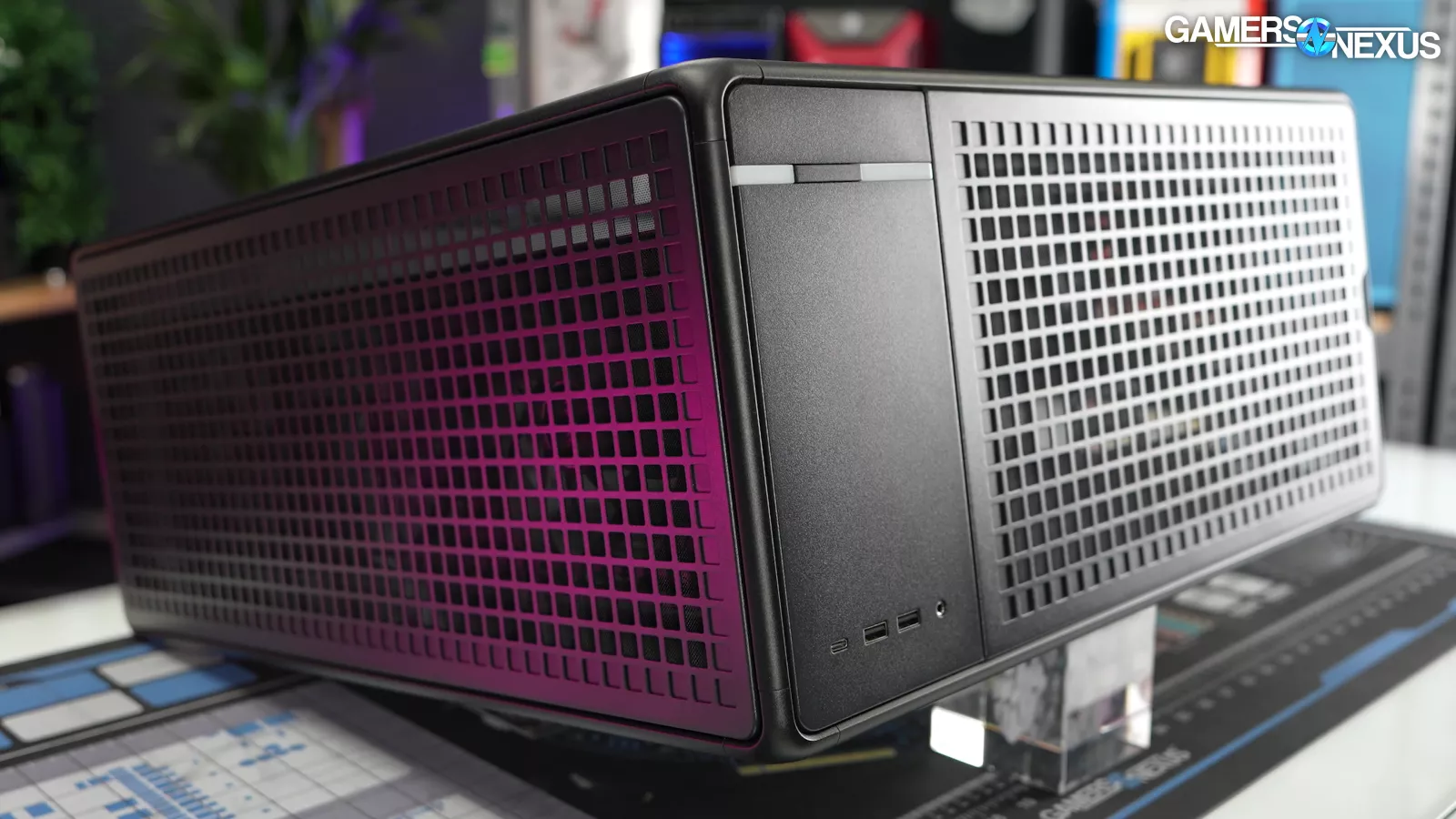
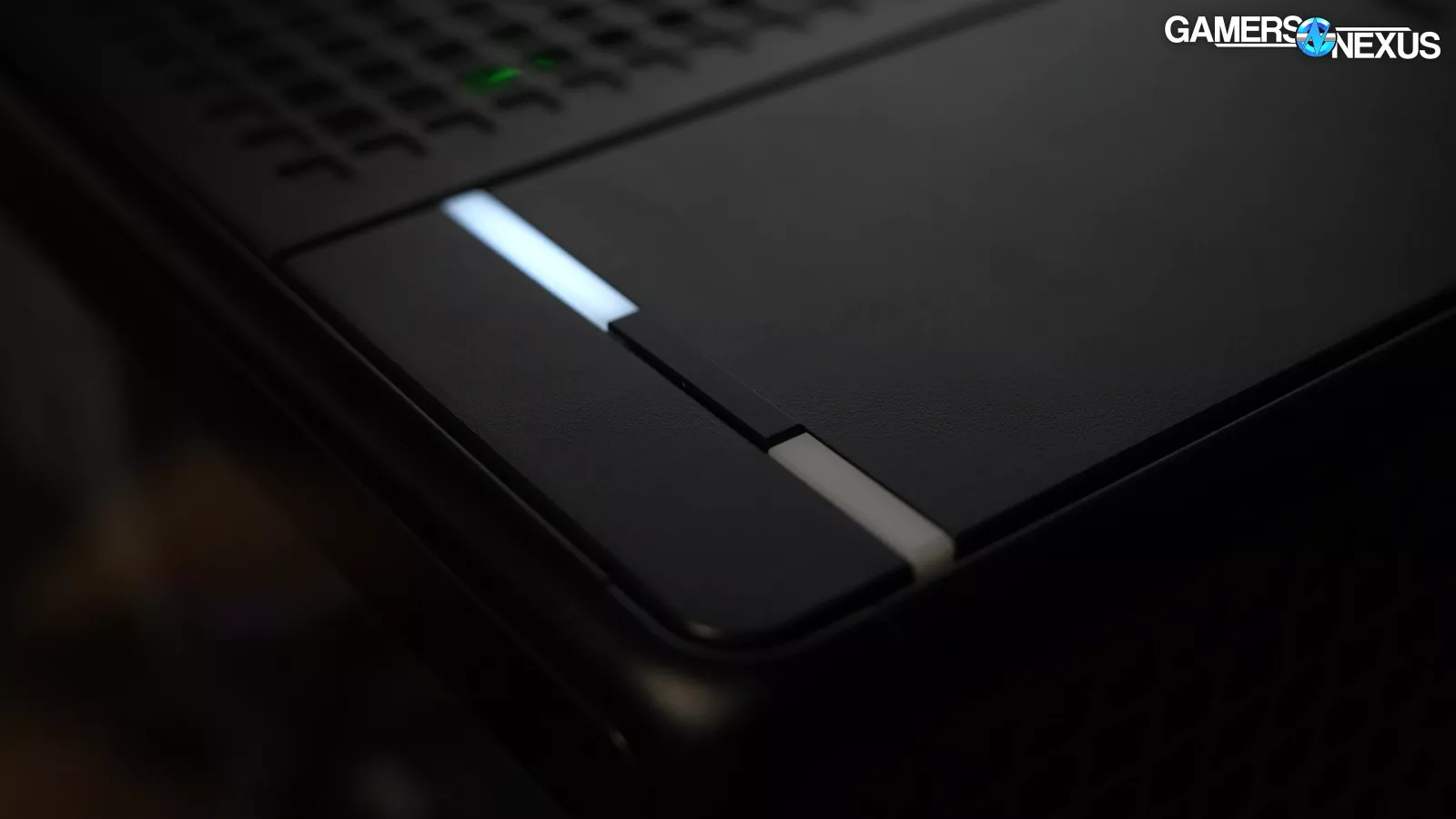
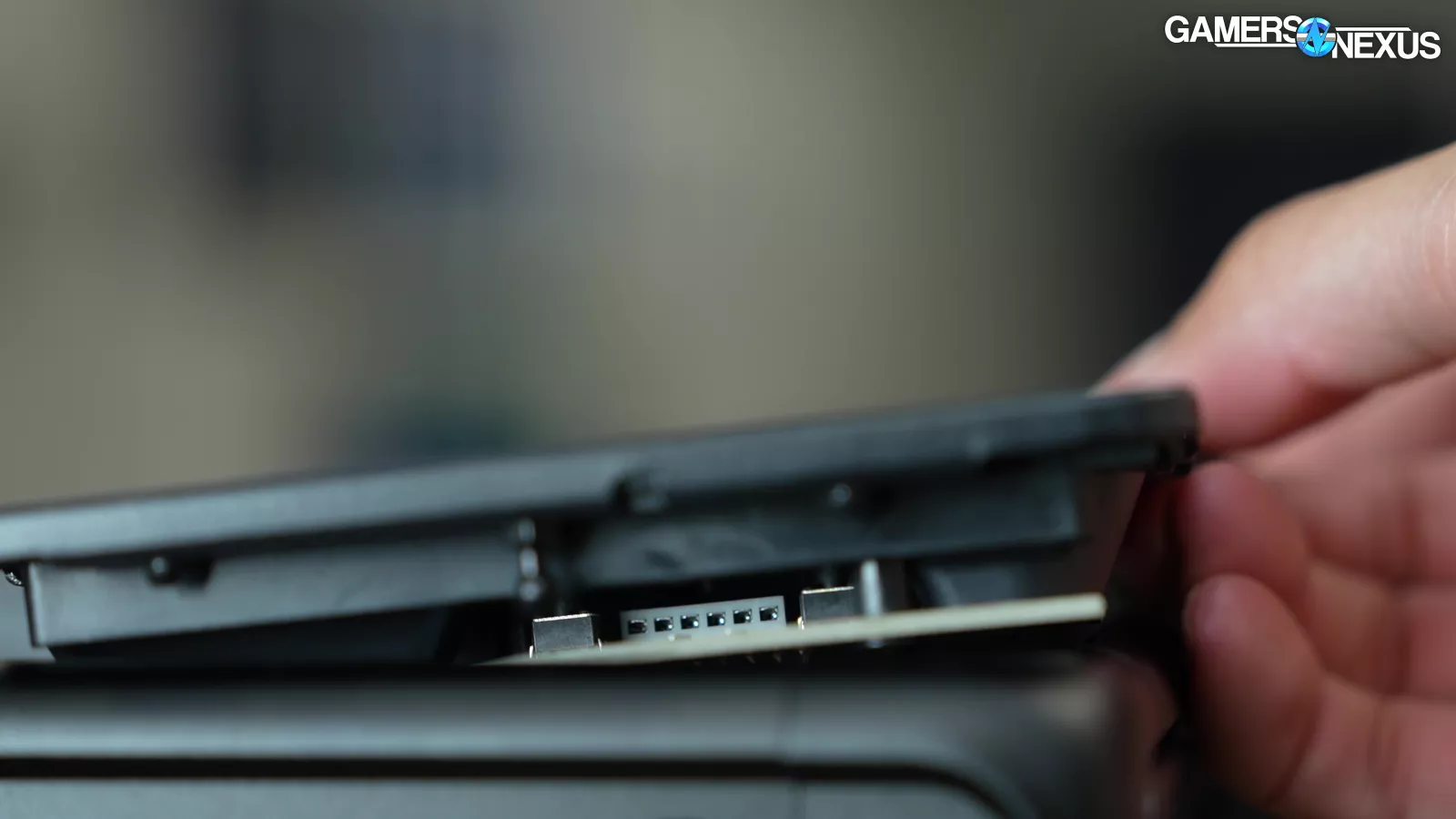
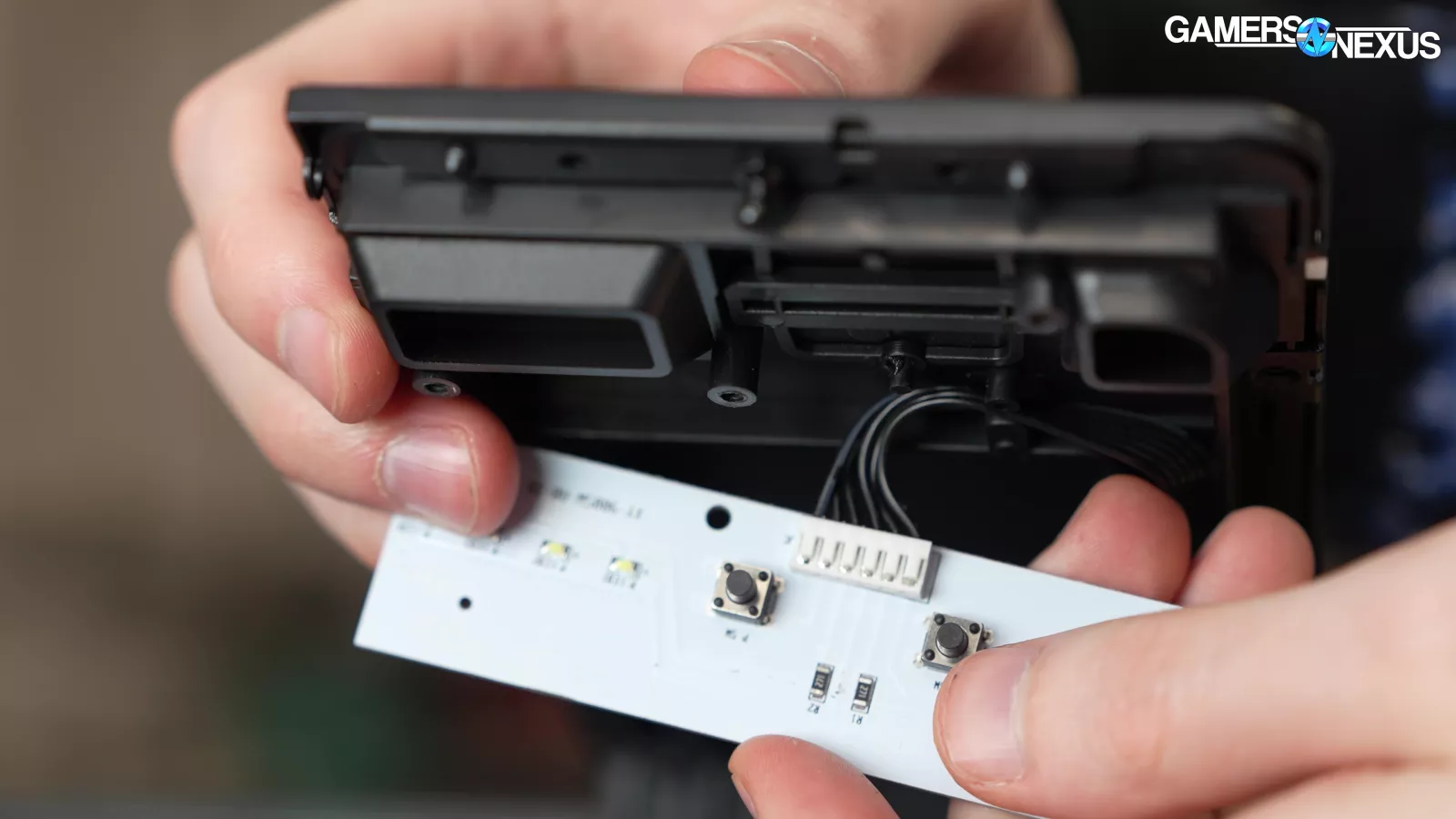
The power button is the most unique stylistic choice, but maybe not in a positive way. The strip on one side of the power button is the power LED, and on the other side is the disk activity LED. With the single SSD in our test system, the disk LED is usually off, so it just looks half burnt out. The power button itself contains two switches, but they both do the same thing.
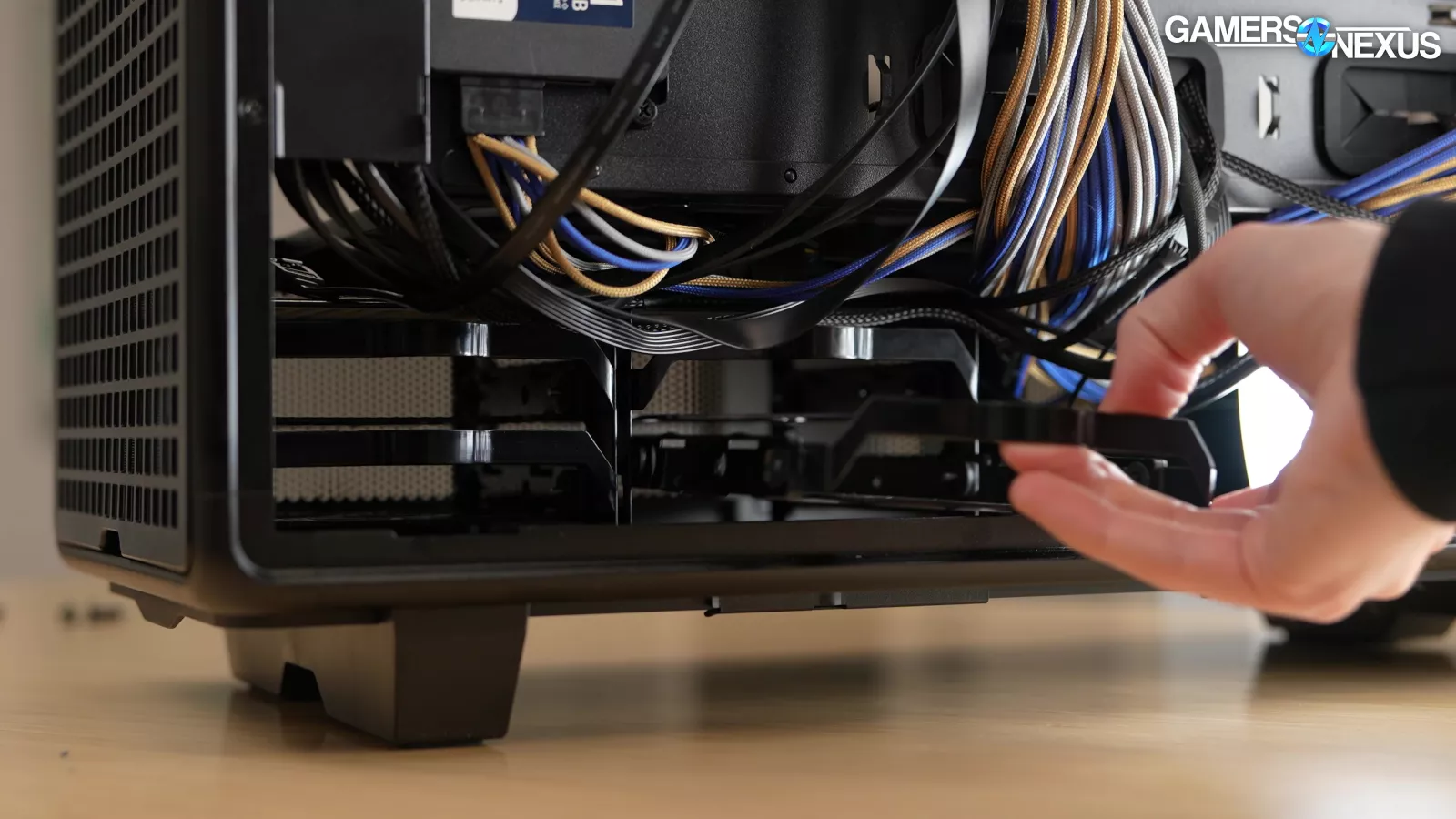
The 3.5" sleds are functional, but their design makes them unavoidably flimsy-feeling. The plastic flexes as the handle is pulled, which warps the sled and allows it to pop out of the cage. The cages are removable, but because of the size of the case, it's unlikely that PSU clearance issues will arise.
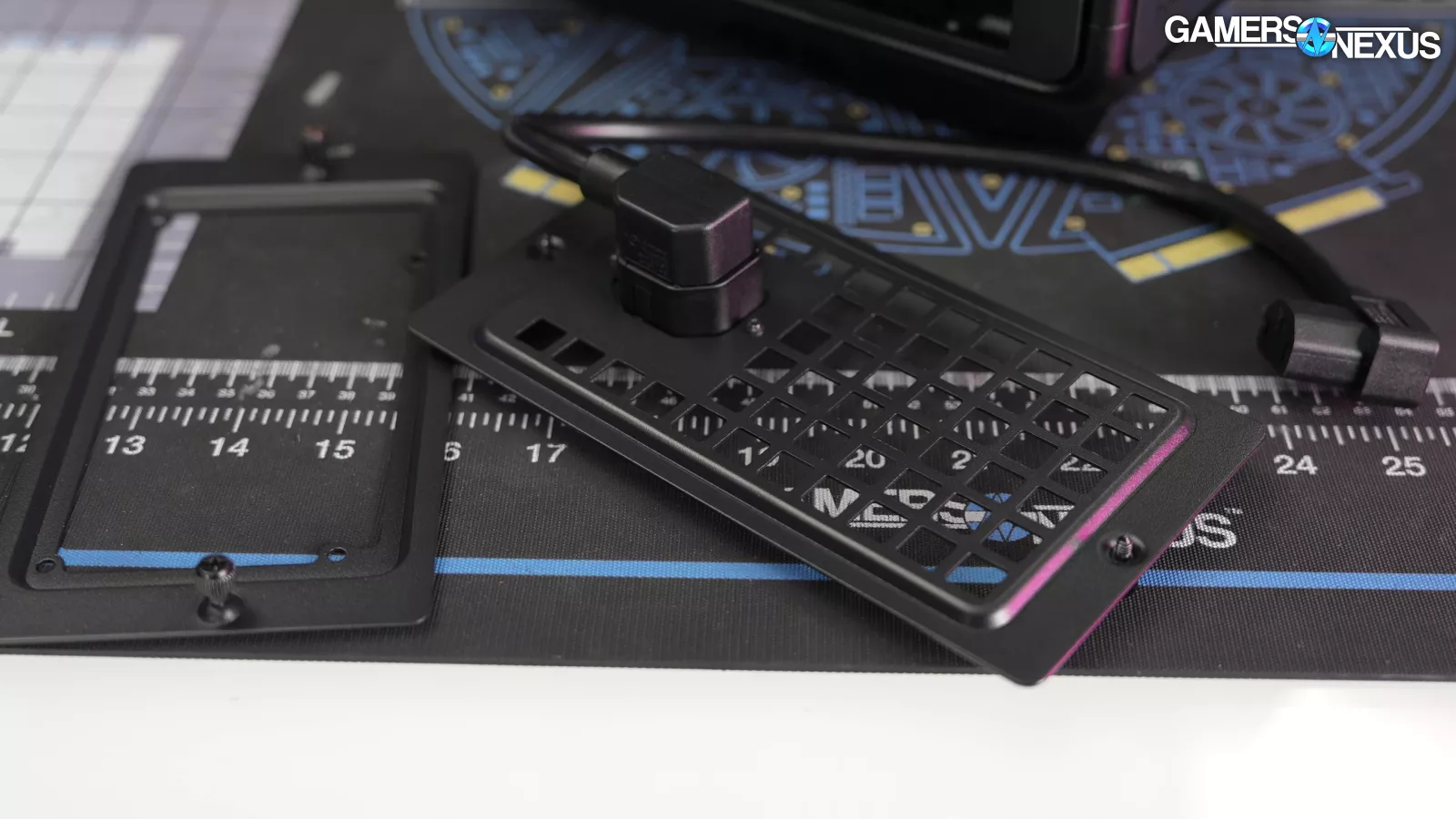
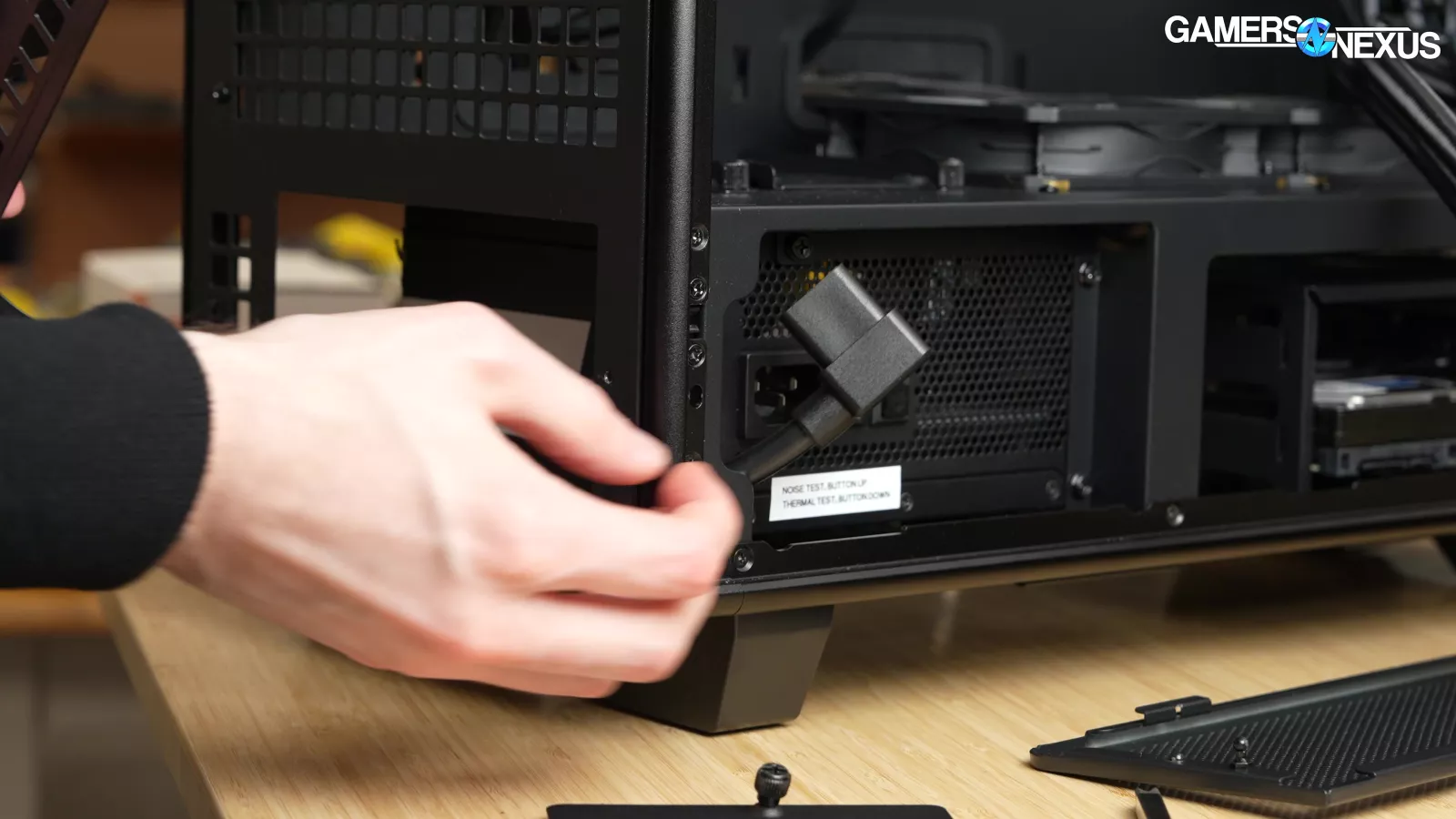
That also means there's not much reason to install the iShift bracket to rotate the PSU: the best reason we can think of is that the shroud-top fan blades aren't protected from PSU wires, and rotating it may help avoid snags.
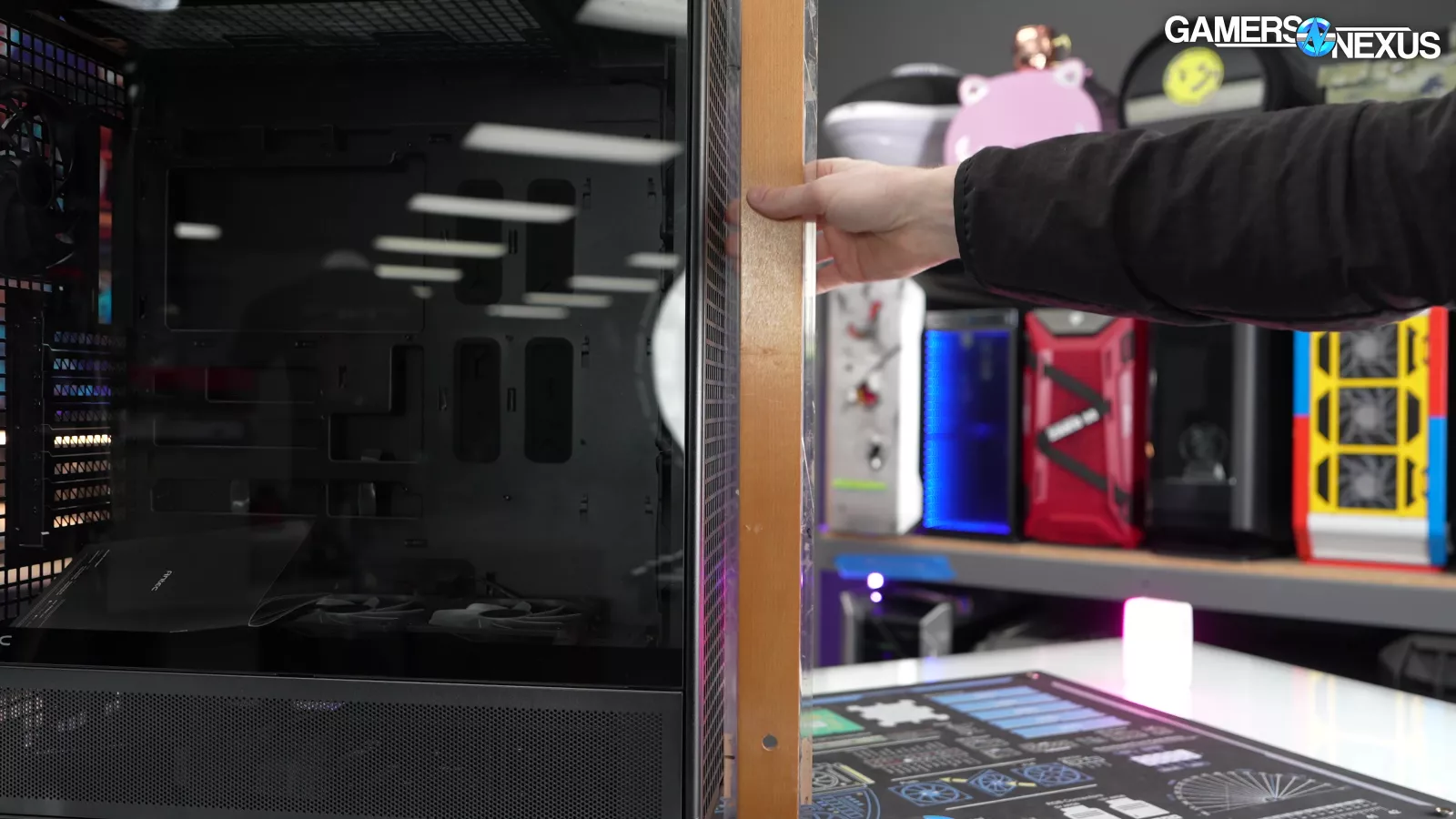
The only manufacturing issue we noticed is that the ventilated panels are slightly concave, probably due to the stamping process.
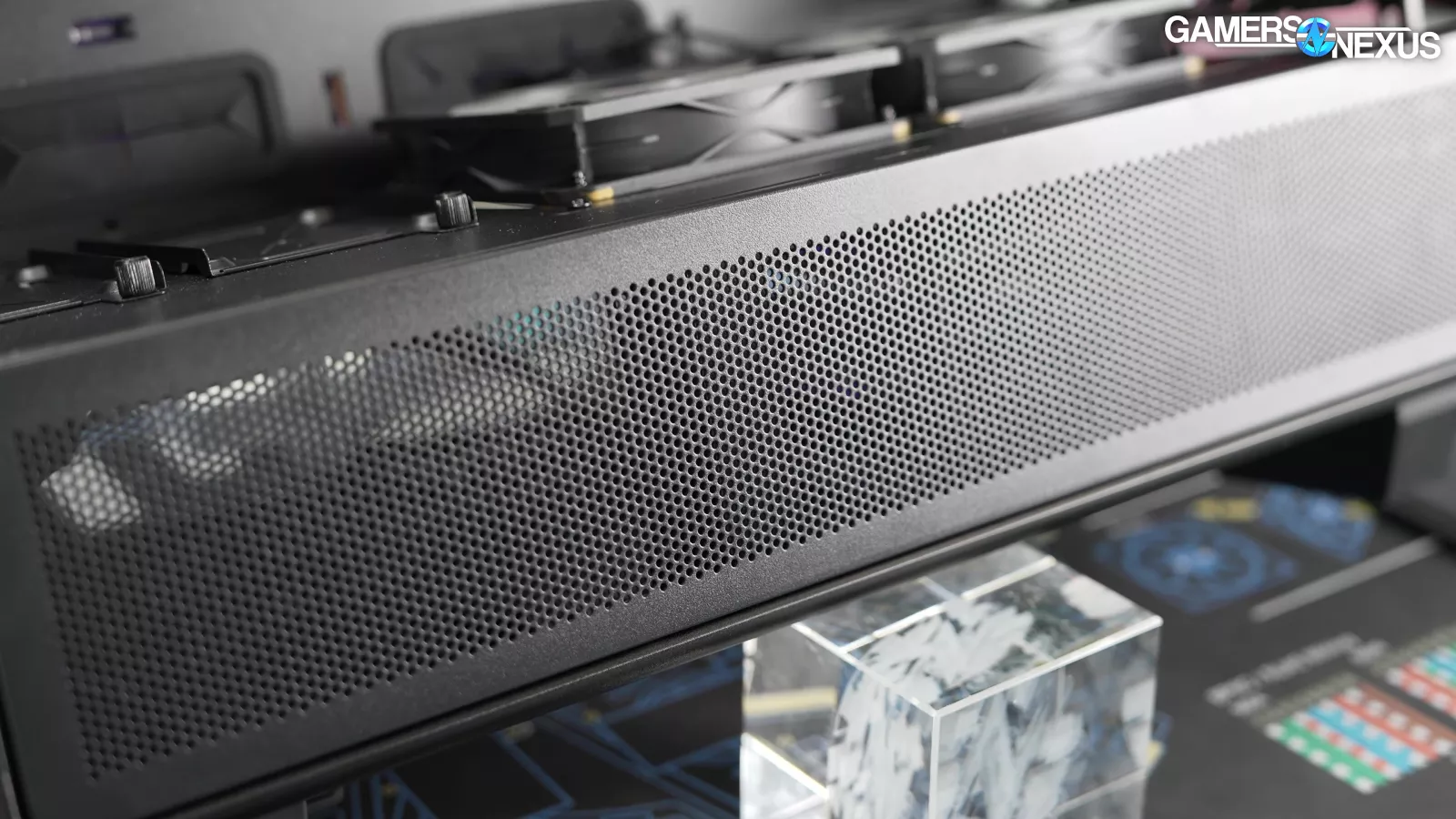
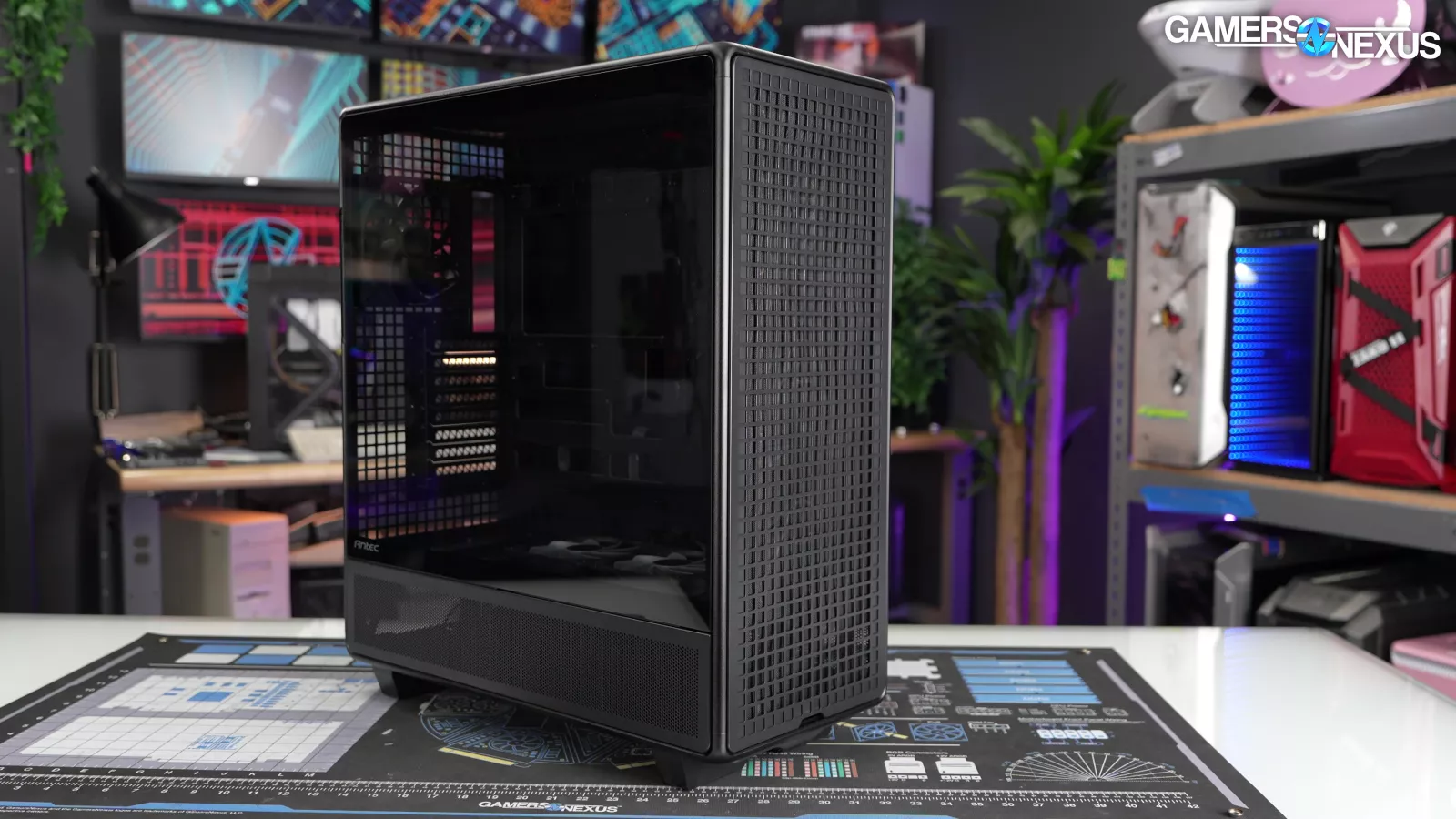
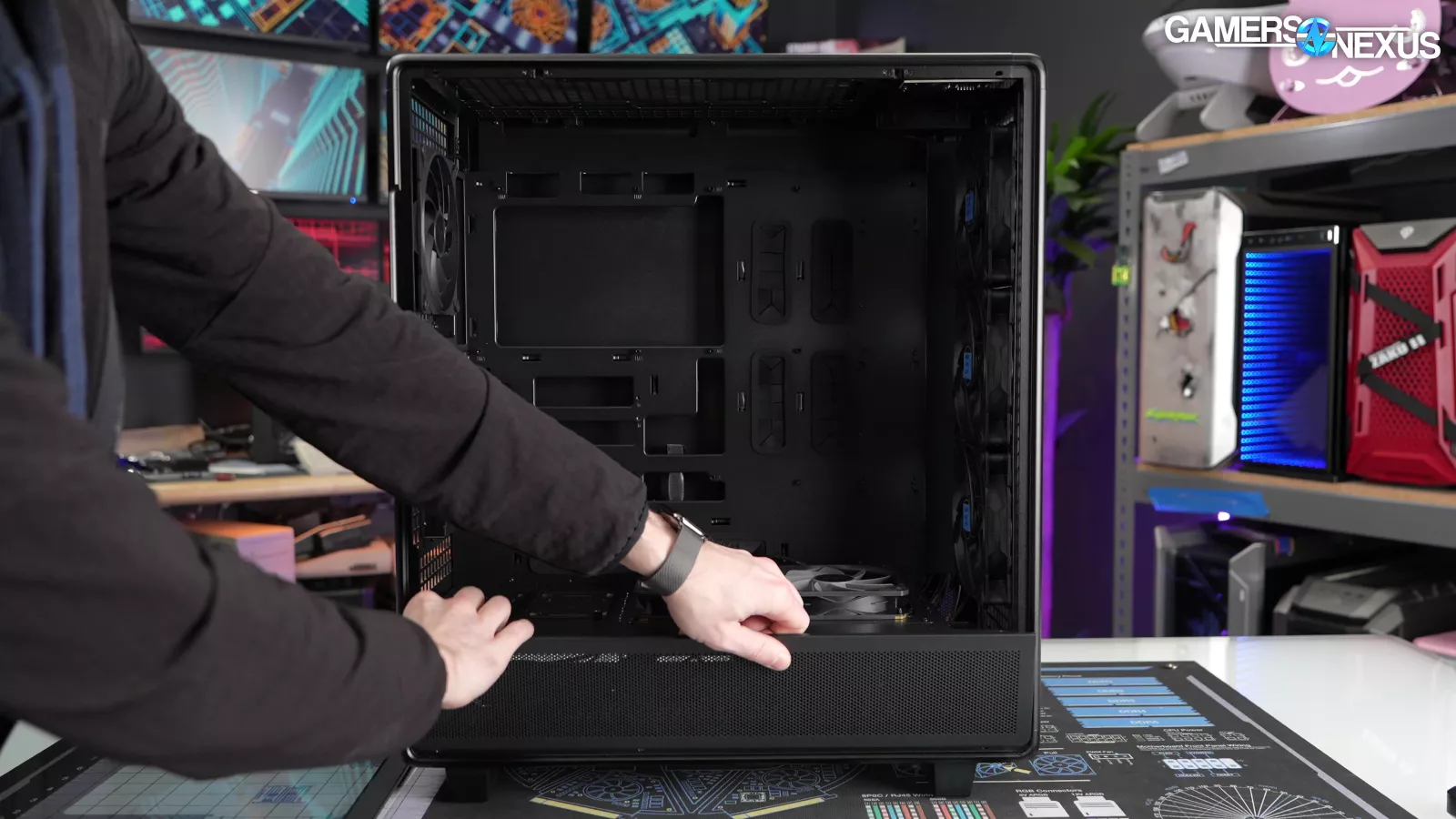
The section of mesh below the glass side panel could be installed and removed separately from the glass, except that there's no way to get a grip on it without removing the glass first.
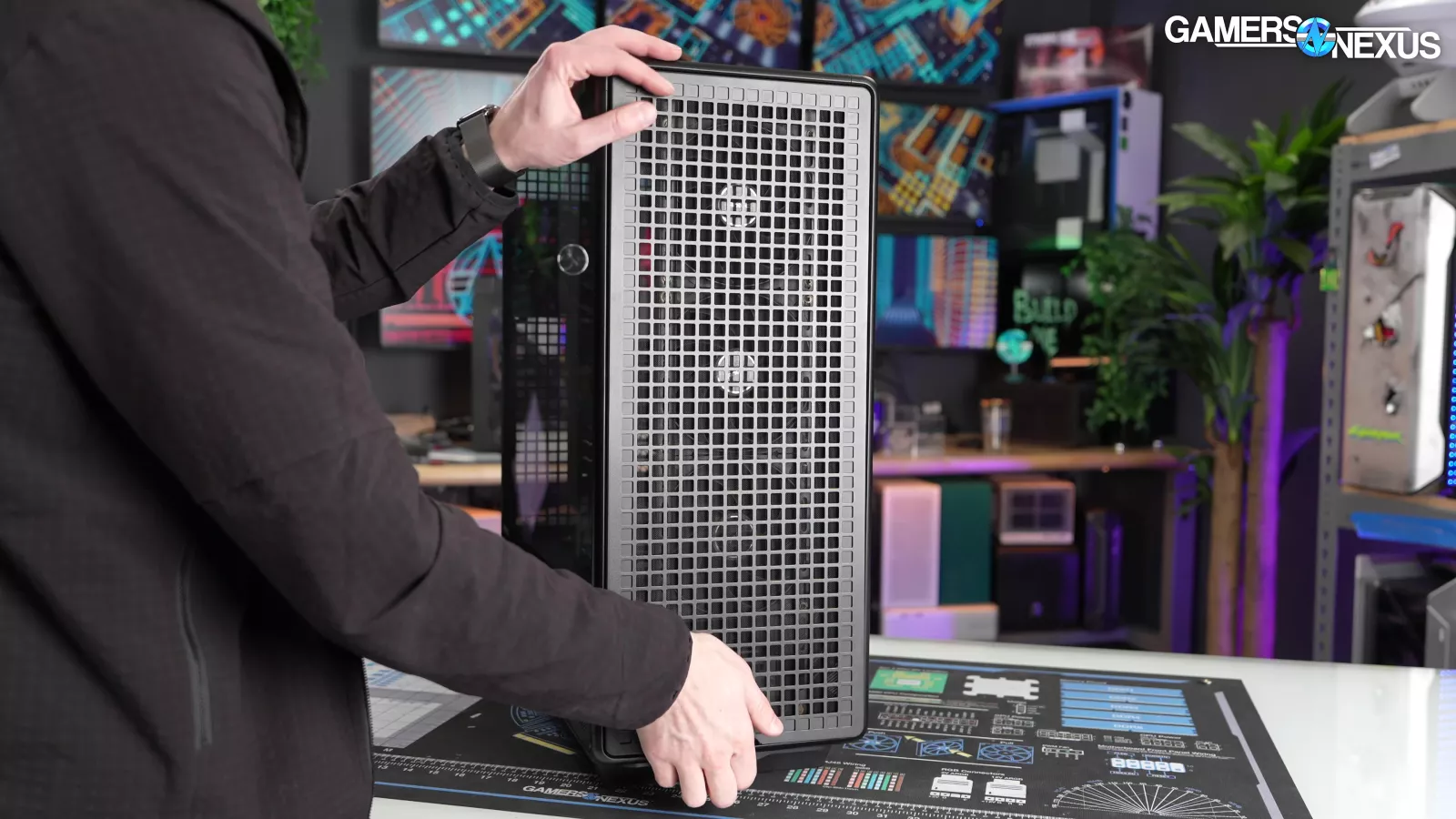
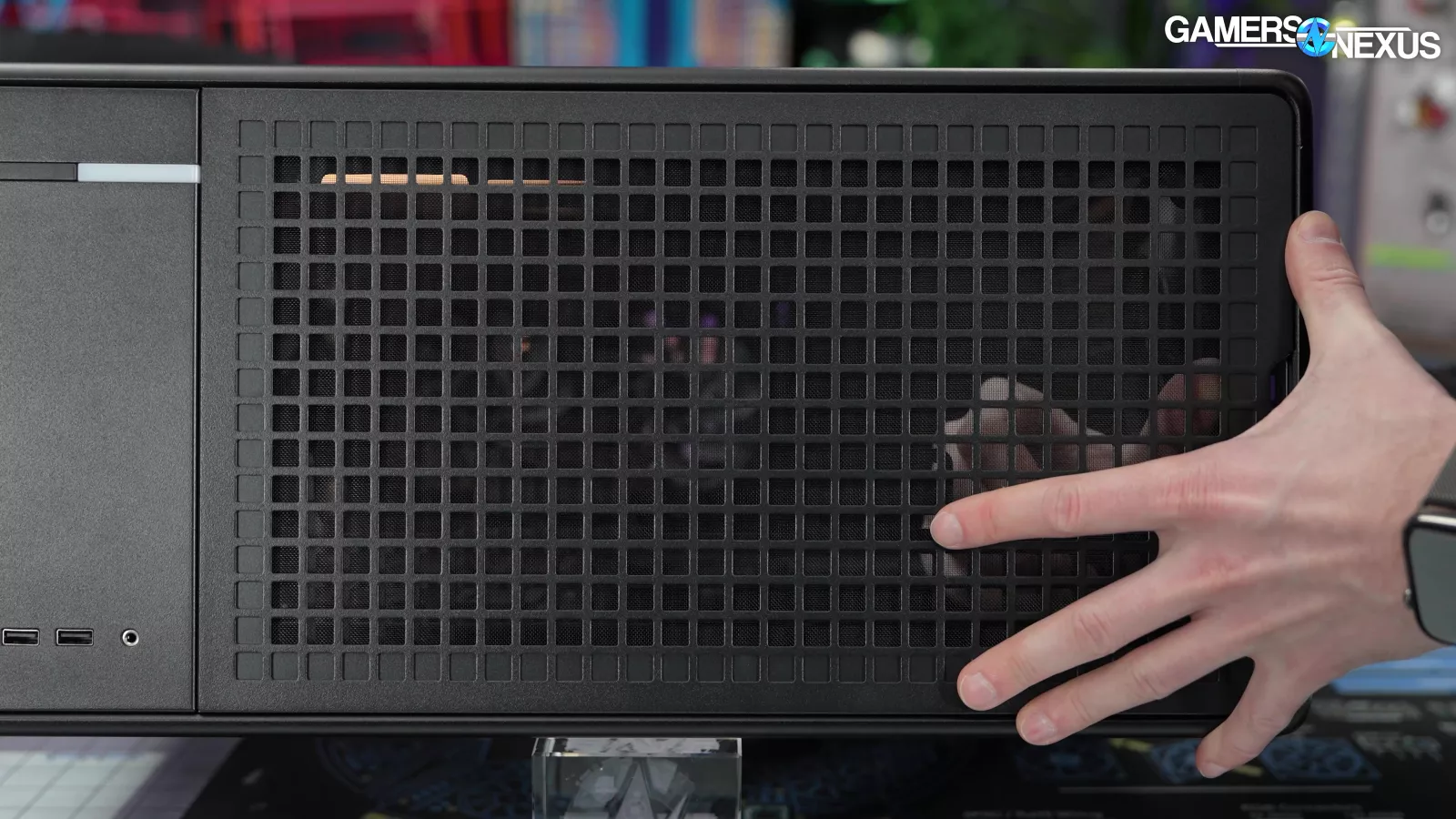
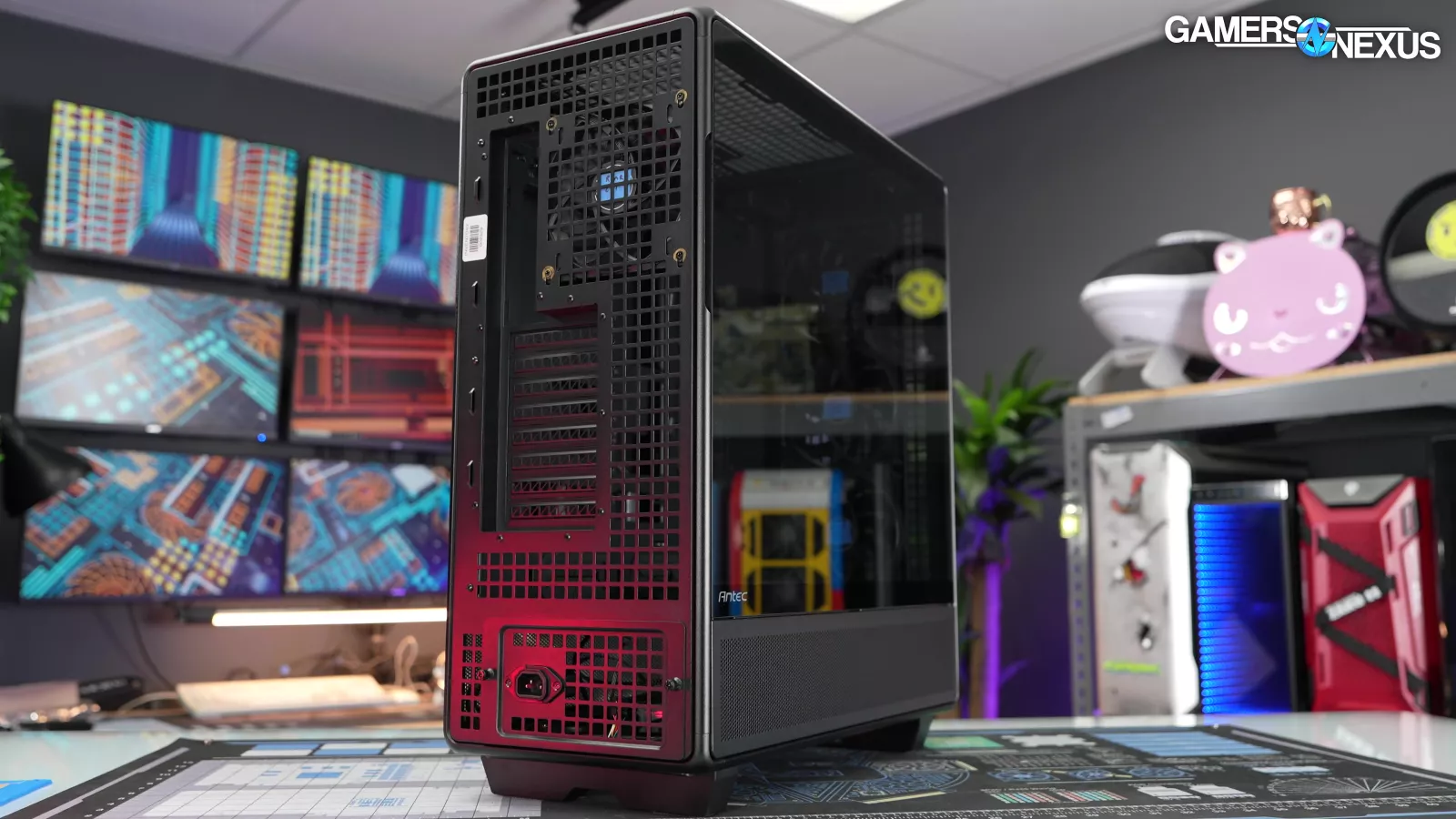
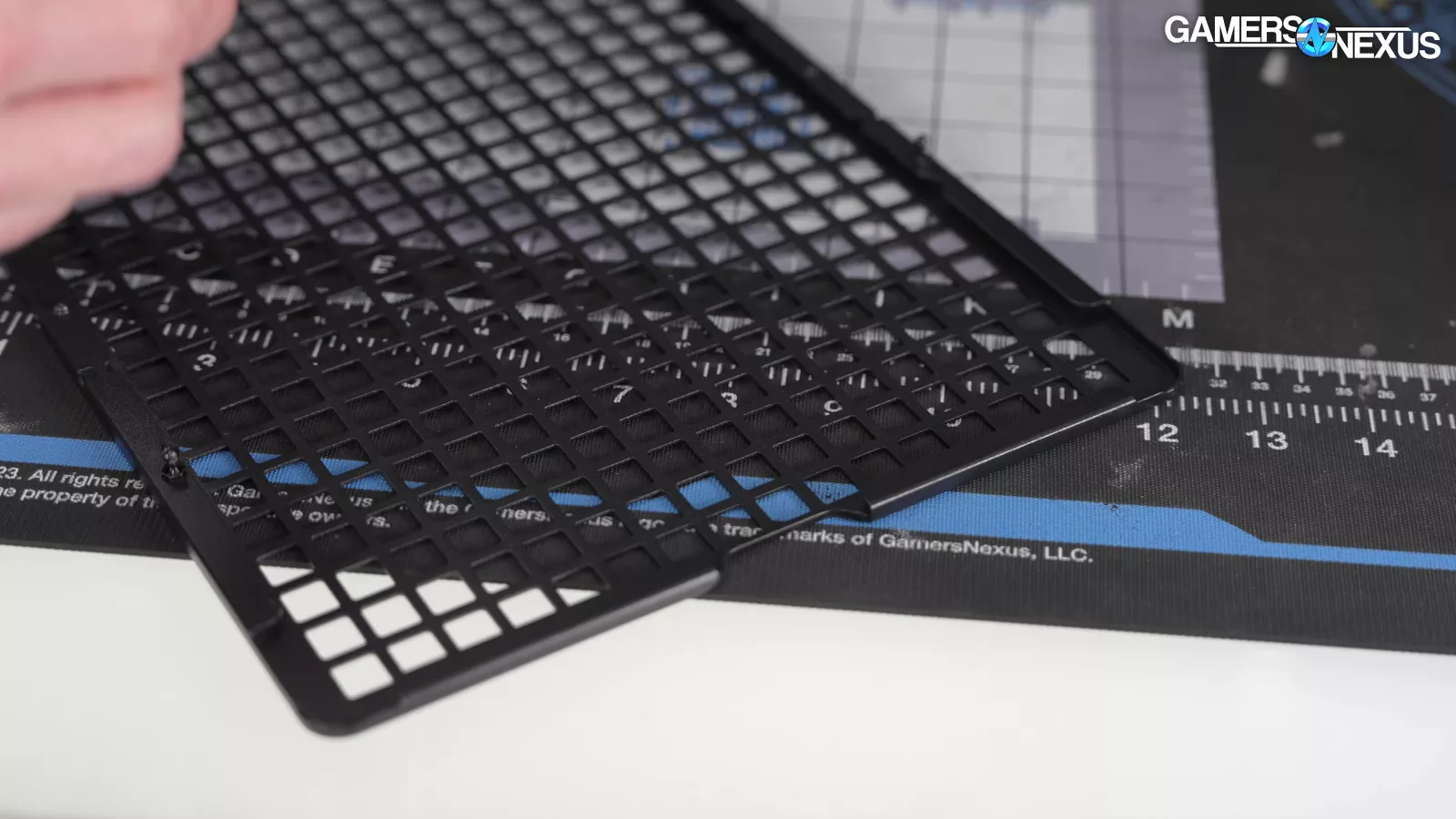
None of the panels come off particularly gracefully: they all have small handles and don't use any magnets, and none of them can be secured with screws, which we maintain as a feature that cases should have for large glass panels. Antec did use magnets to attach the filter inserts to the steel panels, so those are at least easily removable.
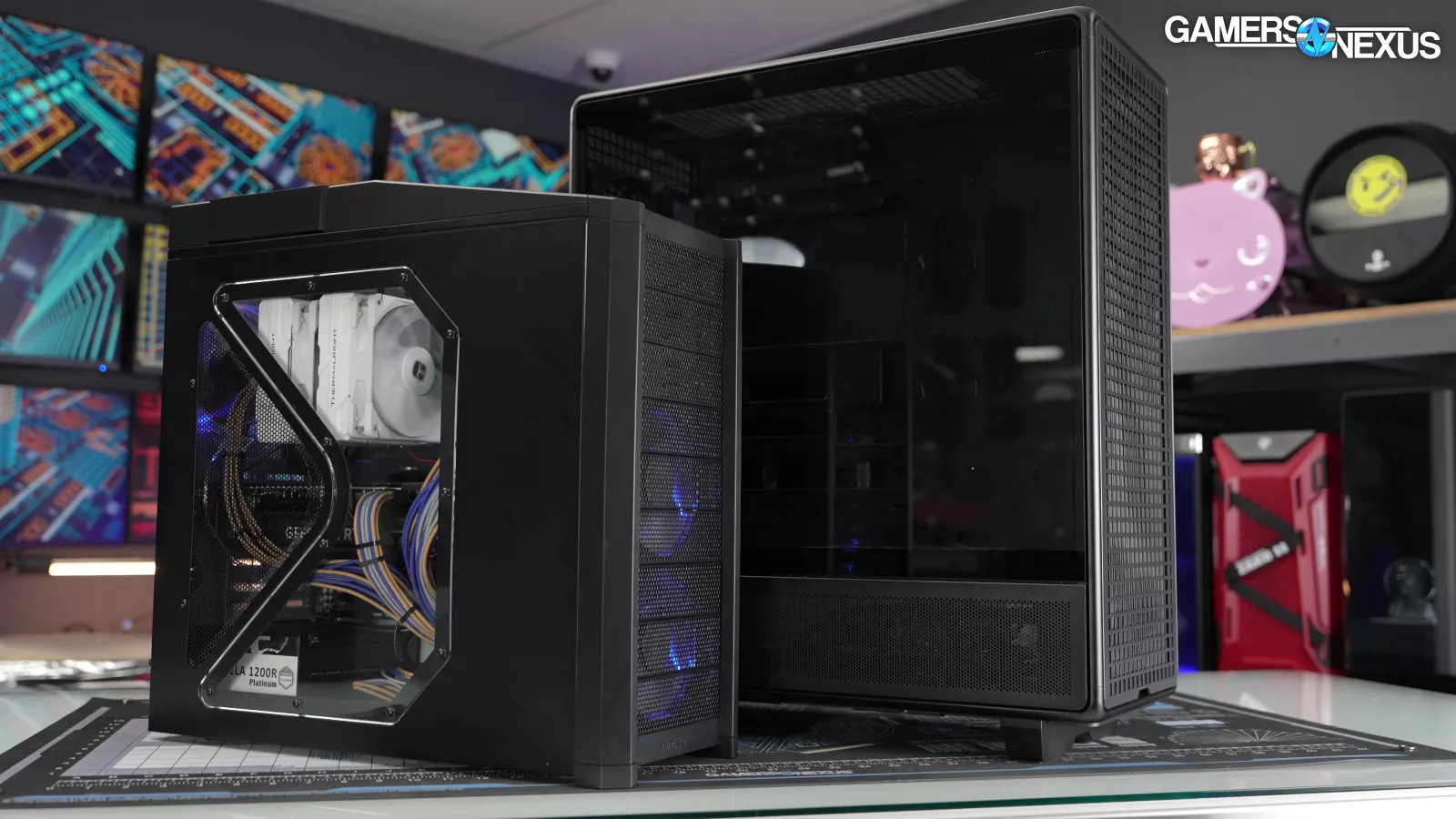
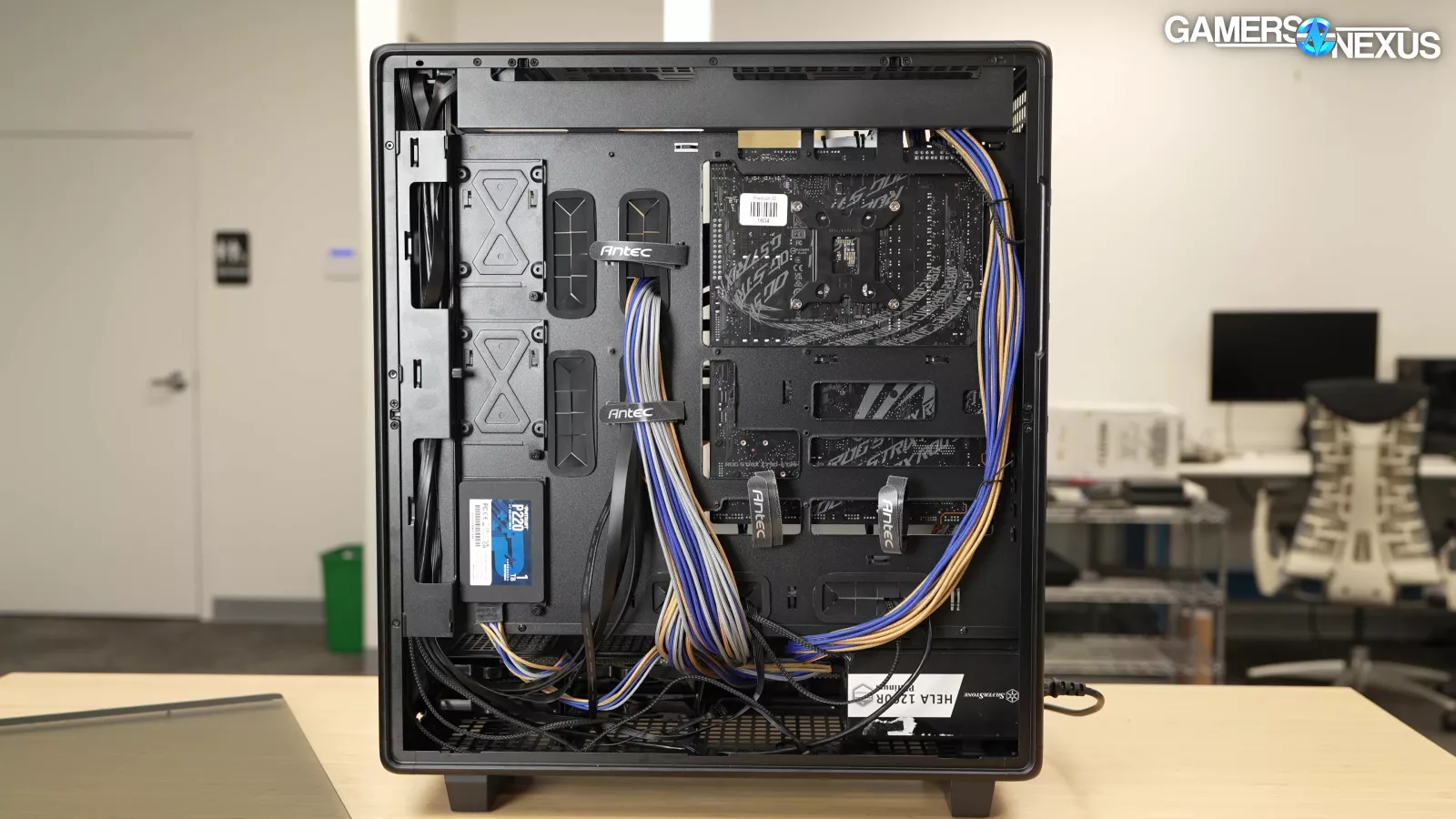
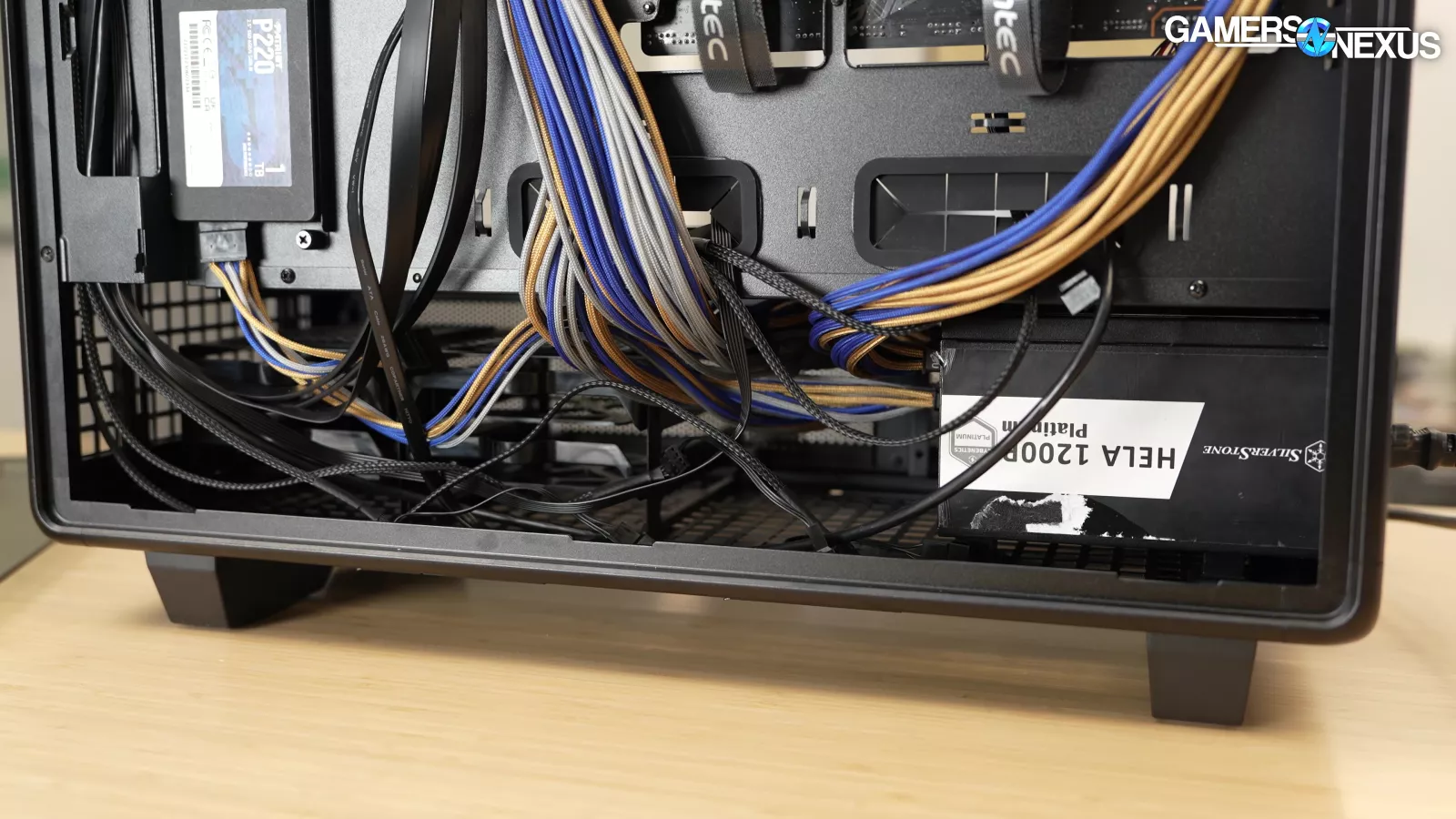
Improved on the old case, cable management is fine. The size of the case is the biggest potential issue for cable-run length. We use a 65cm 24-pin cable with a standard 16cm PSU and, without using the iShift mount, we were approaching the limit of what we could do while maintaining clean cable routing.
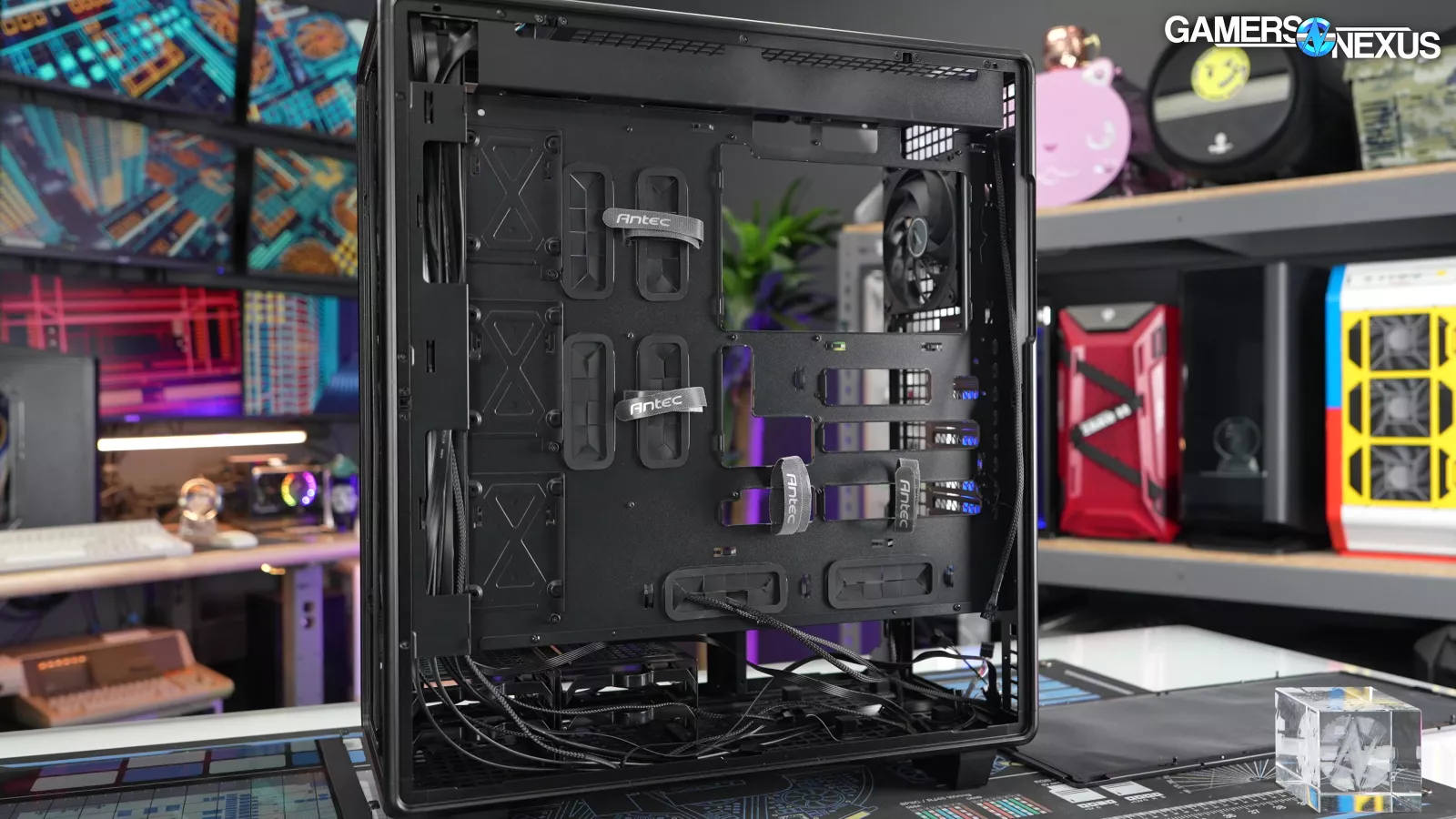
The case is also back-connect compatible, which would make all cable runs shorter.
Thermals & Noise
Since we have a brand new 2007-stamped Antec Nine Hundred on hand, obviously we had to run it through our test suite to compare it to the new 900. For the old case, we removed one hard drive cage to fit our GPU, but otherwise left it stock. We didn't want to jury-rig a Molex fan controller, so baseline tests were done with the fans set to their High speed setting, and "noise-normalized" tests were done at Low. These results are clearly marked because their noise levels don't truly match our testing threshold. We skipped standardized fan testing in the older case since it has no 140mm support.
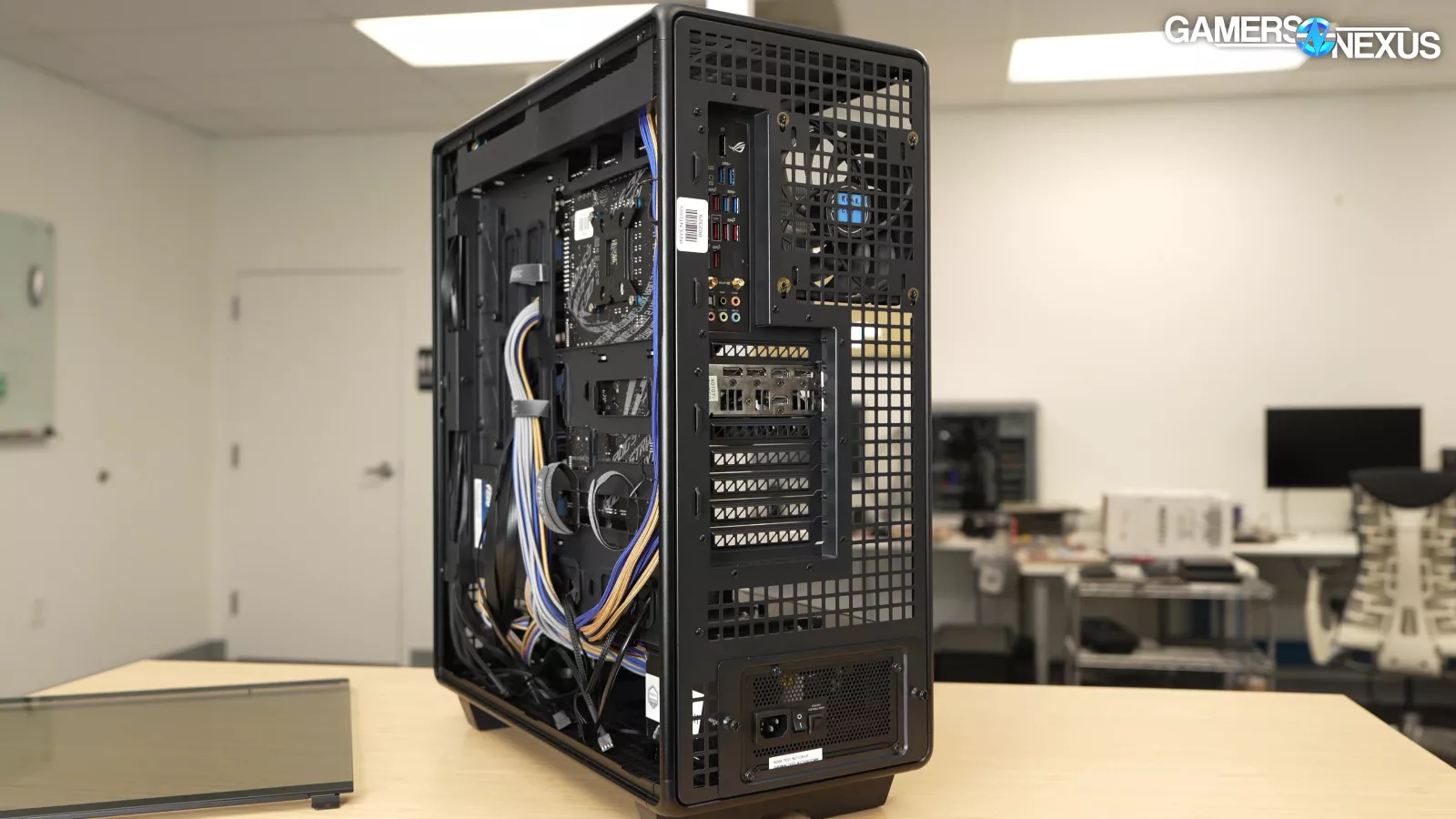
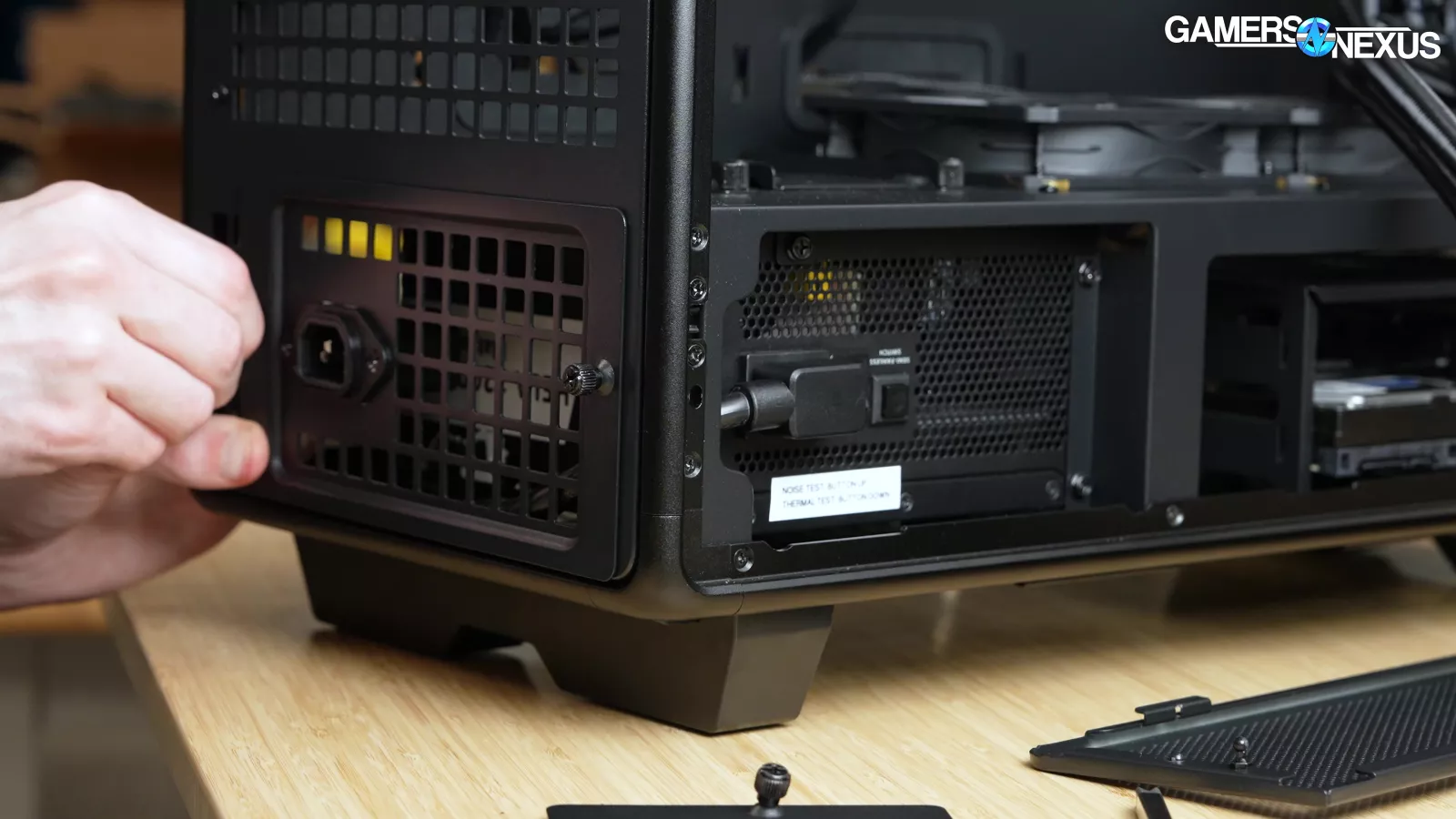
For the new 900, we simply tested the stock layout and the iShift PSU mount. It would have been fun to try the original Nine Hundred's fans in the new case, but it doesn't support installing a 200mm fan in the same location.
Size is the 900's selling point, so its competitors, by size, are the Fractal North XL (read our review) and Antec Flux Pro. The Cooler Master HAF 700 "Berserker" is, maybe, a direct competitor. It’s $300, and we haven't tested it. Instead, we'll compare the MasterFrame 500 Mesh since it's so visually similar. We would also consider the Fractal Meshify 2 XL (read our review), but it's old, and we're guessing Fractal plans to replace it soon.
CPU Full Load Thermals - Full Speed
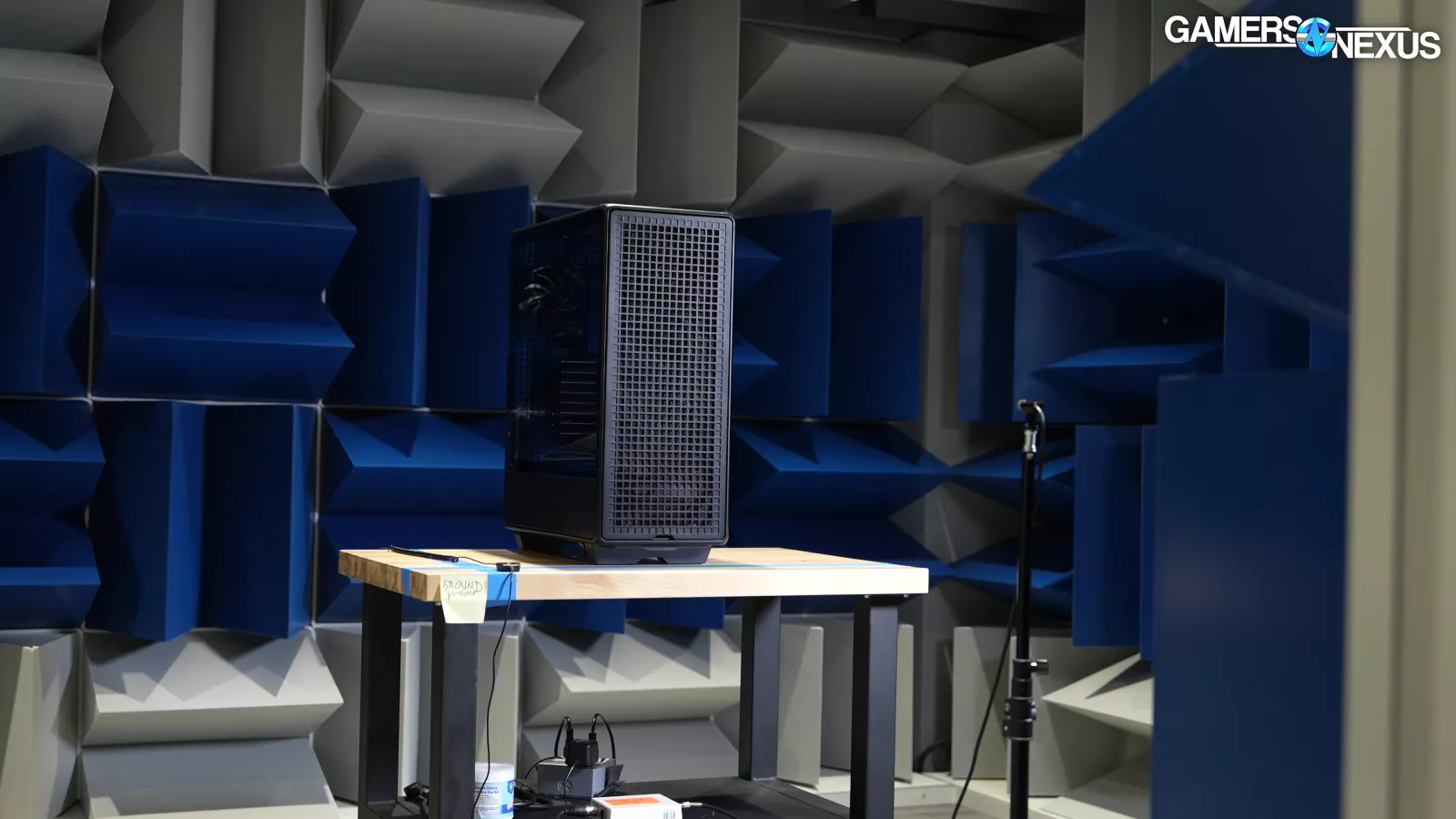
We’ll start with thermals when the cases are configured at full speed. The first step for this is testing in our hemi-anechoic chamber to determine the noise level.
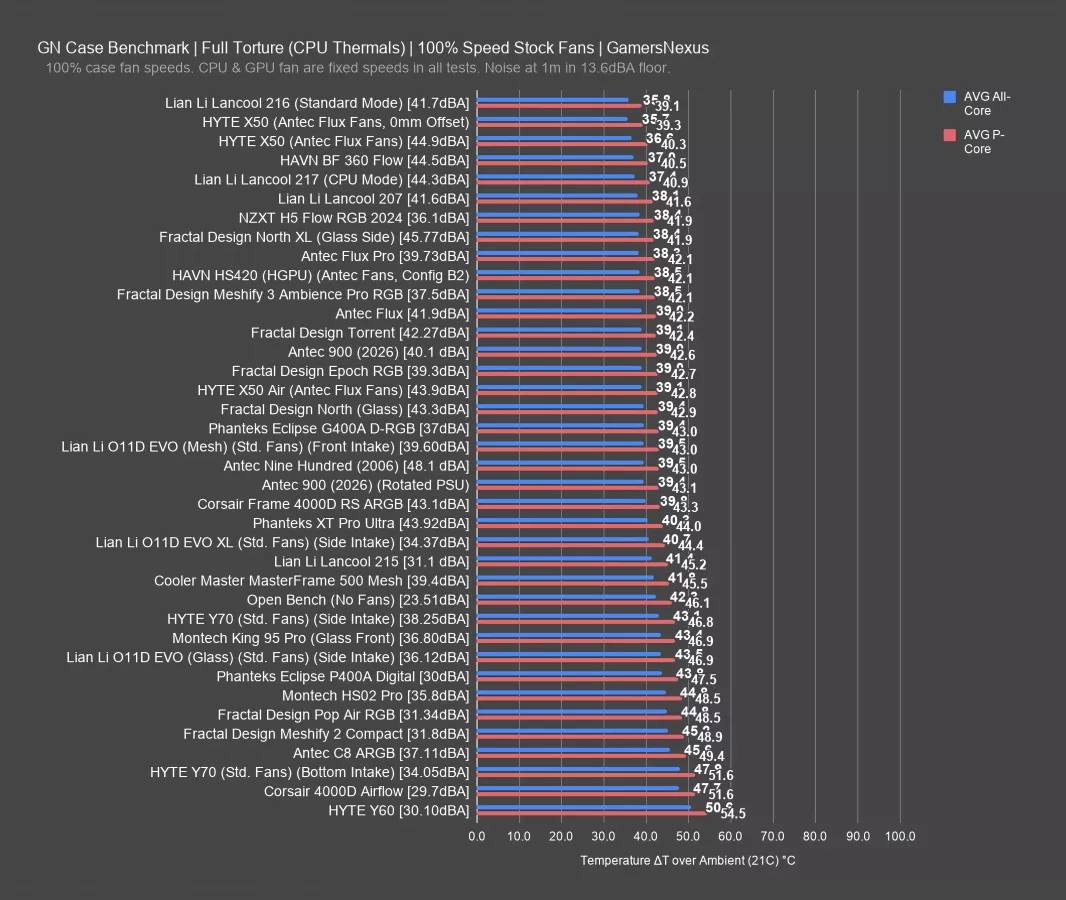
At 1 meter distance, the old 900 was the loudest case and component combo we’ve run lately, at 48.1 dBA SPL. The new Antec 900 runs at 40.1 dBA with the same hardware and full speed, and the Flux Pro is at the same noise level with the same fan layout.
Baseline CPU thermals in the new 900 had it at 39 degrees Celsius above ambient all-core and 43 on the P-cores, with no significant difference resulting from rotating the PSU. The original Nine Hundred also landed at 43 on the P-cores, so the 20-year-old case is starting out strong with a tie, although at far lower “noise efficiency,” so to speak, given its loud 48 dBA result. The older case has intake biased towards the bottom of the case since the top would usually be filled with optical drives, but it also has a 200mm exhaust fan directly above the CPU cooler. The new 900 has full fan coverage along the front of the case, but it's also much larger, quieter, and there's more volume to deal with.
Antec's own Flux Pro averaged 42 on the P-cores, as did the glass-sided North XL, so the new 900 is a little warmer than both. When taking noise levels into account, the Flux Pro leads this group at just under 40 dBA, but the new 900 is keeping up with its peers.
The best cases on the chart are the X50 with the Flux non-Pro fans (although that’s aftermarket) and the BF 360 stock, with the 217 and 207 (read our review) also accompanying these.
GPU Full Load Thermals - Full Speed
GPU thermals in the same test are next.
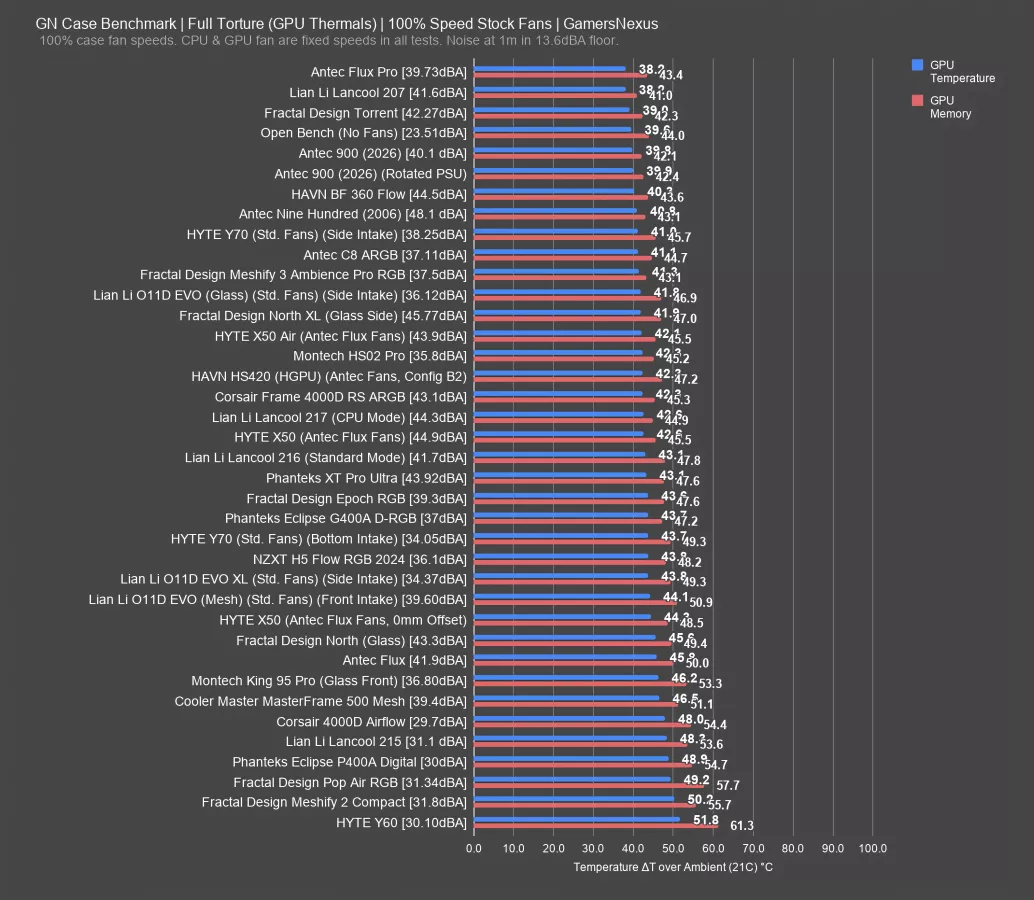
The new 900 held its average GPU temperature at 40 degrees Celsius over ambient and average memory temperature at 42, with almost zero difference from rotating the PSU. That puts the 2026 900 at the top of the results, just ahead of the BF 360 (although worse for CPU thermals) and behind the Fractal Torrent (watch our review), Flux Pro, and Lancool 207.
The original Nine Hundred averaged 41 on the GPU and 43 on the VRAM, so slightly warmer. If we had had space to use either the side fan bracket or the internal fan bracket behind the drive cage, this would have further helped with GPU thermals. Still, the old Nine Hundred performed well in comparison to a case that has two intake fans pointed directly into the GPU cooler. The side ventilation couldn’t clear a fan due to the CPU cooler, but still allowed GPU exhaust to exit, which benefitted results. The case is doing shockingly well for how different modern hardware is from the era -- mostly a result of the noise levels.
For the new 900, GPU thermals are a strong point for this fan layout, which is why the Flux Pro is at the top of the chart with a 38 degree average for the GPU. The glass-sided North XL is behind at 42, and the MasterFrame 500 Mesh is on the other end of the chart at 47.
CPU Full Load Thermals - Noise-Normalized
Noise-normalized thermals are next, leveling for the noise as much as possible by testing in our hemi-anechoic chamber to set all case fans to achieve a fixed noise level across cases. CPU and GPU fans are unchanged.
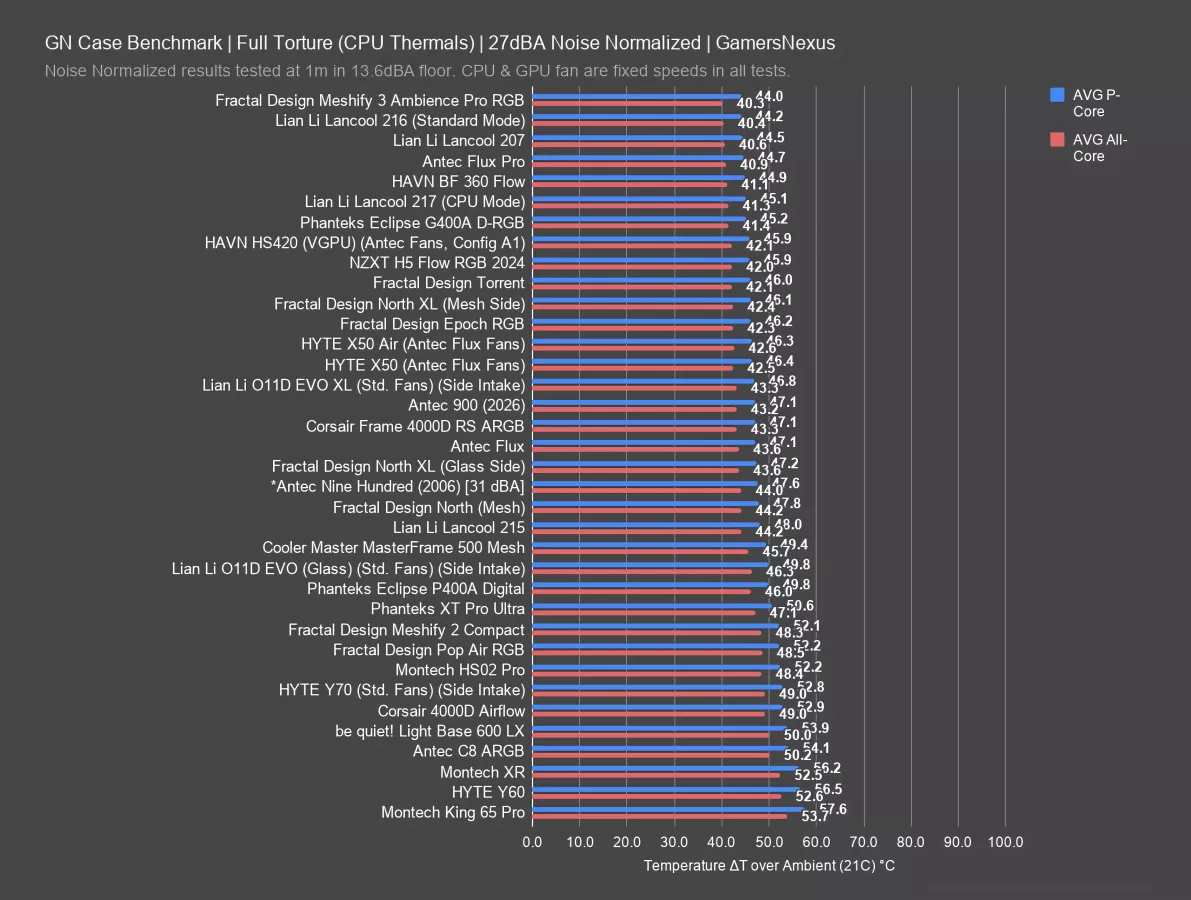
All-core average for the noise-normalized Antec 900 was 43 degrees above ambient and 47 on the P-cores. The older Nine Hundred has an unfair advantage against everything else here, though, because we only tuned it down to 31 dBA rather than the target 27. The reason for this is that without digging up an ancient fan controller, using the 3 speed settings on the fans restricted us to this as the lowest noise level available out of the box. Still, it's impressive to see how well it did given its extremely high noise levels at max speed: 48 degrees is within error of the newer 900's P-core average, although again, the older case isn't truly noise-normalized.
The Flux Pro is easily at the top of the chart here; someone should give it an award for Best Noise-Normalized Thermals or something. The glass-sided North XL is almost exactly tied with the 900 for P-core thermals, while the MasterFrame 500 is still behind but closer at 49 degrees as its 200mm fans are best suited to slow-and-quiet operation.
The Fractal Meshify 3 Pro RGB (read our review), 216, 217, and BF 360 Flow also all do great here.
GPU Full Load Thermals - Noise-Normalized
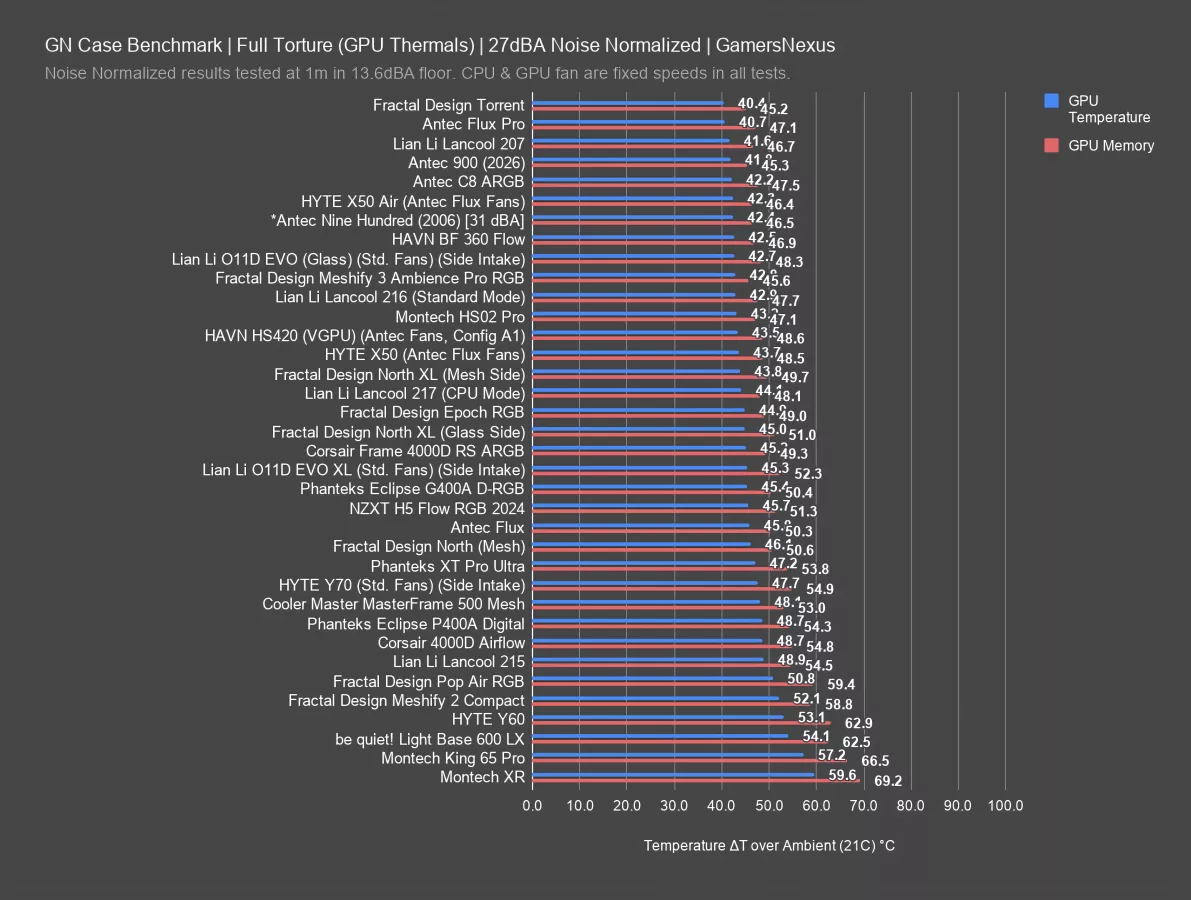
Noise-normalized GPU temperature in the new 900 averaged 42 degrees above ambient, with VRAM at 45 degrees. That effectively ties the old Nine Hundred for the GPU itself, although VRAM was warmer in the old case at 47 degrees. Again, pretty impressive when the newer case has two fans pointed into the GPU.
The Flux Pro still leads at 41 degrees on the GPU, but the glass-sided North XL is several degrees warmer at 45 on the GPU. High performers include the Torrent -- a GOAT of a different era, like the old 900 -- with the X50 using Flux non-Pro fans also up top.
Conclusion

The original Antec Nine Hundred was a great case. It’s not just nostalgia. It actually performed pretty well for something that’s 20 years old and has been shoved with modern hardware. It is loud, though. That’s probably the biggest problem with it if you’re comparing it to the results we have today. The cable management is also lacking.
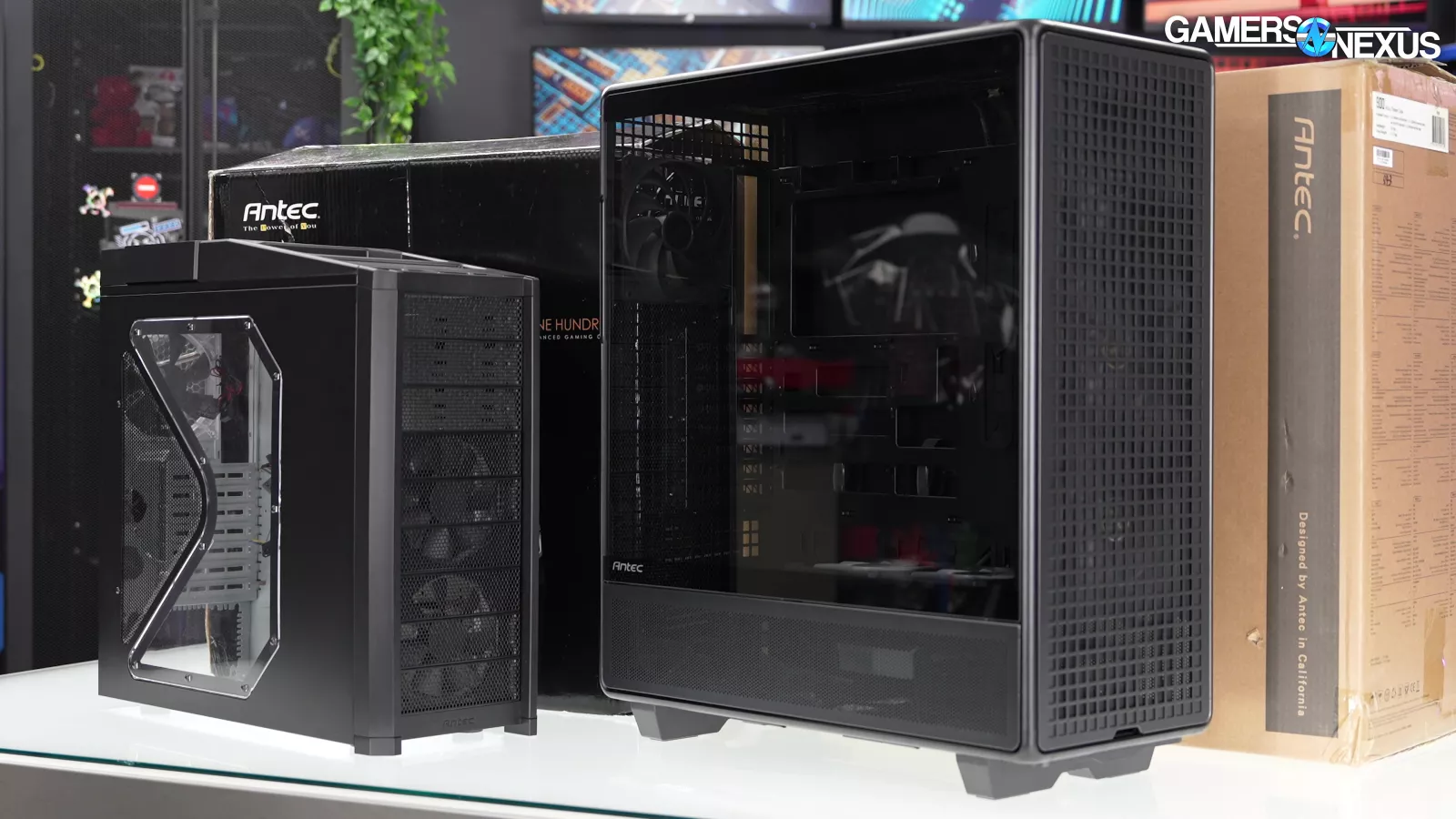
We had a great time working with the original Nine Hundred, and we have absolutely no clue what the new 900 has to do with it. It doesn't share any of the original's design language, functionally or visually.
We’re not sure, but it feels like Antec realized the 20th anniversary was coming up for the case and asked themselves, “What do we have in production? It’s too late to do something new. What can we rename and get out the door in time for that?” At least, that’s what it feels like.
That said, the new 900 performs fine, it does OK on the charts. It’s not a bad case thermally. It is pretty bad in the price department, however.
There’s nothing explicitly “wrong” with the new 900 -- but Antec could have just as easily called any other case the 900. It's not like Antec doesn't make any angular mesh-fronted cases, and they've also made some really exceptional and interesting cases over the past few years, like the C8, Flux, and Performance 1.
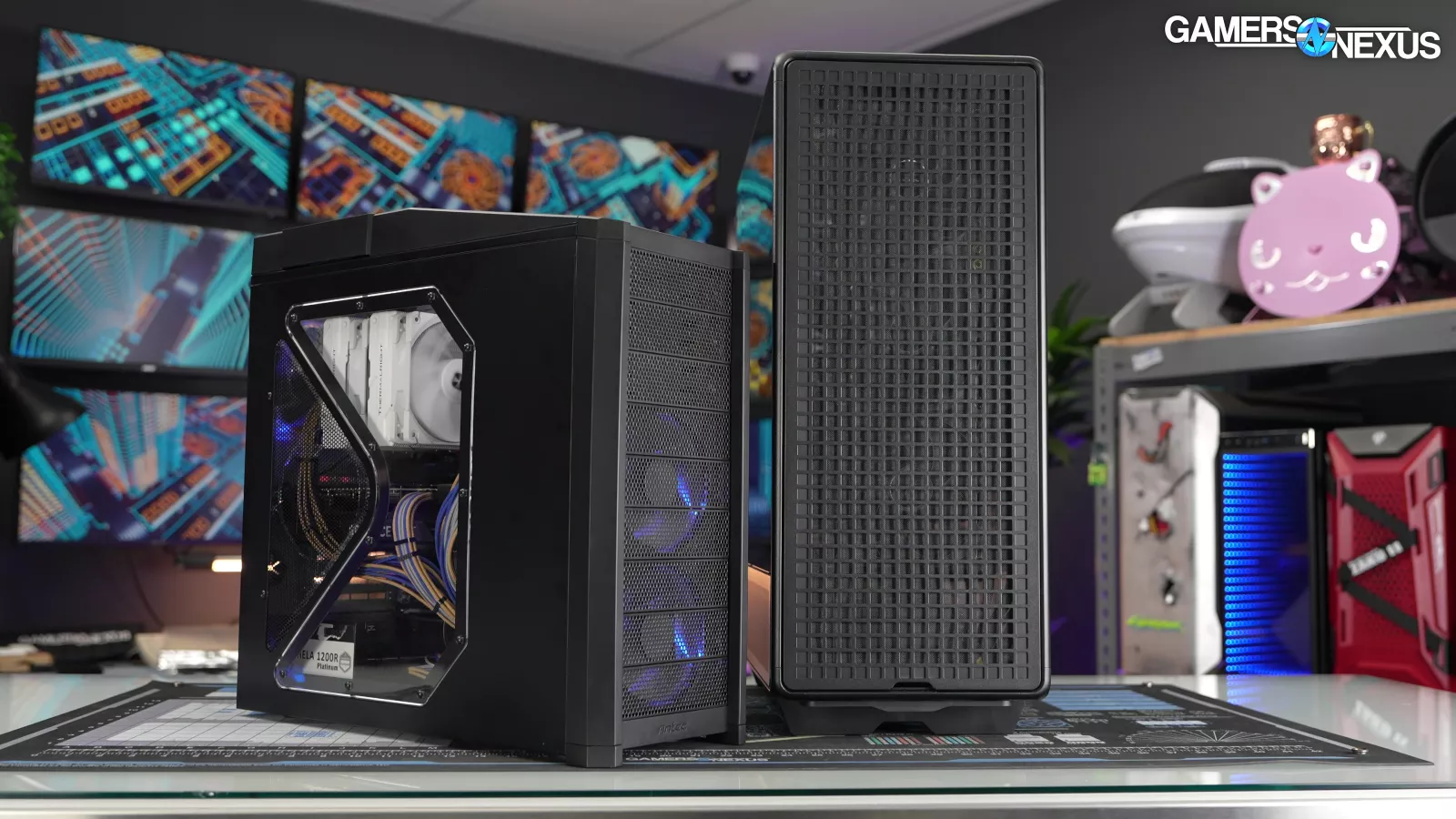
Thermals are a strong point in some tests, which is great for this new case. But it’s average by looks and functionality, and it’s high by price. Tying this relatively unexciting case to something that people remember so fondly is doing it zero favors. The fact that it’s $300 makes it worse.
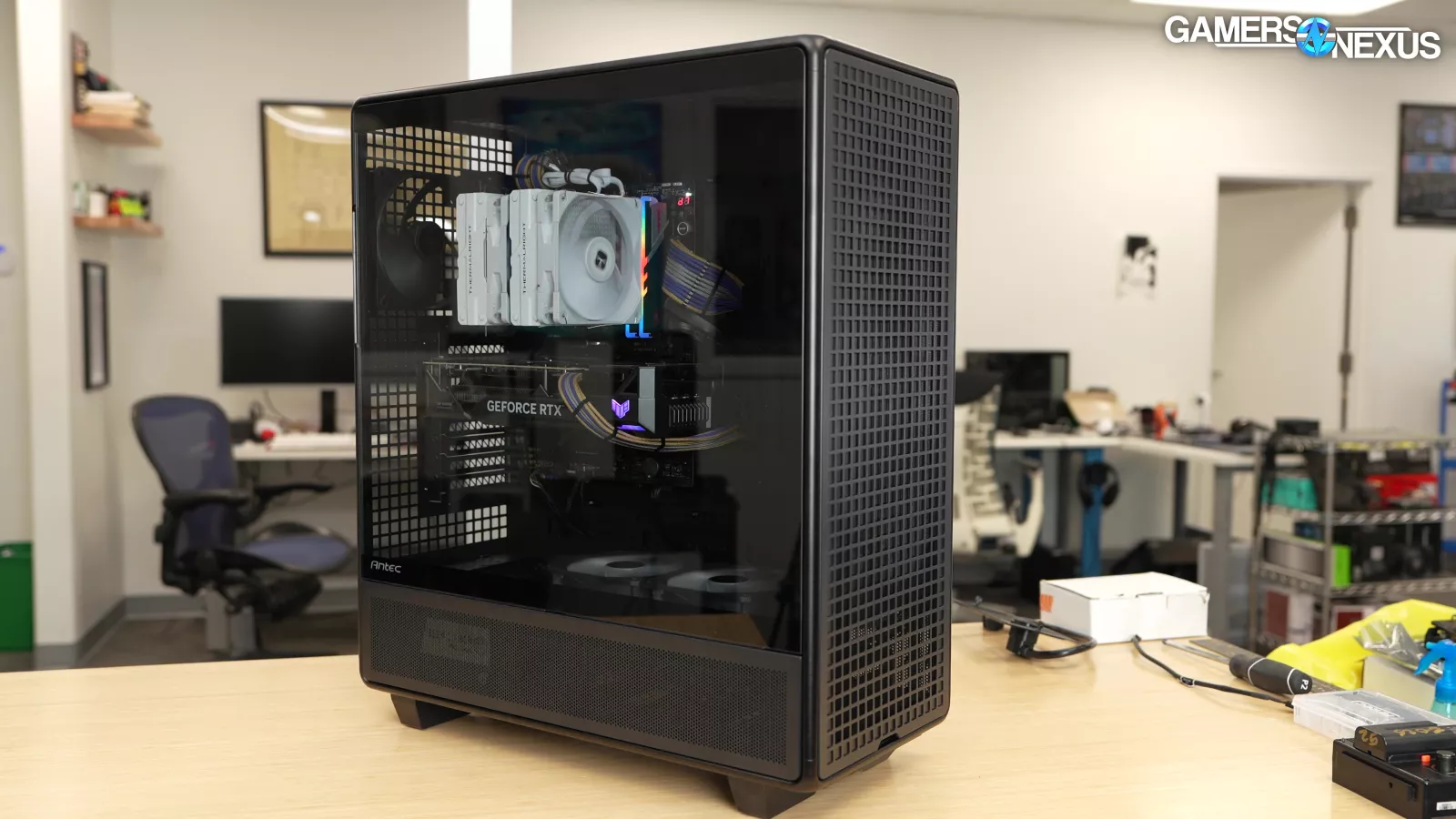
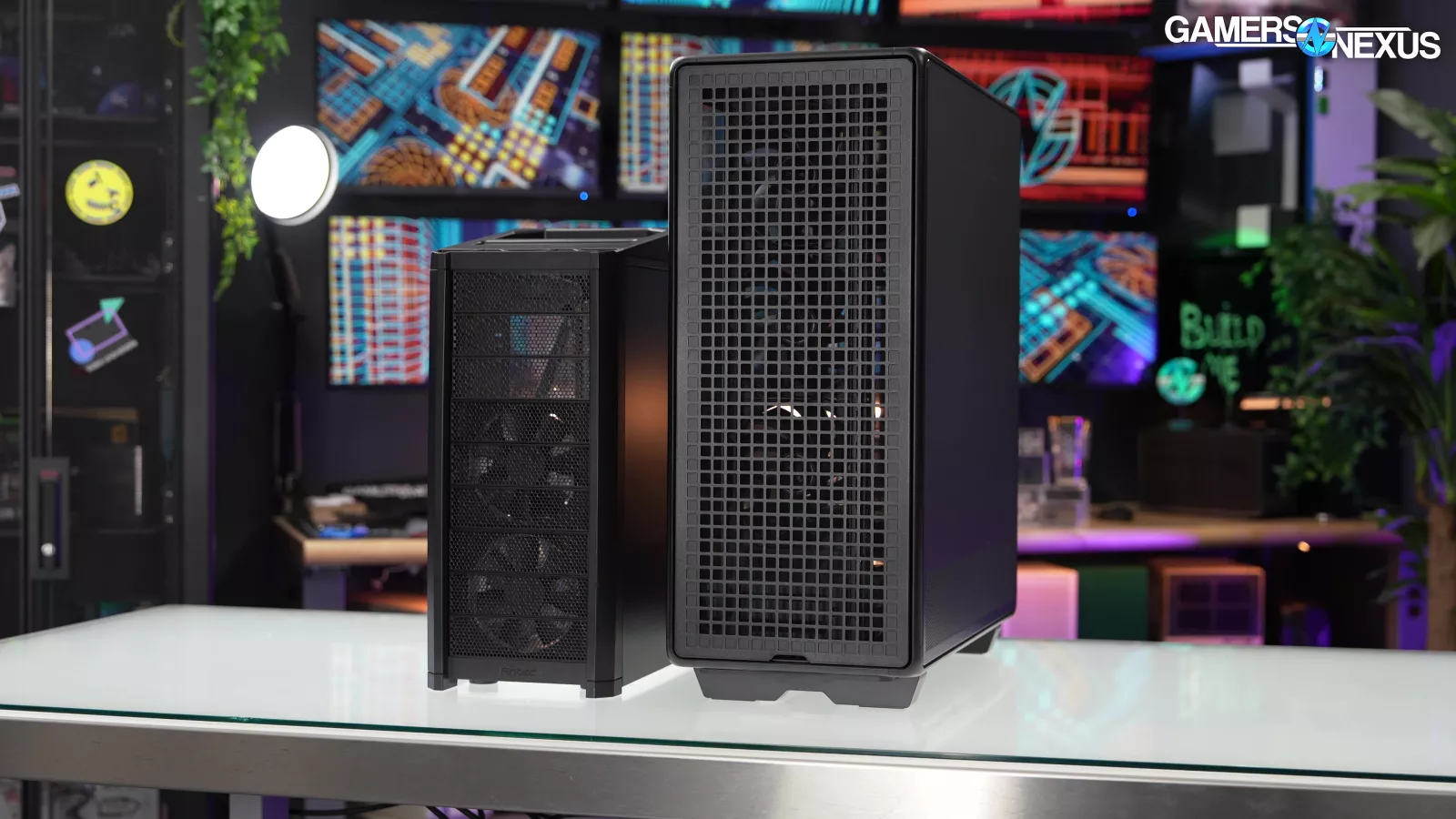
That price might be more acceptable for some people if they did a true-to-form remake of the original Nine Hundred and embraced retro modernism. For instance, look at what SilverStone did with the FLP-02. Read our review.
The thing that is unavoidably terrible about the new 900 is the fact that it costs $300. We have plenty of first-hand experience with how expensive it is to make anything right now, but Antec's own Flux Pro is available for $180 or less right now, and we don't know why anyone would choose the new 900 over it except for size. If you want to put server-grade hardware in a desktop case, you could do that in other desktop cases that are cheaper from other companies. There are also server chassis solutions for half-rack mounts. Otherwise, Antec’s new case is fine; the price just isn’t. We just can’t recommend it at its current price.